
Beanies for Men: Properties, Costs and How to Spec It Right - 2026 Buyer's Guide
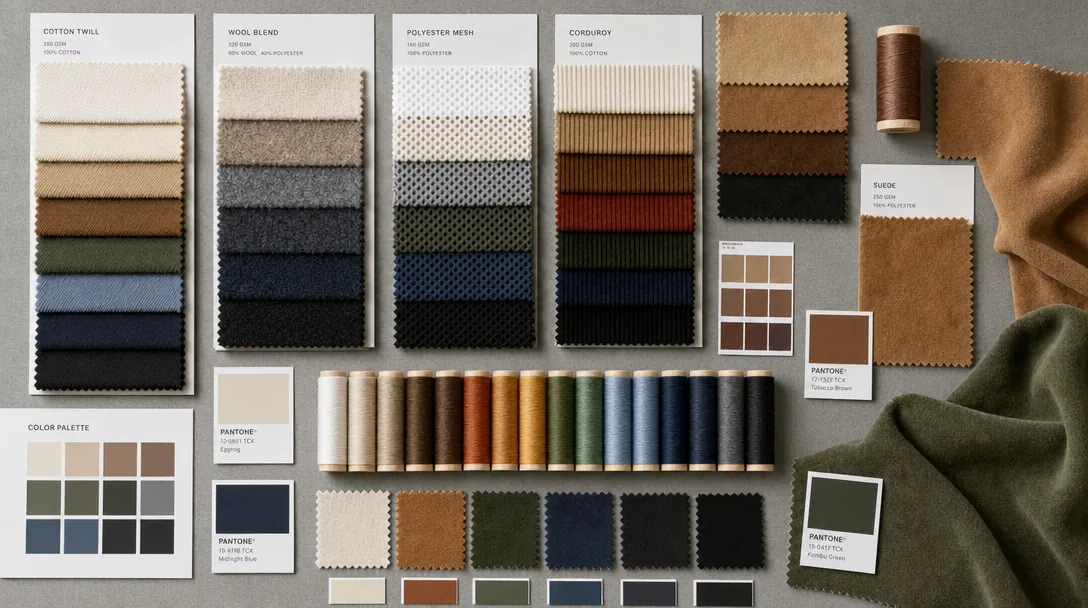
Beanies for Men: Properties, Costs and How to Spec It Right - 2026 Buyer's Guide is one of the most-asked questions we receive from international buyers, and for good reason. With dozens of factories competing for your order and an alphabet soup of technical terms in every supplier quote, even experienced importers can feel lost. This guide consolidates what we have learned producing custom hats for clients in 40+ countries.
Corduroy Hat Men's
Corduroy headwear goes wrong long before decoration if the fabric spec is loose. For a standard 6-panel men’s cap, write the shell first: 100% cotton corduroy, 11-wale or 14-wale, typically 220-280 gsm, with finished weight tolerance at +/-5%. Fine 21-wale looks cleaner on fashion programs, but it is less forgiving on production; embroidery hoop marks, needle tracks, and panel pressure shine show faster than on wider ribs. Shade control also needs to be explicit. If the mill enzyme-washes for a softer hand and lower seam bulk, batch variation can easily drift past Delta-E 1.5 unless lab dips and bulk approvals are locked under D65 lighting. On the factory floor, fabric should relax 12-24 hours before cutting, and every panel must be laid with the wale running in the same direction, or the cap will show obvious panel mismatch once steamed and packed. Decoration has to be tested on actual corduroy, not on cotton twill stand-ins. On Tajima or Barudan heads, dense fill embroidery tends to sink into the channels between ribs, so buyers should approve stitch density, underlay, and pull compensation from a real sew-out on production fabric. A usable tech pack should also call out crown height, visor length, closure type, sweatband composition, eyelet finish, top button requirement, and buckram thickness; for semi-structured fronts, 0.3-0.5 mm fusible buckram is usually enough. If the style sits alongside beanies for men in a winter collection, align color standards early because corduroy and acrylic rib knit take dye differently; the same Pantone TCX reference can still read visibly off across materials unless approvals are reviewed side by side.
Commercially, corduroy caps punish small-order indecision. If the factory is buying stock fabric, MOQ is usually 144-300 pieces per colorway; once you move to custom dyeing, the fabric mill may ask for 500-1,000 meters per shade, which is where too many color options start destroying margin. FOB China, a basic unstructured corduroy cap generally sits around $3.20-$4.80 depending on wale, closure, and logo count. Add metal strap hardware, printed seam tape, custom lining, or high-density embroidery and the cost typically moves to $5.50-$7.20 before freight, duty, and last-mile delivery. That pricing only holds if marker efficiency is decent and pile direction is controlled; re-cutting corduroy panels because the ribs run opposite ways is pure waste. Inspection should be stricter than buyers use for brushed cotton. The repeat failures are mixed pile direction, seam torque after wash, flattened ribs under logos, visor edge creeping, and shade shift between crown panels and back strap when lots are mixed. AQL 2.5 is standard for most programs, but premium retail orders should tighten visual checks on front-panel symmetry, embroidery registration, needle cuts, and crown-to-visor shade continuity under D65. It is also worth asking whether the supplier runs to sedex-audit-cap-supplier-guide.html">BSCI 2.0 or Sedex SMETA 4-Pillar and whether cutting is done in-house rather than subcontracted. The same process discipline matters across beanies for men sourcing too: a factory that cannot control wale alignment, shrinkage, and logo execution on corduroy usually has the same problems with knit gauge consistency, pom attachment strength, and color continuity in winter headwear.
Cotton Beanie Men
Cotton beanies live or die on yarn engineering, not styling. For beanies for men, the real decision is whether the factory is knitting 100% combed cotton, a cotton/acrylic 60/40 or 50/50 blend, or a cotton-wrapped polyester core-spun yarn; those three can look identical in a sales sample and perform very differently in shrinkage, recovery, and shade repeatability. Most commercial production runs on 12-gauge or 14-gauge flat knitting machines in 1x1 rib, fisherman rib, or single jersey with a folded cuff, then linked at the crown and steam-set. For adult sizing, piece weight is the control metric that actually predicts handfeel and warmth: 55-70 g is a lighter three-season beanie, while 70-95 g gives a fuller winter hand. GSM is a weak spec for this category because rib depth, yarn count, and finished dimensions distort the comparison. If you want cotton without bagging at the opening, specify recovery targets after washing; pure cotton often relaxes more than buyers expect, while a 40-50% acrylic content usually stabilizes shape without making the hand feel synthetic.
Color control is where cotton programs get expensive. Issue Pantone TCX references, approve lab dips under D65 lighting, and hold Delta-E to 1.0-1.5 if the order includes black, olive, or navy; otherwise lot-to-lot drift shows up fast once cartons are stacked side by side in retail. Dye chemistry matters too: reactive dye is the safer route for wash fastness and shade consistency, while pigment dye gives a softer washed look but increases crocking and color variation risk. A workable spec sheet for cotton beanies for men should call out yarn count, composition tolerance, gauge, knit structure, finished body height, cuff height, relaxed opening width, wash shrinkage target, crown seam construction, and decoration method at quotation stage. A 6,000-stitch logo run on Tajima or Barudan embroidery heads behaves very differently from a woven patch or PU leatherette patch; heavy embroidery on cotton rib commonly causes puckering and cuff distortion. For 2026 buying, a basic 100% combed cotton rib beanie usually lands around $1.85-$3.20 FOB China at 500-1,000 pcs, with cotton blends typically 10-18% lower. Keep inspection practical: use AQL 2.5 major and 4.0 minor, and focus on twisted body after wash, dropped stitches, uneven crown reduction, loose tails, cuff torque, and carton-to-carton shade variation.
Cotton Hats for Men
Cotton works for a specific slice of beanies for men: spring sell-through, indoor uniforms, university merch, and mild-winter retail where acrylic feels cheap and wool runs too hot. The real problem is not demand; it is spec slippage. If a PO only says “100% cotton beanie,” many factories will substitute lower-cost open-end yarn, and that is where you see limp hand feel, spirality, and crown growth after a 30°C wash. A safer base spec is 100% combed ring-spun cotton or 95/5 cotton-spandex, knitted on 12GG or 14GG machines with target weight fixed before sampling. In production, 180-240 gsm suits lightweight skull-fit styles, while 280-330 gsm gives cuffed shapes enough body to stand properly on shelf. For repeat color programs, lock the Pantone TCX reference, approve lab dips against the actual knit structure, and hold lot-to-lot shade variance to Delta-E 1.0-1.2. Pre-shrunk yarn or post-knit garment washing matters more on cotton than most buyers realize; skip it and 3%-5% dimensional loss plus cuff torque is common after first laundering.
A usable cotton beanie tech pack needs construction, decoration, and testing on one page. The minimum callouts are gauge, yarn count, ply, finished dimensions, cuff height, rib structure, crown closure, wash finish, label position, and packaging. A commercial baseline would be 12GG, 2-ply 28s combed cotton, 1x1 rib, 21 cm width x 22 cm height laid flat, 7 cm cuff, fully fashioned crown, enzyme wash, and single-piece polybag. Decoration has to match the substrate: flat embroidery on Tajima or Barudan heads is reliable when stitch density and backing are balanced, but 3D foam on lightweight cotton rib usually causes puckering and panel distortion. In 2026, realistic FOB China pricing is about US$1.40-US$2.10 for plain stock-color units at volume, and US$2.30-US$3.60 with woven patch, direct embroidery, or silicone badge. For bulk inspection, use AQL 2.5 and focus on defects that actually kill reorders: barre, needle lines, linking gaps at the crown, cuff variance above 0.5 cm, crocking on navy or black, and weak recovery after 20% stretch held for 10 seconds. Cotton is the right choice for breathability and a natural hand, not for buyers expecting true cold-weather insulation.
Acrylic Yarn for Crochet Beanie
Acrylic is still the most forgiving spec for entry-price beanies for men, but “100% acrylic” by itself tells you almost nothing. The yarn type and mill control determine whether the hat sells through cleanly or comes back with pilling claims. For crochet-look programs, the common commercial range is 28/2 Nm to 32/2 Nm staple-spun acrylic, with chunkier looks often built from 2/28 Nm equivalents or multi-end feeds to hit the right cover. I would not release bulk without yarn count tolerance within ±5%, fiber composition within ±3%, and an approved color standard matched to Pantone TCX with Delta-E under 1.5 under D65 lighting. If the supplier is offering “soft acrylic,” ask whether it is high-bulk acrylic or regular acrylic; that difference shows up fast in handfeel, loft retention, and how rough the cuff feels after a week of wear. For commercial durability, target pilling Grade 3–4 minimum after 2,000 Martindale rubs. Anything lower starts looking tired on the fold after a few wears, especially in black, heather charcoal, and other dark shades that expose fuzzing early.
The production spec should lock numbers, not adjectives. A standard men’s crochet beanie usually lands around 65–95 gsm per piece in finished weight, with head opening tolerance at ±1 cm, body length at ±1.5 cm, and cuff height listed separately if it is fold-over. Require dimensional stability testing after three wash cycles at 30°C, and call out recovery after compression packing if the beanie needs shelf-ready rebound. MOQ is usually driven by color, not knitting time: with stock acrylic yarn, 300–500 pcs per shade is normal, while custom dye lots often start at 80–120 kg per color, pushing the order past 1,500 pcs depending on gauge and piece weight. In 2026, FOB China for a basic machine-assisted crochet look is typically US$1.10–1.85, while true hand-crochet with cleaner stitch consistency and branded trims is more like US$1.90–3.20. Bulk inspection should run at AQL 2.5 with extra attention on barre, dropped stitches, crown seam grin, over-heat-set harshness, and lot-to-lot shade variation. At CrownsForge, we seal lab dips before bulk because acrylic that passes under cool LED can still drift badly in daylight.
Cotton Beanie for Summer
If a cotton beanie is meant for July, the yarn spec decides whether it sells through or gets worn once and dumped in a drawer. For warm-weather beanies for men, 100% combed ring-spun cotton is the safe baseline because it gives a cleaner surface, lower hairiness, and better pilling resistance than open-end cotton. In production, 30s to 40s Ne is the workable range for a lightweight single-jersey body; below that, the hand gets too heavy for summer, and above that, recovery usually gets weak unless the knitting is very tight. A realistic finished target is 180-240 gsm in single layer, body height 22-24 cm, and relaxed opening 44-48 cm depending on whether the fit is shallow, standard, or slouchy. “Cotton beanie” on a tech pack tells a factory almost nothing. Lock the structure down early: circular-knit jersey versus 1x1 rib, yarn-dyed versus piece-dyed, machine gauge, stitch density, and post-wash shrinkage. For a stable retail program, I would not accept more than 5% shrinkage in either length or width after one home-laundry wash-and-dry cycle, and spirality needs checking because cotton jersey can torque more visibly than acrylic. If you are approving dyed shades, ask for Pantone TCX under D65 light with a Delta-E tolerance around 1.5-2.0 on bulk. Black is the color most buyers underestimate; reactive black that is under-soaped will crock onto white labels, sweatbands, or polybags during humid transit, and that turns into claims fast. On repeat orders, a sealed shade band from the first approved lot is worth more than a vague promise of “same black as last time.”
The numbers that move cost are straightforward: yarn grade, yarn count, finished weight, color method, and trim application. In China, stock-yarn programs for summer cotton beanies usually start around 300-500 pieces per color, while custom dye lots are more realistically 1,000 pieces per color and up. A basic single-layer cotton beanie at 500 pieces typically sits around $1.10-$1.85 EXW if the yarn is standard combed cotton and branding is simple. Add enzyme wash, jacquard labels, dense embroidery, or tighter color control, and the price can climb into the $2.20-$3.00 range quickly. Compare quotes by gsm, count, and packaging spec, not just FOB price, because a cheap quote is often just lighter fabric with poorer stretch recovery. Inspection should be aimed at wear failure, not table presentation. The claim drivers on summer cotton beanies are usually body spirality, uneven crown linking, needle lines, excessive edge rolling, elasticity loss after wash, and lot-to-lot shading. A practical standard is AQL 2.5 for major defects and 4.0 for minor, backed by measurement checks after conditioning, random wash tests, and tape testing on woven patches or heat-applied trims. If the logo is embroidered or patched, give placement from crown and side seam in millimeters, because even a 5-7 mm shift looks crooked at retail once the body twists after wash. Heavier trims such as PU tabs, suede badges, or high-stitch-count embroidery should also be checked for puckering, color migration, and distortion after heat-and-humidity exposure. Cotton is not the cheap fallback in beanies for men; it is a separate seasonal product, and the spec needs to treat it that way.
Best Material for Beanie
Acrylic is still the safest baseline for beanies for men because it gives the best cost-to-consistency ratio on commercial runs. On the factory floor, most core programs run on computerized flat knitting machines at 3GG, 5GG, or 7GG: 3GG for chunky fisherman ribs, 5GG for mainstream cuffed winter styles, and 7GG when you need a tighter, cleaner retail face. A practical opening spec is 100% anti-pilling acrylic in 28/2 or 32/2 yarn count, with a finished weight around 75-110 g per piece depending on gauge and cuff depth. At 1,000-3,000 pcs, simple solid-color acrylic beanies usually land around $1.10-$2.20 FOB China; jacquard logos, longer bodies, fleece lining, or woven patches push that higher. The common mistake is buying on handfeel alone. Low-grade acrylic can look fine at approval and still pill after 10-15 wear cycles, so require wash-test results, pilling grade, and finished measurements before bulk release.
For a more premium position, blends usually outperform pure wool because they control cost and reduce claims. A 50/50 acrylic-wool blend gives noticeably better warmth and handfeel than straight acrylic, but without the shrinkage risk and price volatility of 100% wool. For cleaner color consistency and higher abrasion resistance, a 30/70 recycled polyester-acrylic blend is often the more stable choice, especially in black, navy, and heather programs. Do not accept vague terms like “soft feel” or “winter yarn.” A usable spec for beanies for men should lock fiber content, yarn count, gauge, knitting construction, finished weight, cuff depth, total height, and relaxed body width tolerance, plus the logo method and top finish because four-point seaming, linking, and pom attachment all affect fit and labor.
Material choice only works if the spec sheet is tight enough to hold through bulk production. At minimum, call out Pantone TCX or approved lab dip, and for critical brand shades set a Delta-E target below 1.5 so repeat lots do not shift under retail lighting. MOQ is typically 300 pcs per color for simple solids and 500 pcs or more for jacquard, stripes, or custom yarn dyeing; offers at 144 pcs usually mean stock yarn and standard body patterns, which limits color precision. Most inspection failures come from finishing, not knitting: uneven rib tension, seam spiraling, loose inside floats, cuff roll-back after packing, and scratchy label stitching at the forehead line. Use AQL 2.5 for bulk inspection and measure width, cuff height, and total length after relaxation, not straight out of compression packing, because a beanie that grows 2-3 cm after handling will fit loose at retail.
Working with CrownsForge for beanies for men programs
The fastest way to derail a beanies for men program is approving artwork before the production spec is frozen. Knitwear needs measurable tolerances, not mood boards: yarn composition, gauge, needle count, fold height, finished weight, logo location, label method, and pack-out should all be locked before sampling. At CrownsForge, we convert the tech pack into a pass-fail sheet with hard limits such as 100% acrylic or 50/50 recycled polyester-acrylic yarn, 7GG or 12GG construction, cuff height within +/-0.5 cm, finished weight within +/-5 g, and logo placement within 3 mm. A standard 1x1 rib cuff beanie at 70-90 g usually samples in 5-7 days; jacquard, intarsia, or custom melange yarn is more like 10-14 days because lab dips need D65 light-box approval against Pantone TCX, with a practical Delta-E target below 1.5 for solids and below 2.0 for heathers. MOQ and costing expose whether you are dealing with an actual factory or a trader working off stock yarn. A plain acrylic cuff style can start around 144-300 pieces per color, but once the spec includes jacquard, woven loop labels, sewn care labels, barcode stickers, and individual polybags with suffocation warning, the real commercial break point is usually 500-1,000 pieces per style-color. Current FOB China pricing is typically $1.35-$2.10 for a basic acrylic cuff beanie, $2.20-$3.40 for recycled poly or acrylic-blend beanies for men with direct embroidery, and $3.60-$5.20 for jacquard or intarsia with custom trims. Quotes materially below that usually mean the supplier is swapping in stock yarn, widening color tolerance, underweighting the hat, or skipping pre-production controls.
Decoration and QC are where most buyers lose margin on knitwear. Artwork that runs clean on a cap often breaks down on a stretchy 1x1 rib beanie, especially above 8,000-10,000 stitches, with satin columns under 1.2 mm, or with fine serif details. The dependable options for beanies for men are direct embroidery on Tajima or Barudan heads, woven patches when edge definition matters, microfiber or faux-leather patches for outdoor looks, and knit-in jacquard when the logo should sit inside the structure rather than on top of it. Each route has a technical tradeoff: embroidery stiffens the panel, patches add labor and attachment variability, and jacquard raises MOQ but delivers the cleanest repeatability in bulk. Bulk control should run through five gates: digital mockup, material confirmation, pre-production sample, inline inspection, and final AQL 2.5 audit before shipment release. For compliance-sensitive accounts, the factory file should be current on BSCI 2.0 or Sedex SMETA 4-Pillar, and trims should meet buyer protocol for REACH, CPSIA, azo dyes, and heavy metal limits. On larger orders, packing errors create more chargebacks than knitting defects, so carton assortment, barcode scan accuracy, net/gross weight, and carton count need verification before loading. That matters whether the order is 300 pieces by express air or 12,000 pieces FOB Ningbo or DDP to a U.S. 3PL, because landed-cost variance usually comes from freight cube and packing discipline, not a few cents of knitting labor.
Frequently Asked Questions
What is the minimum order quantity (MOQ) for custom hats?
Our standard MOQ is 100 pieces per design and color, with sampling available from 1 piece. For complex multi-color logos or premium fabric upgrades, the MOQ can be lowered with a small per-piece surcharge.
Do you support sustainability certifications?
Yes. We work with GOTS organic cotton, GRS-certified recycled polyester, OEKO-TEX Standard 100 fabrics, and are BSCI and Sedex audited. Certification documentation can be provided per order.
Which shipping methods do you support?
We support FOB, CIF and DDP shipping. Air express for samples and small orders, sea LCL for 100 to 500 pieces, sea FCL for 5,000+ pieces. Door-to-door DDP available for US, EU, UK, Canada and Australia.
What file format should I send for my logo?
Vector files (AI, EPS, PDF) are ideal. High-resolution PNG or JPG at 300 dpi on transparent background works as a fallback. Provide Pantone color references for accurate reproduction.
How long does production take?
Sampling takes 7 to 12 days. Bulk production runs 20 to 30 days depending on quantity, fabric availability and decoration complexity. Inspection and packing adds another 3 to 5 days before shipment.
How do I find a reliable custom hat manufacturers usa?
When evaluating custom hat manufacturers usa, the key considerations are construction quality, decoration capability, MOQ flexibility and lead time. Cover everything buyers ask about corduroy hat men's: how it's manufactured, what specs to request from a factory, typical MOQ and pricing, common quality issues to inspect for, and how this ties back to the broader beanies for men sourcing decision. Cover everything buyers ask about cotton beanie men: how it's manufactured, what specs to request from a factory, typical MOQ…
How does ordering beanie hats custom work?
When evaluating beanie hats custom, the key considerations are construction quality, decoration capability, MOQ flexibility and lead time. Cover everything buyers ask about cotton beanie men: how it's manufactured, what specs to request from a factory, typical MOQ and pricing, common quality issues to inspect for, and how this ties back to the broader beanies for men sourcing decision. Cover everything buyers ask about cotton hats for men: how it's manufactured, what specs to request from a factory, typical…
What should buyers know about corduroy hat men's?
When evaluating corduroy hat men's, the key considerations are construction quality, decoration capability, MOQ flexibility and lead time. Cover everything buyers ask about corduroy hat men's: how it's manufactured, what specs to request from a factory, typical MOQ and pricing, common quality issues to inspect for, and how this ties back to the broader beanies for men sourcing decision. Cover everything buyers ask about cotton beanie men: how it's manufactured, what specs to request from a factory, typical MOQ…
What should buyers know about black bucket hat men?
When evaluating black bucket hat men, the key considerations are construction quality, decoration capability, MOQ flexibility and lead time. Cover everything buyers ask about corduroy hat men's: how it's manufactured, what specs to request from a factory, typical MOQ and pricing, common quality issues to inspect for, and how this ties back to the broader beanies for men sourcing decision. Cover everything buyers ask about cotton beanie men: how it's manufactured, what specs to request from a factory, typical MOQ…
Looking for a reliable hat manufacturer in China?
CrownsForge has produced custom hats for 800+ brands across 40 countries. From 100-piece launches to 100,000-piece retail programs, we deliver on time and on spec.
Get in touchRelated guides
Reflective Trim Running Cap Bulk: A 2026 B2B Sourcing Guide
Read article →
5-panel Hat Men: A 2026 B2B Sourcing Guide
Read article →
Festival Hat Women's: A Vertical-Specific Sourcing Guide
Read article →Sourcing custom hats does not have to be complicated. With the right manufacturing partner, clear specifications and a small upfront investment in sampling, you can launch a retail-quality product in 30 to 45 days.