
Performance & Athletic Caps: Moisture-Wicking, UPF and Buyer Specs - Cost & MOQ Breakdown (2026 Update) - Supplier Checklist
Every week, our sales team answers detailed questions about performance & athletic caps: moisture-wicking, upf and buyer specs - cost & moq breakdown (2026 update) - supplier checklist. We wrote this guide so that wholesalers, streetwear brands, corporate buyers and promotional resellers can compare options with full information, and avoid the traps that show up only after production has started.
What makes a cap 'performance' vs 'standard'
A cap is “performance” when the material package is engineered for heat, sweat, and repeat laundering, not just for appearance on a shelf. In practice that usually means a 100% polyester shell or a polyester-spandex blend in the 110-150 gsm range, with a real wicking finish, quick-dry sweatband, and low-water-retention construction. Cotton twill can look clean in a showroom, but once it absorbs sweat it gets heavy, drags down the front panel, and takes too long to dry. A competent performance cap manufacturer will also specify finished weight, not just fabric: about 70-85 g is common for running caps, while golf and training models often land around 90-110 g if the crown needs more structure. If the buyer cannot state fabric construction, sweatband build, brim insert, and target finished weight, it is usually a standard cap with sports branding.
UPF is the other line that separates technical headwear from fashion language. Buyers should ask for a named test basis such as ASTM D6603 or AS/NZS 4399, with UPF 30+ as a practical floor and UPF 50+ as the cleaner target for outdoor sport. The quote should say whether the rating applies to the base fabric, the finished cap, or both, because embroidery, perforation, and panel mapping can change the result. Mesh helps airflow, but it reduces coverage, so a cap with mesh side panels may not achieve the same protection across the whole crown. For a real spec, ask for the panel layout, approved open-mesh zones, wash durability requirement, and whether the UV protection comes from yarn-level treatment or a surface finish that may fade after 10-20 home washes.
Buyer specs should read like a build sheet, not a mood board. List shell fiber content, weave, gsm, sweatband composition, brim insert, crown structure, closure type, thread density, target finished weight, and the exact claim language for moisture wicking and UPF, then add test requirements for colorfastness, shrinkage, and laundering. For a running program, I would usually bias toward lighter polyester, a lower crown profile, softer seam finishing, and minimal internal bulk; for golf, a stiffer front panel, cleaner visor curve, and a slightly heavier hand are often acceptable. The reason to separate running, training, and golf constructions is simple: the cost moves with fabric, bonding, stitch count, and seam tape choices. Clear specs cut sampling loops, stop arguments over vague words like “premium,” and let the factory choose the right materials without guessing the buyer’s intent.
UPF ratings: what's actually meaningful
UPF claims get inflated when buyers read the label instead of the test basis. The numbers are straightforward: UPF 30 blocks 96.7% of UV, UPF 50 blocks 98%, and UPF 50+ means the lab result exceeded 50 under the stated method, usually AATCC 183 or AS/NZS 4399. On caps, that difference is real but not decisive unless the wearer is under strong sun for long periods. What matters is whether the report was run on the finished fabric after dyeing and any chemical finish, not on a greige swatch that never went through production. A 90-130 gsm polyester or polyester-spandex shell with a tight weave, high cover factor, and darker dye can often land in the UPF 20-30 range without special treatment; open-hole mesh, perforated side panels, and laser-cut vents usually fail to hold the same rating. A performance cap manufacturer should be able to quote denier, weave or knit structure, color depth, fabric weight, and the exact test standard without hunting through the mill’s paperwork.
UPF 50+ is where process control starts costing real money. To keep that level stable, mills usually increase yarn density, move to darker shades, add UV-absorbing finish, or switch to a more opaque construction; each choice changes hand feel, air permeability, and price. In China, a plain moisture-wicking polyester shell for a 6-panel running cap might run $0.55-0.85 per piece at scale, while a documented UPF 50+ shell often adds $0.12-0.35 depending on MOQ, chemistry, and whether the report comes from SGS, Intertek, or TÜV. Low-MOQ programs pay more because the finishing surcharge and lab fee do not amortize well; an accredited UPF report can cost $150-300 per color/fabric combination if the mill does not already have current data. Ask for wash-cycle retention data, confirm whether perspiration exposure was included, and check if seams, eyelets, sandwich panels, or mesh zones were excluded from the claim.
The practical buyer rule is simple: treat UPF as a fabric-spec question, not a marketing line. If a supplier cannot tell you whether the tested sample was the body fabric only, the bill of materials used in production, and the post-finishing condition of the fabric, the number is not procurement-grade. For athletic headwear, a credible spec sheet should list the base fiber, gsm, weave density, finish type, report number, lab name, and date, plus any limitations written into the report. In real sourcing, UPF 30 is enough for many training caps because it adds measurable sun resistance without forcing heavy, hot fabric; UPF 50+ belongs on programs where the user is exposed for hours and the buyer is willing to pay for tighter QC and repeated testing. Any supplier that treats all black fabric as automatically “UPF 50+” is guessing, not manufacturing.
Sweatband construction for athletic use
The sweatband is the first component athletes complain about, and cotton is usually the culprit. In field wear, a standard brushed cotton band can saturate within 20 to 30 minutes of running, tennis, or range use, then gain weight, trap salt, and stay cold against the forehead. A competent performance cap manufacturer should be specifying a 180 to 220 gsm polyester or polyester-elastane tricot, interlock, or warp-knit band with a hydrophilic wicking finish, not relying on cotton absorbency and calling it comfort. The target is lateral moisture spread and fast evaporation, so sweat moves across the knit face instead of collecting at the brow line. For athletic programs, I usually want 8% to 15% elastane for recovery, especially on low-profile running caps where brow grip matters more than plush hand-feel. Construction is where good materials get wasted. Sweatbands should be attached with a consistent 2-needle coverstitch or narrow topstitch at controlled tension; otherwise you get tunneling, edge curl, or a rippled inside seam after wash testing. Seam placement matters more than most buyers realize: if the sweatband join sits dead center front, it can print through light-color crowns and create a pressure point on structured 5-panel and 6-panel builds. Offsetting that join 20 to 30 mm from center front is a cheap fix that avoids visible grin-through and wear irritation. Our standard practice on athletic caps is to check stretch recovery after 10 extension cycles and reject bands that bag out or twist before the shell fabric shows any meaningful fatigue.
If the cap is sold on UPF claims, the sweatband still needs its own performance spec because skin-contact failure shows up long before the crown fabric breaks down. Buyers spend too much time on shell weight, laser-cut vents, and UPF labeling, then leave the headband at a generic trim level. That is backwards. The minimum lab package should include AATCC 15 perspiration colorfastness at grade 4 or better, AATCC 61 laundering, and dimensional stability checks after at least 20 home-laundering cycles. I also want no delamination on laminated bands, no more than 5% loss of stretch recovery, and no edge roll severe enough to telegraph through the crown. There is also a real cost difference, but it is smaller than most complaint costs. Upgrading from a basic cotton sweatband to a wicking synthetic usually adds about $0.12 to $0.28 per cap at bulk quantities, depending on gsm, elastane content, and whether the band is dyed-to-match or piece-dyed black. If anti-odor chemistry or bonded foam backing is added, the increase can reach $0.35 to $0.55. That is still cheaper than dealing with return claims from team dealers, golf events, or retail buyers who notice salt staining and forehead slip on first use. On bulk inspection, this trim should be checked under AQL 2.5 for seam security, shade consistency, and contamination, because a high-spec shell paired with a weak sweatband is the fastest way to turn a promising sample into a disappointing production run.
Reflective trim, vented panels, and other athletic features
Reflective trim only earns its keep when drivers or cyclists can actually see it at dusk, so placement matters more than surface area. On running and cycling caps, the locations that hold up in real use are the rear center seam, the back closure tab, and the lower brim edge; a reflective hit on the front usually disappears under a helmet peak or behind sunglasses. I would spec 3M Scotchlite 8910-style sew-on tape, 5 to 8 mm reflective piping, or a certified transfer with documented retroreflectivity after 20 to 30 wash cycles at 30 to 40 C. Generic silver film looks fine in a sample photo and then cracks on a 92/8 polyester-spandex shell after a few laundry runs. The normal add-on is $0.15 to $0.45 per cap, and multi-location layouts or segmented heat transfers can push that to $0.60 or more. A performance cap manufacturer should keep the reflective area functional, narrow, and positioned where it is visible in motion, not turn the cap into PPE.
Laser-cut venting is the lightest airflow option, but it is easy to overcut and ruin the hand of the cap. On 100 percent polyester microfiber or a 90/10 poly-spandex woven shell, I usually specify 40 to 80 holes per side panel with 1.0 to 1.8 mm diameter, then back the panel with 60 to 90 gsm tricot if the style still needs support for embroidery, TPU badges, or a clean front profile. Without backing, the panel ripples during sewing; with a stiff wrong backing, the vent becomes a heat trap instead of airflow. The real controls are bar-tack placement, stitch balance, and edge seal quality, not the CAD sketch buyers like to stare at. For warm-weather programs, perforated mesh inserts are still the safer commercial option: a 110 to 130 gsm woven front with 150 to 180 gsm mesh side and rear panels usually adds $0.20 to $0.60 per cap and samples faster than reflective-plus-laser combinations.
Other athletic features should be chosen for the job, not because they sound technical in a product deck. Moisture-wicking sweatbands should use 100 percent polyester or polyester/spandex jersey with a hydrophilic finish, typically 180 to 220 gsm, and a foam or terry insert if the cap is meant for heavy sweating. For UPF, ask for the fabric test report, not just a marketing claim; UPF 40+ is common on tightly woven polyester, while dark colors and higher yarn density can reach UPF 50+ without coating. If the buyer wants a performance cap manufacturer to hit both retail and team-program targets, the practical spec is a balanced package: breathable shell, stable front panel for decoration, low-profile seam construction, and trims that survive at least AQL 2.5 inspection without puckering or edge lift. The cheapest feature is the one that does not add rework, and in caps that usually means keeping the feature count tight and the placement disciplined.
Color and design considerations for athletic positioning
Athletic buyers usually want restraint, not loud contrast. A monochrome cap with a tonal logo, matte thread, and a clean front panel reads as performance gear immediately; high-contrast sandwich visors, rope trims, and shiny appliques push it toward lifestyle streetwear. In production terms, keep crown, visor, sandwich, and closure within a Delta-E 1.0 to 1.5 window on repeat orders, and avoid metallic thread, oversized woven patches, and glossy TPU unless the brand is deliberately chasing fashion cues. The strongest sell-through still comes from team-safe colors such as black, navy, graphite, white, and muted heather tones. For a moisture-wicking cap or running cap custom program, the design hierarchy is simple: motion first, branding second, with low-sheen embroidery or a flat silicone transfer doing the work instead of loud ornament.
The cleanest athletic positioning comes from how the line is segmented. Mainline colorways should stay disciplined, while a sub-brand drop or team program can carry player numbers, sponsor marks, or sharper color accents without contaminating the core assortment. That is common in golf cap wholesale and licensed sports accounts, where the same 6-panel silhouette is held in black and white for retail, then opened up to team colors for bulk production. Fabric choice matters just as much as color: polyester mesh, recycled polyester, or nylon in the 80 to 120 gsm range accepts tonal embroidery cleanly, dries faster than brushed cotton, and keeps the silhouette from collapsing after sweat exposure. If the brief includes UPF 50+ requirements, keep the underbrim tone coordinated unless the buyer explicitly wants glare control, because a dark contrast undervisor can make the cap feel promotional instead of athletic.
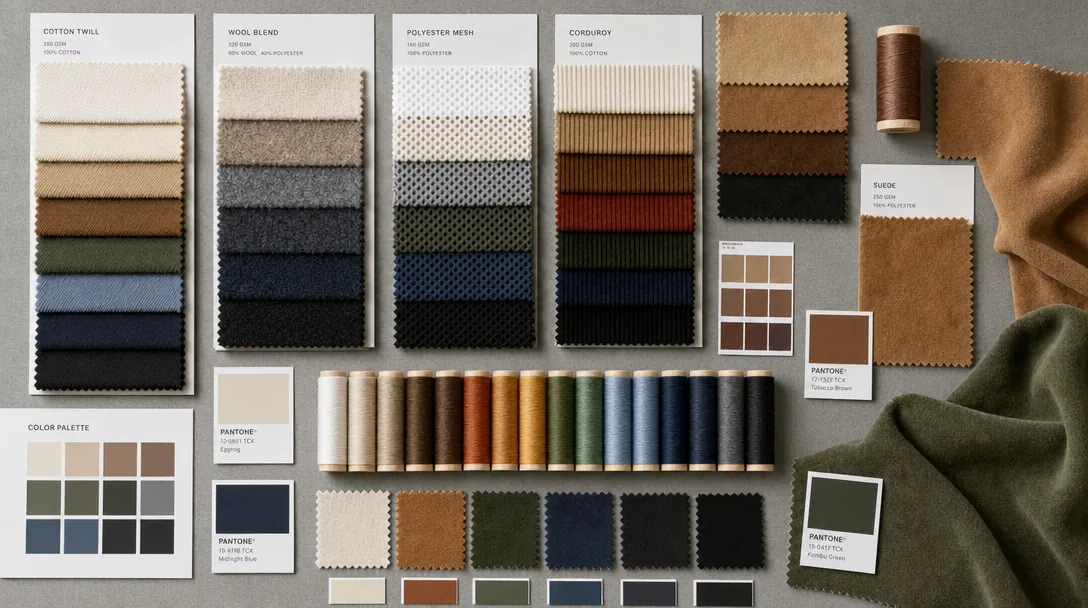
Color approval has to be treated as a production control point, not a mood-board exercise. Lock Pantone TCX references early, then check sealed samples under D65 and noon daylight before grading the logo against the base fabric and visor. Tonal work is unforgiving: a navy-on-navy thread that looks fine on screen can read lighter once stitched on Tajima, Barudan, or ZSK heads, especially with a dense satin column and 8,000 to 12,000 stitches on the front logo. The practical checklist is straightforward: approve fabric, thread, and closure as one set; confirm the mark still reads at 2 to 3 meters; and verify that the cap stays in the sport category instead of drifting into fashion. That discipline is what buyers expect from a performance cap manufacturer, because it preserves team identity without creating sample-to-bulk surprises or excess visual noise.
Pricing: performance fabric costs vs standard cotton
Cotton is still the cheapest line on the BOM, but it is the wrong benchmark for athletic headwear. A basic 6-panel cap in 260-280 gsm cotton twill might use fabric costing around $0.55-$0.80 per cap at 500 pcs, while a comparable performance shell in 100% polyester interlock, 75D or 100D micropeach, or 88/12 poly-spandex usually adds $0.35-$0.85 depending on yarn origin, wicking chemistry, and whether the mill keeps stock greige. The premium is not just fiber price. You are paying for stable shrinkage under 3%, better colorfastness to perspiration and washing, and less panel torque after heat setting. Any experienced performance cap manufacturer will tell you fabric construction moves cost more than the word “polyester”: solution-dyed 100D/144F, mechanical stretch woven, sandwich mesh laminations, or recycled GRS-certified yarn can each add another $0.10-$0.30 before cutting even starts.
The sweatband and vent package usually decide whether the cap performs or just looks technical. Replacing standard cotton tape with polyester terry, Coolmax-type warp knit, or perforated microfiber generally adds $0.08-$0.18 per cap; laser-cut side vents with heat-transfer taping add another $0.12-$0.25; and switching from chipboard to EVA or HDPE visor inserts adds about $0.05-$0.10 but prevents warping after repeated sweat exposure. On decorated styles, clean embroidery on lightweight shells often requires underlay adjustments and lower stitch density on Tajima or Barudan heads, otherwise you get puckering around front logos. That is why low-MOQ orders rarely benefit from chasing the cheapest cloth: on a 300-500 pc run, setup, marker efficiency, and labor can outweigh a $0.20 fabric saving.
UPF is the cost area buyers underestimate most. A legitimate UPF 40+ or UPF 50+ claim should be tied to a specific fabric lot and test report, typically AATCC 183 or AS/NZS 4399, not just a hangtag. In practice, tested fabric plus paperwork adds around $0.18-$0.35 per cap, and dark shades usually hold the rating more easily than pale colors unless fabric density is increased. Once you combine performance shell, upgraded sweatband, and verified UPF, the realistic premium over standard cotton is usually $0.75-$1.35 per unit on a 500-piece order; at 144-288 pcs, it can climb another $0.20-$0.40 because mill minimums and cutting waste are spread over fewer units. At CrownsForge, we lock Pantone TCX target, fabric spec, and test requirements before sampling, because late changes on color, finish, or UV rating are what trigger re-dye, Delta-E disputes, and avoidable rework.
Frequently Asked Questions
What logo decoration techniques do you offer?
3D puff embroidery, flat embroidery, woven patch, leather patch, PVC patch, screen printing, sublimation, applique and laser etching, all in-house with no subcontracting.
What file format should I send for my logo?
Vector files (AI, EPS, PDF) are ideal. High-resolution PNG or JPG at 300 dpi on transparent background works as a fallback. Provide Pantone color references for accurate reproduction.
How long does production take?
Sampling takes 7 to 12 days. Bulk production runs 20 to 30 days depending on quantity, fabric availability and decoration complexity. Inspection and packing adds another 3 to 5 days before shipment.
Do you support sustainability certifications?
Yes. We work with GOTS organic cotton, GRS-certified recycled polyester, OEKO-TEX Standard 100 fabrics, and are BSCI and Sedex audited. Certification documentation can be provided per order.
Which shipping methods do you support?
We support FOB, CIF and DDP shipping. Air express for samples and small orders, sea LCL for 100 to 500 pieces, sea FCL for 5,000+ pieces. Door-to-door DDP available for US, EU, UK, Canada and Australia.
How does ordering baseball cap custom logo work?
When evaluating baseball cap custom logo, the key considerations are construction quality, decoration capability, MOQ flexibility and lead time. Performance polyester adds roughly $0.40-$0.80 per cap vs standard cotton. UPF treatment adds another $0.20-$0.30. Sweatband upgrade adds $0.10-$0.20. Moisture-wicking fabric (typically polyester with wicking finish), moisture-wicking sweatband (usually polyester-elastane blend), lightweight construction (under 80g), and often UPF treatment.
What should buyers know about branded bills performance hat?
When evaluating branded bills performance hat, the key considerations are construction quality, decoration capability, MOQ flexibility and lead time. UPF 30 blocks ~97% of UV. UPF 50+ blocks 98%+. Most performance polyester fabric reaches UPF 30 naturally without chemical treatment. UPF 50+ usually requires treated fabric, which adds cost. Performance polyester adds roughly $0.40-$0.80 per cap vs standard cotton. UPF treatment adds another $0.20-$0.30. Sweatband upgrade adds $0.10-$0.20.
How much does branded bills custom hat cost typically cost?
When evaluating branded bills custom hat cost, the key considerations are construction quality, decoration capability, MOQ flexibility and lead time. UPF 30 blocks ~97% of UV. UPF 50+ blocks 98%+. Most performance polyester fabric reaches UPF 30 naturally without chemical treatment. UPF 50+ usually requires treated fabric, which adds cost. Moisture-wicking fabric (typically polyester with wicking finish), moisture-wicking sweatband (usually polyester-elastane blend), lightweight construction (under 80g), and often UPF…
How does ordering custom logo bucket hat work?
When evaluating custom logo bucket hat, the key considerations are construction quality, decoration capability, MOQ flexibility and lead time. Moisture-wicking fabric (typically polyester with wicking finish), moisture-wicking sweatband (usually polyester-elastane blend), lightweight construction (under 80g), and often UPF treatment. UPF 30 blocks ~97% of UV. UPF 50+ blocks 98%+. Most performance polyester fabric reaches UPF 30 naturally without chemical treatment. UPF 50+ usually requires treated fabric, which…
Ready to start your custom hat project?
Send us your tech-pack, sketch or even just an inspiration photo. We will respond with a detailed quotation and digital mock-up within 24 hours.
Request a free quoteRelated guides
Camouflage Bucket Hat: Properties, Costs and How to Spec It Right
Read article →
Custom Made Trucker Hat: The 2026 Sourcing & Manufacturing Playbook (2026 Update) - Supplier Checklist
Read article →
Merino Wool Beanie: Properties, Costs and How to Spec It Right - Cost & MOQ Breakdown (2026 Update) (2026 Update)
Read article →Sourcing custom hats does not have to be complicated. With the right manufacturing partner, clear specifications and a small upfront investment in sampling, you can launch a retail-quality product in 30 to 45 days.