
Patch Hats Decoration QC Checklist for Custom Hat Buyers - Cost & MOQ Breakdown - Cost & MOQ Breakdown (2026 Update)
Patch Hats Decoration QC Checklist for Custom Hat Buyers - Cost & MOQ Breakdown - Cost & MOQ Breakdown (2026 Update) is one of the most-asked questions we receive from international buyers, and for good reason. With dozens of factories competing for your order and an alphabet soup of technical terms in every supplier quote, even experienced importers can feel lost. This guide consolidates what we have learned producing custom hats for clients in 40+ countries.
Why patch hats decoration qc checklist needs a separate sourcing plan
A separate sourcing plan is mandatory because a patch hat is not one item; it is a cap shell, a patch trim, and an attachment process, each with its own defect map. That is why a patch hats decoration qc checklist cannot be replaced by a standard cap inspection sheet. Normal headwear QC covers crown symmetry, seam slippage, visor shape, stitch density, and embroidery thread trims. It does not control how a rigid or semi-rigid badge behaves on a curved front panel under heat, tension, and carton compression. The first sourcing decision is the patch substrate: merrowed twill, woven damask, 0.6-0.8 mm PVC, debossed PU, full-grain leather, silicone, or printed microfiber. Each one changes needle spec, backing, press temperature, and transit risk. PVC that looks flat after pressing can warp above 145°C for 12-15 seconds; low-grade PU often passes inline inspection, then turns tacky or hydrolyzes after 30-45 days in humid ocean transit. On foam-front truckers or washed unstructured cotton, the moving panel makes edge lift, tunneling, and corner curl much worse, so the patch-body combination has to be qualified before bulk.
Lead time, MOQ, and landed cost shift immediately once the patch is treated as a separate trim rather than just “decoration.” A stock 6-panel brushed cotton twill cap may sample in 5-7 days, but patch development usually adds 4-10 days for woven loom setup, laser cutting files, embossing plate approval, or a 2D PVC mold. MOQ also splits: the sewing line may run 144 caps, while the patch vendor asks for 300-500 woven pieces, 500-1,000 PVC units per color, or an $80-$250 tooling charge before production. Typical trim cost is $0.15-$0.28 for a basic embroidered patch, $0.35-$0.75 for woven or PU badges, and $0.90-$1.60 for molded silicone or PVC, before sewing, heat press, or hook-and-loop labor. Direct stitch is still the most stable option on curved crowns; heat press is faster but risky on nylon taslon, DWR-coated fabrics, and foam truckers; Velcro adds interchangeability but increases snagging and carton-abrasion claims.
Compliance is where buyers get caught, because the cap fabric may already be approved while the patch introduces a separate chemical and performance exposure. For EU retail, children’s programs, or licensed sports product, the patch hats decoration qc checklist should require independent lab scope for the patch substrate, inks, adhesive film, PU topcoat, and PVC compound. The hat body may already pass AZO, REACH Annex XVII, and CPSIA thresholds, but the patch can still fail phthalates, total lead, or EN 71-3 migratory elements. QC also needs tolerances a generic hat spec never lists: placement within ±2 mm from centerline, rotation within 2°, stitch margin within ±1 mm, peel strength targets for heat-applied badges, and color control at Delta-E 1.5-2.0 against the approved Pantone TCX standard. Our standard practice is to inspect attachment security at AQL 2.5, then flex the front panel 20-30 cycles and recheck for delamination, stitch cutting, whitening, or surface cracking, because those failures usually appear after bending, packing, and linehaul vibration, not at first look on the sewing line.
Factory capability checks before quoting
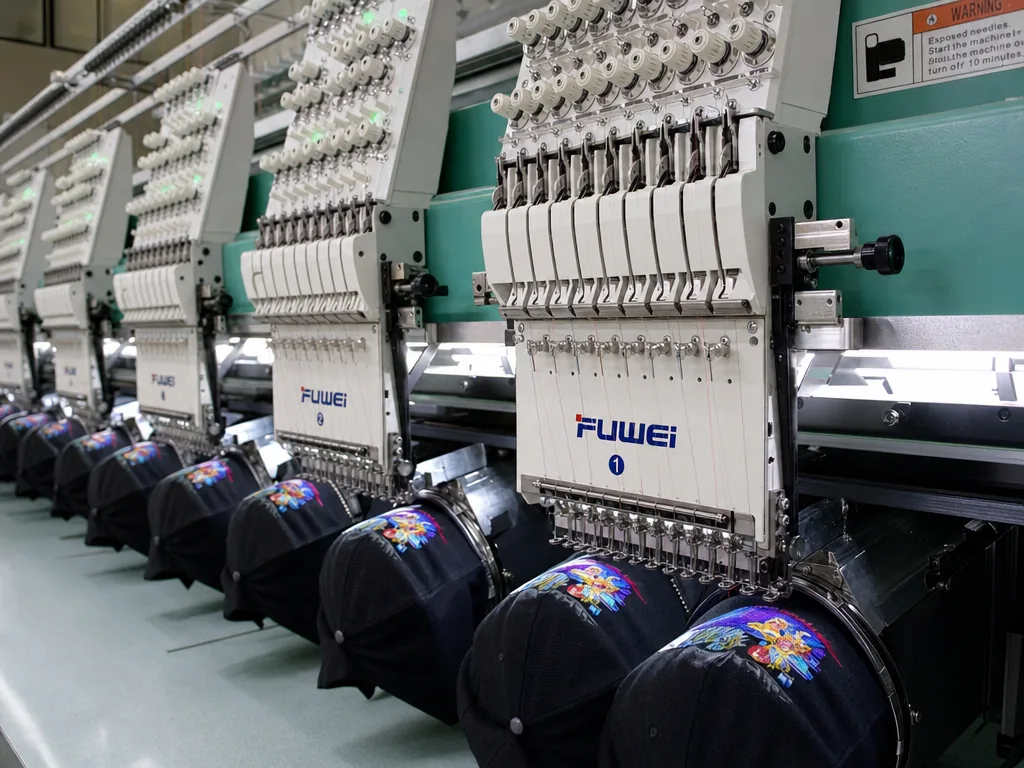
A quote is guesswork until you confirm the supplier can control both the cap body and the patch program without pushing critical steps to a trader. In a usable patch hats decoration qc checklist, the first questions are operational: how many Tajima, Barudan, or ZSK heads are running, whether the factory uses 270 mm or 360 mm cap frames, what patch formats are made in-house, and what is subcontracted. That single distinction changes lead time, MOQ, and defect ownership. Outsourced woven patches, molded TPU badges, leather emblems, or hook-and-loop assemblies typically add 3 to 7 days to bulk and create the usual finger-pointing when merrow borders fray, laser-cut edges yellow, or Velcro backing delaminates after pressing. A serious factory should quote against measurable limits, not sales language: laser-cut tolerance within +/-0.5 mm, woven border width at least 1.0 to 1.2 mm, embroidery stitch spacing around 0.35 to 0.50 mm depending on thread count and fill area, and Pantone TCX matching within Delta-E 1.5 to 2.0 on twill, felt, microfiber, or PU bases.
The shell is where many bad quotes hide, because patch cost is only one variable and the crown construction often drives rejection risk. Before you accept pricing, ask what fabrics are actually stocked or sourced routinely: cotton twill 260 to 320 gsm, brushed chino around 240 gsm, recycled polyester 150D to 300D, wool-blend melton 380 to 450 gsm, 11-wale corduroy, or standard trucker mesh in nylon/poly blends. Then verify what body constructions they can hold consistently: 5-panel foam trucker, 6-panel structured cap with 0.8 to 1.2 mm buckram, unstructured dad cap, or high-profile snapback with fused front panels. A capable team will state seam allowance tolerance, visor board options such as PE or paperboard sandwich, sweatband composition, and how closures affect MOQ. In practice, MOQ moves more from shell and trim complexity than from the patch itself: a stock 6-panel twill cap with a stitched embroidered patch may start around 144 pieces per colorway, while a corduroy body with molded TPU patch, custom metal buckle, and interior logo taping usually becomes a realistic 300 to 500 pieces because setup loss, trim sourcing, and AQL 2.5 rejection exposure are materially higher.
The sample room and the paperwork tell you whether the factory can quote from engineering reality or from hope. Insist on a pre-production sample using the actual crown fabric, actual patch substrate, final backing, and the real attachment method—stitch-down, satin applique, heat press film, or hook-and-loop. A competent team should deliver a first sample in 5 to 7 working days and a revision in 3 to 5, with measured comments: front patch placement tolerance within +/-2 mm, heat-press window around 145 to 160 C for 12 to 18 seconds, front seam distortion on patches wider than roughly 75 mm, and needle-cut risk on coated nylon or low-denier synthetics. If they cannot explain why a low-gsm unstructured crown collapses under a heavy badge, the quote is not reliable. Before moving forward, ask for current sedex-audit-cap-supplier-guide.html">BSCI 2.0 or Sedex SMETA 4-Pillar reports, broken-needle logs, metal detection procedure if retailer-required, and lot traceability for shell fabric, patch base, and key trims. If the merchandiser cannot write a clean spec covering attachment method, MOQ by body style, packing ratio, and ex-factory versus FOB timing, your patch hats decoration qc checklist is already failing before production starts.
MOQ, pricing and sample approval
MOQ is driven by the patch process far more than the cap shell. A blank 6-panel in 10x10 brushed cotton twill, recycled nylon taslon, or 30/70 wool-acrylic may only be $2.20 to $4.80 FOB, but decoration sets the commercial floor. Embroidered and woven patches are usually viable at 50 to 100 pcs per colorway because the setup is digitizing, loom file prep, border programming, and cutting; typical charges are $25 to $60 for embroidery digitizing and $35 to $80 for woven separation. PVC, TPU, and molded rubber patches usually need 100 to 300 pcs to make sense because mold charges run about $120 to $250 per design, and that cost gets ugly below 144 pcs. If a factory accepts very small runs without a surcharge, it often recovers margin by loosening process control, combining colorways, or simplifying attachment. A practical patch hats decoration qc checklist should therefore ask for MOQ by patch type, edge finish, and attachment method, not just by cap style. The real quote spread is usually in the add-ons, not the headline cap price. Merrow edge versus heat-cut edge, hook-and-loop backing, heat-press film, branded seam tape, hangtag, barcode label, size sticker, and individual polybag can add $0.18 to $0.85 per cap before freight. Attachment sequence matters too: sewing a patch after crown assembly costs more labor but gives cleaner centering on structured A-frame and buckram-backed fronts; applying before assembly may save a few cents, yet it raises the risk of panel distortion, stitch shadowing, and left-right symmetry drift. Buyers should also ask whether patch production is in-house on Tajima, Barudan, or ZSK equipment or subcontracted to a woven or PVC vendor, because subcontracting changes lead-time control and QC accountability. On a normal program, expect 5 to 7 days for sampling, 3 to 5 days for approval, and 18 to 30 days for bulk depending on raw material readiness and outsourced molding.
Sample approval is where most avoidable claims should be killed. A proper PPS sample must confirm the cap body, the patch itself, and the final attachment on the actual hat; approving a loose patch on a card is not enough. I have seen a 60 mm front patch look dead center on a flat layout and end up riding 3 to 5 mm high once stitched onto a curved A-frame. Color standards also need to match the substrate: Pantone TCX is the right reference for woven and embroidered textile patches, while Pantone Solid Coated is more useful for PVC inks, screen prints, and molded components. For brand-managed programs, set Delta-E at 2.0 or below for primary colors, then require written sign-off for any thread substitution, base fabric swap, or edge-finish change. The details that fail in bulk are usually small and predictable. On embroidered patches, over-dense satin borders can crush counters and make text under roughly 2.0 mm unreadable; on woven patches, reversed lines below about 0.8 mm often close up after laser cutting or edge sealing. Placement tolerance should be stated at +/-2 mm, and attachment strength should be verified by a simple pull test or wash/heat-resistance check depending on whether the patch is sewn, heat-pressed, or hook-and-loop mounted. Our standard practice is to approve one physical PPS, annotated photos, packaging details, carton pack-out, and a written QC standard before bulk starts. If your patch hats decoration qc checklist does not lock those points before production, an apparently cheap quote can turn into rework, air freight, or a debit note after final AQL 2.5 inspection.
Quality inspection and shipping risk
Most chargebacks on patch programs come from attachment failure, wrong artwork revision, or bad carton execution, not from cosmetic issues spotted in a quick walk-through. A practical patch hats decoration qc checklist should start with ANSI/ASQ Z1.4, General Inspection Level II, using AQL 2.5 for major defects and 4.0 for minor. On a 5,000-piece lot, that means code letter L and 200 units pulled across cartons, colors, and production dates. Major defects should include wrong patch graphic, incorrect shell or patch color, placement off more than ±3 mm from approved spec, visible panel puckering around the patch, mixed back closures, sharp needle damage, and any bond or stitch failure that can worsen in wear. Minor defects are things like thread tails under 10 mm, slight top-button lean, or crown shade variation within an agreed tolerance. Cap body measurements can often hold at ±5 mm, but patch position needs tighter control because a 4 mm drift is obvious at retail and impossible to average out across a run.
The patch itself needs a separate defect map because woven, embroidered, PVC, leatherette, and heat-applied constructions fail for different reasons. On embroidered or woven badges, inspect merrow finish, border closure, stitch density, registration, edge fray, and reverse cleanliness. On Tajima, Barudan, or ZSK heads, weak digitizing shows up as satin tunneling, exposed underlay, poor pull compensation, birdnesting, and inconsistent tatami coverage. For sewn-on patches, check seam margin and skipped stitches; operators sometimes catch only the patch edge and miss the cap shell, which passes appearance check but fails in use. For heat-applied patches, do a peel test after full cooling and again after 24 hours; edge lift, adhesive bleed, blistering, and scorch marks should be treated as major. Our standard practice is to spread the inspection sample by sewing line and patch lot, because repeat defects usually cluster by operator setting or one bad incoming patch batch, not evenly across all cartons.
Color and shipping risk are where margin disappears quietly. If the shell fabric and patch ground come from different mills, matching “black” by eye is reckless; use approved Pantone TCX references or lab dips for both materials and confirm under D65 lighting, with a pre-agreed Delta-E tolerance before bulk. For branded work, also ask for fabric and patch test data suited to the end use: dry crocking grade 4 minimum, wet crocking 3-4, plus acceptable light and perspiration fastness on cotton chino around 260-300 gsm, polyester twill, or acrylic/wool blends. White fill embroidery should be checked for oil marks, thread contamination, and registration drift under cool-white task lighting because those defects become obvious on shelf. Shipping control starts at packing: keep export cartons around 12-15 kg gross, use brim inserts or divider boards to protect buckram fronts, and mark each carton with PO, style, color, sequence, gross/net weight, dimensions, COO, and destination code. Under FOB Ningbo or Shanghai, late SI, carton-count mismatches, or bad HS classification can still cause rolled cargo; under DDP, incorrect composition declarations create customs reclassification risk just as fast.
Buyer checklist for the next RFQ
A workable RFQ for patch hats is six hard specs, not a JPG in an email: cap silhouette, shell fabric, patch construction, finished patch size, placement, and quantity by colorway. Name the body correctly—6-panel structured trucker, high-profile snapback, unstructured dad cap, bucket, or cuff beanie—and include fabric details if known: 260 gsm brushed cotton twill, 300D heather polyester, 100% recycled 600D oxford, or 1.2 mm PU suede. For the patch, state woven, merrowed embroidery, laser-cut embroidery, TPU, molded PVC, genuine leather, PU leather, felt, sublimated twill, or printed canvas. Then specify size in millimeters, shape, edge finish, backing, and attachment method: stitch-down, merrow sew-on, satin border, heat press, Velcro hook-and-loop, or adhesive carrier for post-application. If you want the patch hats decoration qc checklist to work before sampling, force the supplier to confirm measurable tolerances in writing: patch centering within ±2 mm, rotation within ±3 degrees, edge overhang tolerance, color match to approved standard at Delta-E 2.0 or tighter, and final audit level at AQL 2.5 with major/minor definitions.
Bad artwork is the fastest way to get a fake low quote. Send vector files in AI, EPS, or layered PDF, and assign color references correctly: Pantone Solid Coated for printed inks, Pantone TCX for textile shade targets on woven, felt, or embroidery yarn. Add a marked cap sketch with dimensions from fixed landmarks—front patch 12 mm above visor seam, side patch 25 mm behind eyelet, back tab centered on opening—so the sewing line is not guessing placement off a mockup. If the logo has fine text, state the minimum readable letter height. On embroidery patches, text below 3.5 mm cap height usually closes up unless the digitizer redraws paths and lowers stitch density for Tajima, Barudan, or ZSK heads; on woven patches, 2.0-2.5 mm is more realistic if the pick count is high enough. Also lock the sample route before quoting: photo approval, pre-production sample, or sealed sample, because each adds different lead time and cost.
The cost section of the RFQ should read like a factory traveler sheet. State MOQ by SKU and total order because the patch type changes the minimum immediately: woven or printed patches can be practical at 144 pcs per colorway, while molded PVC, debossed leather, or custom dies often push the real break-even to 300-500 pcs per design once mold, knife, and setup charges are spread. Tell the supplier the trade term and destination at RFQ stage—EXW Yiwu, FOB Ningbo, or DDP Los Angeles—because freight on finished caps usually moves by cube, not weight, and can swing from about $0.35 to $1.20 per piece depending on carton size, peak season, and booking window. Include barcode symbology, carton mark format, country-of-origin label wording, needle policy, and any compliance requirement such as BSCI 2.0 or Sedex SMETA 4-Pillar if the order is for licensed retail or big-box channels. Our standard practice is that a one-page spec sheet with these fields cuts at least one sample revision and removes most quote disputes before bulk production starts.
Working with CrownsForge
The useful patch hats decoration qc checklist is locked before bulk cutting, not at final inspection, because most expensive failures are baked in during sampling. On patch caps we freeze four approvals: patch material, decoration strike-off, sewn pre-production sample on the actual cap body, and placement tolerance by reference points. The sewn PP sample is the non-negotiable step; a raw patch can look fine on the table and still distort once it is stitched onto a buckram-backed 6-panel crown or heat-pressed onto foam trucker mesh. Our standard practice at CrownsForge is to measure placement from the center-front seam, eyelet line, and visor stitch line, with ±2.0 mm tolerance on standard 5-panel and 6-panel caps and ±1.5 mm on front badges under 55 mm wide. Color approval should also match the patch type: Pantone TCX for textile constructions, Pantone Coated for printed TPU, PVC, or silicone, checked under D65 lighting with Delta-E 1.5 target and 2.0 maximum commercial acceptance. Merrow patches, laser-cut twill, suede appliqué, molded rubber, and high-frequency TPU each need separate risk notes because edge curl, rebound, and carton-pressure marking behave very differently in transit.
Most defects come from the handoff between patch production and cap assembly, so the patch hats decoration qc checklist has to split those controls. Before patches ever reach the sewing line, inspect embroidery density, underlay balance, backing stiffness, edge finish, die-cut accuracy, adhesive coverage, and stitch-count consistency. On Tajima, Barudan, and ZSK heads, over-digitized fills and heavy satin borders will pucker after attachment, especially on 10x10 cotton twill, brushed canvas, corduroy, or 600D polyester fronts. Woven patches solve bulk but create edge-fray risk below roughly 150D yarns or on aggressive hot-cut corners. For heat-applied badges, same-day tack means nothing; run a 24-hour peel test and repeat after a 60°C closed-carton simulation to catch glue systems that fail during ocean transit. In-line control should start with 100% inspection of the first 20 pieces, then one check every 100 units per style, with immediate hold points for crooked application over 2 mm, uneven border bite, puckering, needle cutting on nylon, crown collapse from press pressure, and visible glue bleed. Final release should be judged to AQL 2.5 major and 4.0 minor unless the PO specifies tighter limits, and defect codes should separate patch faults from cap-body faults so rework is commercially rational. Export checks belong inside the same plan: humidity review if warehouse RH exceeds 65%, carton drop test, confirmation that stack pressure is not embossing adjacent crowns, and verification that carton marks, country-of-origin labels, HS description, and PO packing details match the booking whether the shipment moves FOB Ningbo or DDP.
Frequently Asked Questions
What file format should I send for my logo?
Vector files (AI, EPS, PDF) are ideal. High-resolution PNG or JPG at 300 dpi on transparent background works as a fallback. Provide Pantone color references for accurate reproduction.
Can I order a sample before bulk production?
Yes. We strongly recommend approving a pre-production sample before mass production. Samples are charged at 35 to 60 USD each plus express shipping, fully refundable against confirmed bulk orders over 500 pieces.
How long does production take?
Sampling takes 7 to 12 days. Bulk production runs 20 to 30 days depending on quantity, fabric availability and decoration complexity. Inspection and packing adds another 3 to 5 days before shipment.
Which shipping methods do you support?
We support FOB, CIF and DDP shipping. Air express for samples and small orders, sea LCL for 100 to 500 pieces, sea FCL for 5,000+ pieces. Door-to-door DDP available for US, EU, UK, Canada and Australia.
What logo decoration techniques do you offer?
3D puff embroidery, flat embroidery, woven patch, leather patch, PVC patch, screen printing, sublimation, applique and laser etching, all in-house with no subcontracting.
How does ordering custom hat leather patch work?
When evaluating custom hat leather patch, the key considerations are construction quality, decoration capability, MOQ flexibility and lead time. Explain the buyer intent behind patch hats decoration qc checklist, when it differs from generic hat sourcing, and what decisions affect cost, lead time and compliance. Cover embroidery, patch, fabric, panel construction, closure options, sample room capability, audit readiness and communication checks.
What's the MOQ for custom leather patch hat low minimum?
When evaluating custom leather patch hat low minimum, the key considerations are construction quality, decoration capability, MOQ flexibility and lead time. Explain the buyer intent behind patch hats decoration qc checklist, when it differs from generic hat sourcing, and what decisions affect cost, lead time and compliance. Cover embroidery, patch, fabric, panel construction, closure options, sample room capability, audit readiness and communication checks.
How does ordering custom leather patches for hats work?
When evaluating custom leather patches for hats, the key considerations are construction quality, decoration capability, MOQ flexibility and lead time. Explain the buyer intent behind patch hats decoration qc checklist, when it differs from generic hat sourcing, and what decisions affect cost, lead time and compliance. Describe how CrownsForge manages patch hats decoration qc checklist programs with sampling, decoration, QC and export coordination.
How does ordering custom patch trucker hats work?
When evaluating custom patch trucker hats, the key considerations are construction quality, decoration capability, MOQ flexibility and lead time. Explain the buyer intent behind patch hats decoration qc checklist, when it differs from generic hat sourcing, and what decisions affect cost, lead time and compliance. Describe how CrownsForge manages patch hats decoration qc checklist programs with sampling, decoration, QC and export coordination.
What do I need to put patches on hats?
So what you'll need is a post bed sewing. Machine we use a FAF. Machine i mean it's not cheap it's like $3 $4,000. For the FAF. But really you need a sewing machine that has a raised bed.
What must you inspect on the hard hat?
Check the hard hat for excessive fading in colour as this can be a sign of deterioration from UV exposure. Inspect the suspension system closely for cracks, cuts or frayed shell straps, torn headband, loss of pliability or other signs of wear. Replace the suspension if you find any damage.
Need a low-MOQ test order?
We help emerging brands launch with as few as 100 pieces. Premium fabric, in-house embroidery, retail-ready packaging.
Start a small orderRelated guides
Custom Logo Hats: When to Use It, Costs, and What to Ask Your Factory (2026 Update)
Read article →
Custom Hat Embroidery: The 2026 Sourcing & Manufacturing Playbook
Read article →
Festival Bucket Hats Reorder Planning Guide for Custom Hat Buyers
Read article →We hope this guide demystifies patch hats decoration qc checklist for custom hat buyers - cost & moq breakdown - cost & moq breakdown (2026 update) and helps you move forward with confidence. If you have questions specific to your project, our English-speaking sales engineers are one message away.