
Fitted vs Snapback vs Adjustable: A Closure-Type Buyer's Guide
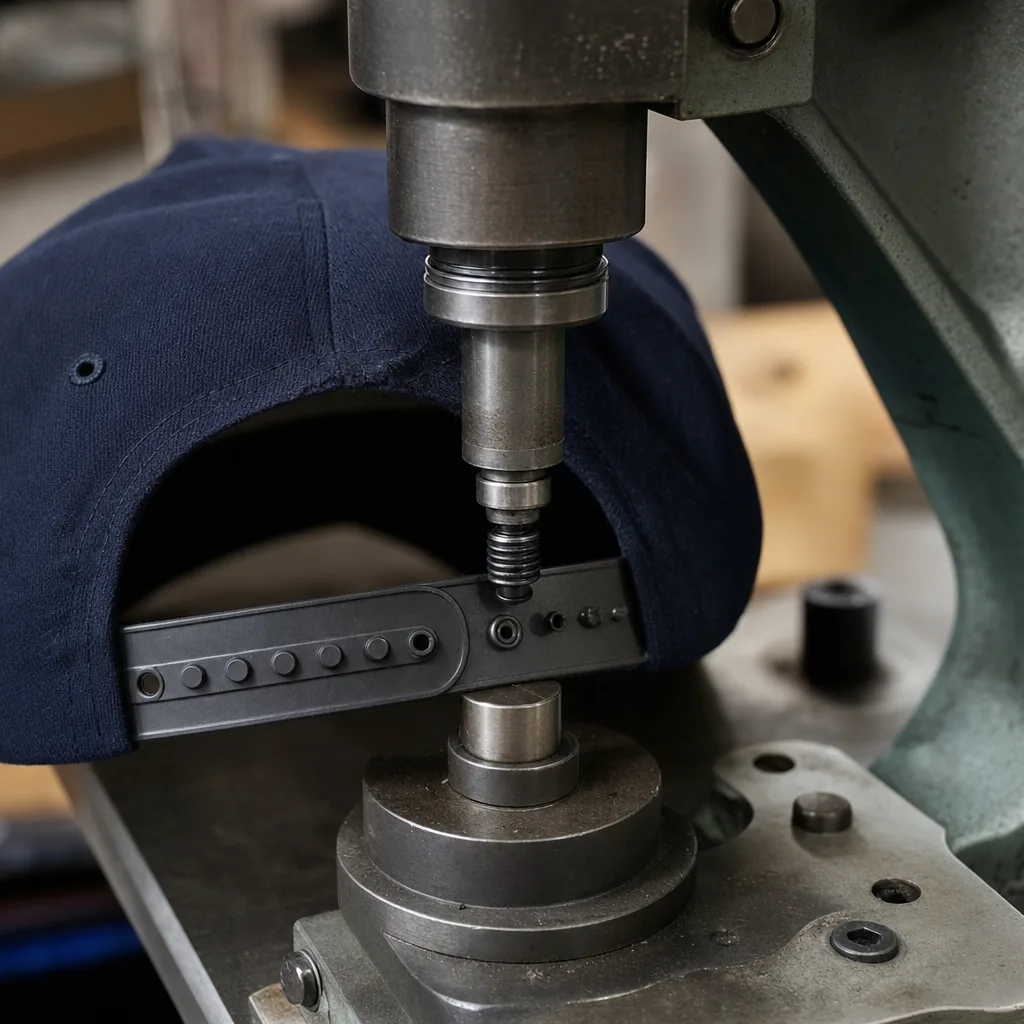
For brand owners, wholesalers and procurement teams entering the custom headwear category, fitted vs snapback vs adjustable: a closure-type buyer's guide is one of the highest-leverage decisions you will make. Get it right and your unit economics, retail story and reorder cycle all improve. Get it wrong and you carry the cost for years.
Fitted caps: how the tooling and sizing works
Fitted caps are not “adjustable” in disguise; they are built to a fixed head circumference, usually in 1/8-size steps from 6 7/8 through 8. In a real hat sizing system, each size needs its own cutting ratio, crown blocks, sweatband length, and final QC target. If a buyer asks for 6 3/4, 7, 7 1/4, and 7 1/2 in the same order, that is four separate production runs in practice, even if the shell fabric is identical. Compared with the fitted cap vs snapback decision, the fitted route gives a cleaner retail fit and a better “pro” look, but it also increases complexity at the factory floor because there is no slack built into the closure.
A fitted hat manufacturer has to hold tight control on pattern grading and shrinkage, especially on wool blends, acrylic-wool, and structured poly twill. The crown panels, visor board, and sweatband all need to match size tolerance closely; if the circumference drifts by even 3 to 4 mm, the cap can feel wrong on-head. We usually check finished internal circumference against the size spec after blocking, then sample-fit on heads or gauges before packing. For licensees and sports retailers, that precision is why fitted caps stay popular: consumers pay for exact sizing, and they expect the product to sit low, clean, and consistent across replenishment buys.
The tradeoff is commercial, not technical. With cap closure types like fitted, you carry inventory risk by size, because MOQ effectively multiplies across the size curve instead of pooling into one adjustable closure. A 1,200-piece order split across six fitted sizes is not the same as 1,200 one-size caps; the smaller sizes often become dead stock, while the larger sizes sell through first. That is why many buyers compare snapback vs strapback or go to an adjustable cap supplier for broader sell-through, but fitted still wins in pro sports retail and premium streetwear where the customer already knows their size. If the fit is wrong, returns are immediate; if it is right, repeat purchase rates are usually stronger than with generic adjustable styles.
Snapback: the universal adjustable
The snapback became the default answer to sizing because it removes most of the measurement risk from production and retail. A standard plastic snap closure usually gives 8 fixed positions, which covers roughly 54-62 cm and works for the bulk of adult buyers without needing a precise head measurement. For a brand comparing fitted cap vs snapback, this is the practical difference: a fitted cap demands a tight size run, while a snapback lets one SKU handle far more bodies, which is why it has stayed dominant in streetwear for 30-plus years. In factory terms, the closure is simple, cheap, and fast to assemble, and that keeps labor cost down versus more complex cap closure types.
The real advantage is inventory flexibility, not fashion theory. If you are buying through a fitted hat manufacturer or an adjustable cap supplier, a snapback reduces the risk of dead stock because you do not need to split demand across 6 7/8, 7, 7 1/8, and so on. It also tolerates broader gift and promo channels, where the buyer often has no size data at all. In a hat sizing system, that matters more than people admit: one adjustable model can cover retail floors, team merch drops, and corporate giveaways without a second size chart. The tradeoff is fit precision. On smaller heads, the rear plastic band can sit high and feel loose, and on very large heads the last snap can still be tight at 62 cm or above.
Between snapback vs strapback, the snapback is the more recognizable streetwear closure, while the strapback usually gives a slightly cleaner look and more micro-adjustment. Production-wise, snapbacks are easier to standardize because the molded PVC or ABS snap strip is consistent across batches, and that consistency helps QC. On the line, I would check the closure alignment, stitch density around the rear panels, and whether the sweatband extension interferes with the snap seat; bad assembly shows up as twisted closures or uneven gaps. If you are sourcing from a supplier, ask for wear testing on the snap hardware, because cheap plastic can crack after repeated force cycles, especially in cold-weather shipping.
Strapback: fabric strap with buckle
A strapback uses a fabric or leather strap at the rear with a metal slide buckle, usually paired with a metal grommet or sewn loop set. Compared with a plastic snap closure, it feels more finished on the shelf and it fits the dad-hat look that premium streetwear brands keep leaning on. In a fitted cap vs snapback comparison, strapback sits in the middle: it is still adjustable, but it reads more refined than a molded plastic snap and less rigid than a true fitted construction. For heritage retail, that matters because customers are buying the silhouette as much as the sizing.
The practical advantage is range. A good strapback can cover roughly 54-62 cm head circumference if the pattern is drafted correctly, which makes it useful for mixed-size runs and lower-return retail programs. As a cap closure type, it adjusts more slowly than a snapback because you have to thread the strap through the buckle, but once set it tends to stay put better and looks cleaner from the back. A fitted hat manufacturer will usually treat this as a separate hat sizing system choice, not just a hardware swap, because the rear opening, sweatband tension, and crown depth all affect how the size range wears on head shapes.
From a production standpoint, strapbacks are not hard, but they are unforgiving if the details are sloppy. Leather straps need consistent thickness, usually 1.4-1.8 mm, or the buckle slips; fabric straps should be cut on-grain so they do not twist after washing. We normally spec nickel-free buckles, lockstitch reinforcement at the back seam, and a stitched-down tail end so the excess does not flap. For buyers comparing snapback vs strapback, the strapback usually lands higher in perceived value by retail customers, but it also adds a little labor and QC time because buckle alignment, strap length, and stitch tension all have to be checked before packing.
Velcro / hook-and-loop
Hook-and-loop is the cheapest of the cap closure types, and you can usually tell why the moment you handle it. It gives you fast size adjustment, no metal hardware, and very low assembly cost, which is why promo caps, kids' caps, and cadet-style military caps use it so often. As an adjustable cap supplier, I’d call it the easiest closure to live with on a production line: less stitching than a buckle strap, fewer parts to source, and almost no risk of a broken clip in transit. The tradeoff is appearance. On a fitted cap vs snapback comparison, Velcro is even less premium-looking than a basic plastic snapback because the closure sits flat, collects lint, and tends to fuzz up after repeated use.
From a hat sizing system standpoint, hook-and-loop is not really about precision; it’s about broad tolerance. It works best when you need one size to cover a wide head range, typically around 55 to 60 cm, without committing to full size runs. That makes it useful for giveaways and school programs, but not ideal for streetwear or licensed retail where buyers inspect the back panel closely. The scratchy sound and exposed tab are small details, but they matter in retail. A fitted hat manufacturer will usually avoid Velcro unless the product is clearly positioned as utility-first, because the closure instantly lowers perceived value even if the crown, fabric, and embroidery are solid.
If you need a low-cost closure and you do not care about premium presentation, hook-and-loop is the practical choice. But if the cap is going into a fashion assortment, teams-store program, or anything competing against strapback and snapback styles, it will usually lose on shelf appeal. On a production quote, the difference can be small — often only a few cents to a few tenths of a dollar versus a plastic strap or fabric strap — yet the retail impact is much bigger than the cost gap suggests. In my experience, buyers use Velcro when they want speed, simplicity, and a wide fit window, not when they want a closure that helps sell the hat.
Buckle (metal slide or tuck-buckle)
The buckle closure is the premium retail standard for dad hats and unstructured caps because it gives you a cleaner back profile than a plastic snap and a more controlled fit than a simple Velcro strap. In the fitted cap vs snapback conversation, this is the third lane buyers often miss: it does not try to be one-size-fits-all in the same crude way a snapback does, but it also avoids the rigid size breakpoints of a fitted hat manufacturer’s crown blocks. A brass slide buckle is the heritage default, especially on washed cotton twill, chino, and brushed canvas caps where buyers want an understated, workwear look. It sits flat, ages well, and feels more expensive than it is when the stitching and strap thickness are done properly. On the factory floor, the weak point is usually not the buckle itself but the strap tail length and stitch density at the loop, which should hold up under repeated adjustment without fraying.
Tuck-buckle, the small flat metal clip, is common in Japanese-influenced premium retail because it looks cleaner than a chunky buckle and photographs well on minimalist product pages. It is one of those cap closure types that can lift a $6 FOB cap into a $9 to $11 FOB program if the rest of the build is right: 260 to 300 gsm cotton twill, matte-finished hardware, low-profile labeling, and neat edge folding on the strap. For buyers comparing snapback vs strapback, this is where strapback wins on aesthetics but loses on speed of adjustment; the buckle takes a second longer to set, but it does not feel cheap. The tradeoff is metal-to-fabric contact, so if the strap material is thin or the plating is poor, you get scratching, tarnish, or a noisy closure that annoys retail customers.
From a fit and sourcing standpoint, buckle closures sit in the middle of the hat sizing system: they are not truly fitted, but they are more precise than a generic adjustable cap supplier’s plastic snap. That matters for return rates, especially in premium direct-to-consumer channels where a 3 to 5 percent fit complaint can wipe out the margin on a small order. A good fitted hat manufacturer will usually hold the crown shape tighter and rely less on rear adjustment, while a buckle cap depends on a clean strap arc and consistent sewing tolerance, usually within 1 to 2 mm at the buckle tunnel. Our standard practice is to check the closure under AQL 2.5 along with pull testing on the strap seam, because a loose buckle stitch is one of the fastest ways to turn a premium dad hat into a customer complaint.
Cost comparison and fit tolerance
If you are comparing fitted cap vs snapback on a real buying sheet, the fitted style almost always costs more to execute because you are buying size complexity, not just a cap. A true fitted program usually means 6 to 8 head sizes per style, sometimes more if you want a full run from 6 7/8 to 7 5/8. That multiplies cutting, inventory, and risk: one weak size can leave you with dead stock while another size sells out. A snapback is the opposite. With a standard 6-panel crown and one plastic closure, you can cover roughly 90 percent of adult heads in one SKU, which is why it stays the default for streetwear and promo programs. If you are working with a fitted hat manufacturer, the labor and grading are what move the price, not just the fabric.
On cost, the closure itself is not the main driver except when you move away from the basic plastic snap. Strapback and metal-buckle styles usually add a small upcharge because the closure hardware, stitching, and QC take longer; expect something like $0.15 to $0.45 per piece depending on the finish, whether the strap is self-fabric, PU, or grosgrain, and whether you want engraved metal parts. Velcro is the cheapest closure, but it is also the least premium in hand feel and the first thing buyers complain about after a few wash cycles. In the hat sizing system, snapback vs strapback is mostly a tradeoff between adjustability and presentation: snapback reads more casual and standardized, while strapback can look cleaner for fashion retail if the hardware is decent.
Fit tolerance is where the real operational difference shows up. Snapbacks are forgiving because the closure gives you a wide tolerance window, but fitted caps need tighter pattern control, especially in crown depth, sweatband length, and seam balance. For adult retail, a well-made fitted usually has about ±1/8 inch tolerance on band circumference before customers start calling it uncomfortable; on lower-cost programs, even 3 mm off can matter. Adjustable cap supplier work is easier because you can absorb a little variation in the closure range, but you still have to keep the crown from collapsing or riding high. In practice, the best choice depends on retail positioning and SKU discipline: fitted for premium sports licensing and core collectors, snapback for broad sell-through, and basic adjustable styles for promotion or entry-level pricing.
Frequently Asked Questions
What file format should I send for my logo?
Vector files (AI, EPS, PDF) are ideal. High-resolution PNG or JPG at 300 dpi on transparent background works as a fallback. Provide Pantone color references for accurate reproduction.
What logo decoration techniques do you offer?
3D puff embroidery, flat embroidery, woven patch, leather patch, PVC patch, screen printing, sublimation, applique and laser etching, all in-house with no subcontracting.
Can I order a sample before bulk production?
Yes. We strongly recommend approving a pre-production sample before mass production. Samples are charged at 35 to 60 USD each plus express shipping, fully refundable against confirmed bulk orders over 500 pieces.
What is the minimum order quantity (MOQ) for custom hats?
Our standard MOQ is 100 pieces per design and color, with sampling available from 1 piece. For complex multi-color logos or premium fabric upgrades, the MOQ can be lowered with a small per-piece surcharge.
Which shipping methods do you support?
We support FOB, CIF and DDP shipping. Air express for samples and small orders, sea LCL for 100 to 500 pieces, sea FCL for 5,000+ pieces. Door-to-door DDP available for US, EU, UK, Canada and Australia.
How does ordering baseball cap custom embroidery work?
When evaluating baseball cap custom embroidery, the key considerations are construction quality, decoration capability, MOQ flexibility and lead time. Fitted caps are stitched at exact size (6 7/8 through 8). Production requires per-size dedicated runs. MOQ effectively multiplies by number of sizes you stock. Fan-favorite for pro sports retail. Plastic snap closure with 8 standard positions. Universal sizing fits most adults (54-62 cm). The streetwear default for 30+ years.
How does ordering custom embroidered trucker hat work?
When evaluating custom embroidered trucker hat, the key considerations are construction quality, decoration capability, MOQ flexibility and lead time. Fabric or leather strap with metal slide buckle. Premium streetwear (dad hat aesthetic), heritage retail. Adjustable across a wider range than snapback but slightly slower to adjust. Fitted caps are stitched at exact size (6 7/8 through 8). Production requires per-size dedicated runs. MOQ effectively multiplies by number of sizes you stock. Fan-favorite for pro sports retail.
How does ordering custom dad hat embroidery work?
When evaluating custom dad hat embroidery, the key considerations are construction quality, decoration capability, MOQ flexibility and lead time. Fabric or leather strap with metal slide buckle. Premium streetwear (dad hat aesthetic), heritage retail. Adjustable across a wider range than snapback but slightly slower to adjust. Premium retail standard for dad hats and unstructured caps. Brass slide buckle is the heritage default. Tuck-buckle (the small flat metal clip) is also popular on Japanese-influenced premium…
How does ordering custom embroidered baseball caps work?
When evaluating custom embroidered baseball caps, the key considerations are construction quality, decoration capability, MOQ flexibility and lead time. Fitted caps are stitched at exact size (6 7/8 through 8). Production requires per-size dedicated runs. MOQ effectively multiplies by number of sizes you stock. Fan-favorite for pro sports retail. Cheapest closure, easiest to adjust, but visually downmarket. Common on promotional caps, kids' caps, military-style cadet caps.
Looking for a reliable hat manufacturer in China?
CrownsForge has produced custom hats for 800+ brands across 40 countries. From 100-piece launches to 100,000-piece retail programs, we deliver on time and on spec.
Get in touchRelated guides
Launching a Hat Brand: Marketing Playbook for the First 12 Months
Read article →
Esports Team Caps: Manufacturing Specs for Pro and Amateur Gaming Brands
Read article →
Customizing Blank Fitted Caps: New Era 59FIFTY, Otto, Imperial Buyer's Guide
Read article →Sourcing custom hats does not have to be complicated. With the right manufacturing partner, clear specifications and a small upfront investment in sampling, you can launch a retail-quality product in 30 to 45 days.