
Custom Made Trucker Hat: The 2026 Sourcing & Manufacturing Playbook - Supplier Checklist - Cost & MOQ Breakdown
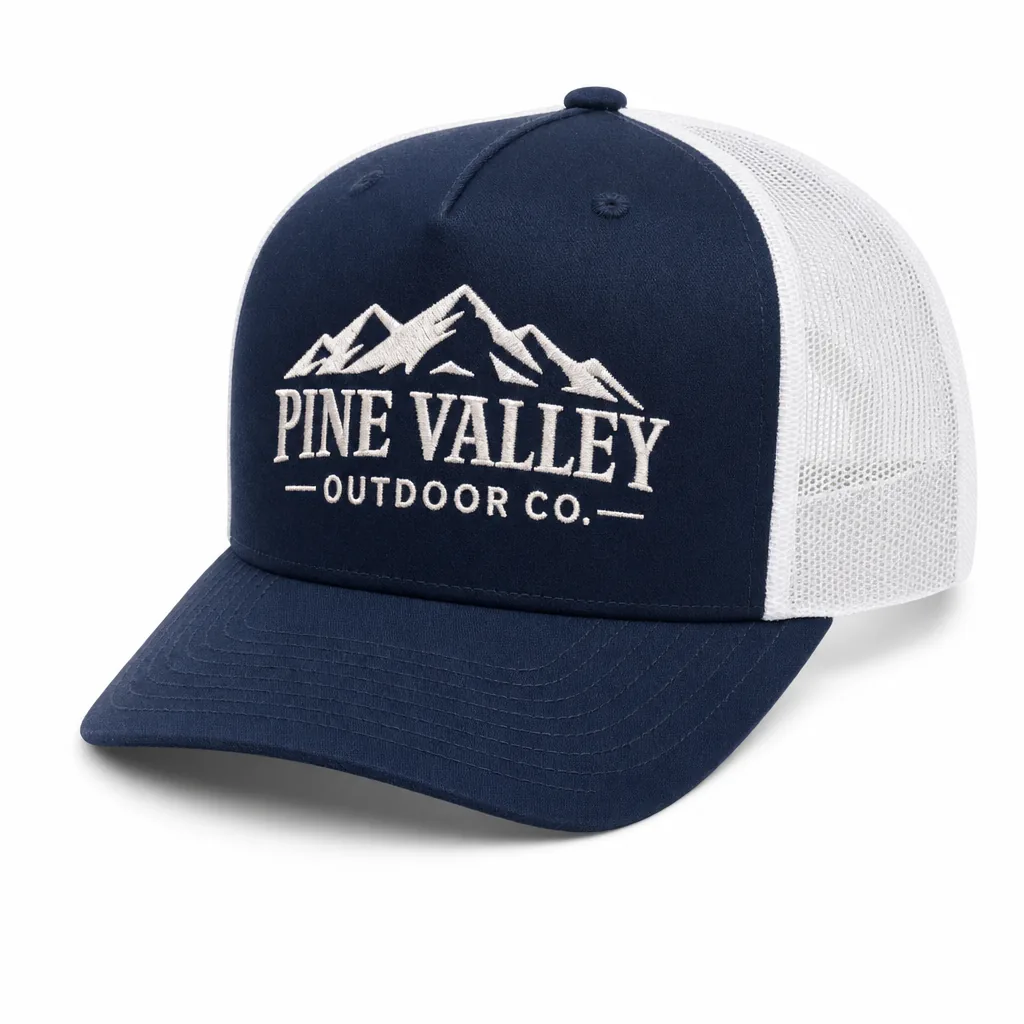
For brand owners, wholesalers and procurement teams entering the custom headwear category, custom made trucker hat: the 2026 sourcing & manufacturing playbook - supplier checklist - cost & moq breakdown is one of the highest-leverage decisions you will make. Get it right and your unit economics, retail story and reorder cycle all improve. Get it wrong and you carry the cost for years.
Custom Embroidered Hats
Embroidery is still the most forgiving decoration for a custom made trucker hat, but only when the digitizing is built around the cap structure instead of the artwork. A structured 5-panel foam-front trucker sews very differently from a 6-panel chino twill cap with buckram: foam needs lighter fill density, wider underlay spacing, and more pull compensation to keep the crown from collapsing. On Tajima, Barudan, or ZSK multi-heads, a standard front logo usually lands in the 5,000-12,000 stitch range; above roughly 15,000 stitches on laminated EVA foam, you start seeing tunneling, seam grin, and the front centerline getting dragged off vertical. The common buyer mistake is approving a pretty PDF while ignoring sewability limits. A usable tech pack should lock the embroidery field in millimeters, logo offset from visor seam, stitch type by element, thread brand and weight, and whether the crown is foam, buckram-backed, or unstructured before digitizing starts. Thread spec matters more than most importers realize. For retail programs, 40 wt trilobal polyester is the default because it holds sheen and color better than rayon after UV exposure, sweat, and repeated carton compression in transit; 60 wt works only for fine outlines or small lettering under 4 mm cap height. If you want 3D puff, call out 2 mm or 3 mm EVA foam, and avoid thin scripts, tight counters, or serif details that will close up once the satin columns bite into the foam. Physical sew-out approval under D65 lighting is non-negotiable because thread can drift visibly from a Pantone TCX reference even when the digital mockup looks exact; on white foam fronts, warm grays, oranges, and neons can miss by Delta-E 2.0-3.5 and still get waved through by an inexperienced factory. For front logos, ±2 mm placement tolerance is a realistic retail standard, not a luxury.
Cost on a custom made trucker hat is driven less by the shell than by setup complexity and stitch time. For a stock-body trucker using standard 100% polyester mesh, a PE foam front, and one flat front logo, factories in Zhejiang typically quote MOQs of 144-300 pieces per colorway. Once you move to a fully custom body—say proprietary 260 gsm brushed cotton twill, custom mesh in a specific denier, branded snap closure, or a revised visor curvature—the practical MOQ usually jumps to 500-1,000 pieces because pattern, trim, and material procurement stop being shared. Real FOB pricing at 300-500 pieces is commonly US$2.20-US$3.80 for a 5,000-8,000 stitch front hit; 3D puff usually adds US$0.18-US$0.45, and side or back embroidery adds around US$0.12-US$0.35 per location. Digitizing is normally US$25-US$80 per logo unless credited back against bulk production. Inspection should target embroidery-specific failure points, not just general cap defects. The first things I look for are birdnesting at start-stop points, loose jump-thread trimming on the underside, exposed foam on puff edges, puckering around dense fills, and mesh needle cuts where the operator lost hoop tension. On finished caps, verify logo placement to ±2 mm, visor-to-crown alignment, and whether the embroidery has telegraphed through low-density foam or weak front fabric; a cheap 140-160 gsm front panel will expose every digitizing mistake. Bulk should be checked to AQL 2.5, with thread shades compared to the approved standard under controlled light, not warehouse daylight. CrownsForge treats shell quality and embroidery quality as inseparable: inconsistent buckram stiffness, poor foam lamination, or unstable front-panel fabric will sew badly no matter how good the Tajima program is. If the order is for licensed retail or a corporate client, ask for current sedex-audit-cap-supplier-guide.html">BSCI 2.0 or Sedex SMETA 4-Pillar audit reports before bulk approval.
Custom Hat Embroidery
Embroidery is the fastest way to tell whether a custom made trucker hat was engineered properly or pushed through sampling with a stock DST file. Most failures start in digitizing, not on the sewing floor. A supplier worth taking seriously should ask about panel material, seam location, logo dimensions in millimeters, and whether the front is buckram-backed foam, brushed cotton twill, or 600D rPET before quoting. The same artwork runs differently on a Tajima TMEZ, Barudan BEKY, or ZSK Sprint because cap frame angle, thread path, and tension stability change how satin edges and fills behave over the crown seam. On 5-panel trucker fronts, a 90 to 110 mm logo usually performs cleanly at roughly 7,000 to 11,000 stitches; once you push dense fills past 12,000 on foam, you start seeing panel distortion, collapsed puff, and visible needle penetration. For 3D puff, 2 mm to 3 mm EVA is the workable range on most structured fronts. At 5 mm, the edge coverage often breaks down during carton compression, especially if the logo uses tight corners or thin serif details.
A clean RFQ should lock the variables that actually drive lead time and rejects: Pantone target for thread shade, acceptable Delta-E tolerance, stitch-count cap, logo placement tolerance of +/-2 mm, thread spec such as 120D/2 rayon or 150D polyester, needle size #11 or #12, and backing weight in the 50 to 80 gsm range for structured crowns. Small text is where weak factories overpromise. On mesh-back caps with foam fronts, letter height below 4 mm usually closes up, and enclosed counters in A, R, or P disappear unless the art is simplified before digitizing. Ask for a DST preview, then a sew-out on the actual shell fabric, not on generic twill. If the design mixes flat fill, satin borders, and puff, a pre-production sample is not optional. Our standard practice is to reject gradient-heavy art and hairline outlines unless the buyer accepts a stitch-safe redraw, because embroidery follows needle mechanics, not screen graphics.
Embroidery cost on a custom made trucker hat should track machine time and stitch count, not vague labels like "basic logo." In Yiwu, front flat embroidery on stock trucker bodies usually adds about US$0.35 to US$0.85 per piece at 300 units; front 3D puff plus one side hit typically lands around US$1.10 to US$1.80; add rear arch embroidery and you are often at US$1.60 to US$2.20 depending on total stitches and thread changes. Digitizing is normally US$25 to US$70 per logo, though many factories waive it above 500 pieces. MOQ for efficient embroidery setup is commonly 144 to 300 pieces per colorway; shops offering 50-piece runs usually recover margin through higher sample fees or looser QC. Final inspection should be done at AQL 2.5 with embroidery-specific checkpoints: registration, puckering, exposed backing, loose tails, foam height consistency, and thread color under D65 light. If the program is licensed retail, add color approval against branded standards and rub testing for metallic or specialty polyester threads.
Custom Trucker Hat
A dependable custom made trucker hat is built around pattern stability, not surface decoration. The front crown on serious export programs is usually 180 to 300 gsm cotton twill, brushed canvas, foam-backed polyester, or 8 to 12 wale corduroy, fused to 0.7 to 1.0 mm buckram to hold shape through embroidery, packing, and shelf display. The two commercial baselines are 5-panel high-profile and 6-panel mid-profile, with finished crown height typically 11.0 to 12.5 cm from sweatband to top button. Mesh is where weak factories cut corners: low-cost polyester mesh in the 70D range will crease and whiten after compression, while 100D to 140D nylon mesh usually rebounds better and keeps a cleaner hand after carton transit. Visors are normally built with PE board for lower cost or EVA for softer bend memory, then locked with 6 to 8 stitch rows; at retail, that difference shows up immediately in edge wave, recovery, and how the curve holds after wear. Your tech pack needs to define the hat like a controlled product, not a mood board. Call out panel count, profile, visor curvature, front fabric gsm, mesh denier, sweatband composition, snapback material, seam tape artwork, and Pantone reference in TCX for textiles instead of guessing from the coated book. For logo execution, specify stitch count, thread brand, backing weight, and 2 mm or 3 mm EVA foam for 3D puff. On Tajima, Barudan, or ZSK heads, bad 3D puff almost always comes from poor digitizing and underlay, not the machine. QC should be measurable: logo placement ±2 mm, visor centering within 3 mm, crown height tolerance ±3 mm, and AQL 2.5 for majors. The repeat defects are predictable on the factory floor: twisted crowns from uneven panel feeding, mesh puckering at the sweatband seam, black twill versus black mesh color shift under D65 light, and brittle PP snaps that crack after cold-weather delivery.
MOQ and pricing for a custom made trucker hat are driven more by material and trim customization than by sewing time. If you use a stock body with one flat embroidery position, workable MOQs are usually 144 to 300 pieces per colorway. Once you move into dyed-to-match front fabric, custom mesh, branded seam tape, woven flag label, under-visor print, and retail packaging, the practical factory MOQ becomes 500 to 1,000 pieces per style-color because fabric dye lots, trim setup, and cutting loss start to matter. In the current China market, entry-level foam-front builds still land around $1.80 to $2.60 EXW at 500 pieces. Mid-grade cotton twill plus mesh with standard front embroidery is more often $2.90 to $4.80 EXW. Fashion-tier builds with corduroy or washed canvas, 3D puff plus side hit, custom interior tape, and individual polybags usually run $5.50 to $8.50 EXW before freight. Sampling and lead time are where buyers either control risk or create rework. A logo strike-off normally costs $35 to $80, while a sewn pre-production sample is usually $80 to $180 depending on fabric sourcing and whether new embroidery files or patch molds are required. Standard timing is 7 to 12 days for sample approval and 25 to 35 days for bulk production after deposit and final artwork lock. Add time if you require third-party inspection, carton drop testing, metal detection, or compliance files tied to BSCI 2.0, Sedex SMETA 4-Pillar, or CPSIA-friendly component declarations. Our standard practice is to freeze a golden sample before bulk and check textile shade tolerance at Delta-E under 2.0; if the hat needs to match apparel exactly, under 1.5 is the safer target.
Custom Trucker Hats
The biggest cost and quality lever in a custom made trucker hat is the front body spec, not the logo file. Buyers compare quotes as if all trucker blanks are interchangeable; they are not. A 5-panel crown gives the cleanest decoration area because there is no center seam to break embroidery or patch placement, but it only works if the front panel has enough structure to resist packing pressure. Low-cost programs usually use 2.5 to 3.0 mm EVA or PU foam laminated to 120 to 150 gsm polyester, which is fine for event giveaways but prone to crease memory after vacuum packing or a 30- to 40-day ocean transit. For retail, I would lock the shell to 10 oz cotton twill, brushed canvas, or 8 to 9 oz poly-cotton with 0.35 to 0.50 mm buckram, 75D or 100D mesh, a PE visor insert at 1.8 to 2.2 mm, and a standard 7-hole PP snap closure with color matched pegs.
Sampling has to define shape in measurable terms or the factory will substitute a different base body and still claim it matches. Set crown height at 16 to 17 cm for standard profile or 18 cm for high profile, visor length around 7.0 to 7.5 cm, bill curve radius, front panel width, and mesh aperture. Decoration needs the same discipline. If the supplier is running Tajima, Barudan, or ZSK heads, approve a sew-out after underlay, pull compensation, and foam distortion are tuned; on foam fronts, satin column widths around 0.35 to 0.40 mm and pull compensation of 0.2 to 0.4 mm are common starting points. A proper tech pack for custom trucker hats should call out Pantone TCX references, Delta-E tolerance of 1.5 to 2.0 on dyed front fabric and up to 2.5 on mesh, artwork size in mm, patch type, sweatband composition, seam tape print, and carton ratio. In Yiwu or Dongguan, realistic pricing is about $2.20 to $3.30 FOB for promo grade, $3.90 to $6.80 FOB for solid retail, and $7.00 to $10.50 FOB for rope trims, branded interior taping, multi-location decoration, and tighter workmanship control; MOQ is typically 144 to 300 pcs on stock materials, but custom-dyed mesh, molded rubber patches, or branded snaps usually push the run to 500 to 1,000 pcs.
Inspection should focus on shape retention and assembly symmetry, because that is where trucker orders quietly fail. The recurring defects on bulk custom made trucker hat production are twisted front panels, visor mismatch left to right, mesh splits at the rear seam, embroidery puckering on foam, weak snap peg retention, and bulky sweatband joins that make the cap sit off-center on head. Use measurable tolerances: crown height within plus or minus 0.5 cm, logo centering within 2 mm, visor symmetry checked flat against a template, snap closure engagement force verified by hand test, and patch adhesion tested only after a 24-hour cool-down if heat press is involved. AQL 2.5 works for most retail programs, but licensed sports and fashion drops should apply stricter judgment to front-panel workmanship because customers notice silhouette defects before they notice labeling or loose inside threads. Packing is part of quality control, not an afterthought. If cartons are over-nested or compression load is too high, even a well-built hat arrives with front-panel memory lines that never fully recover.
Hat Trucker Custom
A custom made trucker hat is not one SKU; it is five subassemblies with separate risk points: front crown, mesh back, visor, sweatband, and closure. The front panel is where most cost and rejects are created. A promo-grade 5-panel foam trucker usually uses 3 to 5 mm PU foam laminated to 120 to 160 gsm polyester tricot, while a retail-grade structured 6-panel build is more stable in 10 oz cotton twill, 7x7 canvas, or 180 to 220 gsm recycled polyester with 75D or 100D polyester mesh. That material choice determines whether embroidery stays clean, whether the crown holds shape after carton compression, and whether the cap can survive repeated wear without front-panel collapse. If the logo sits on foam, artwork alone is not enough. The tech pack should call out stitch count range, satin-column minimums of roughly 1.2 to 1.5 mm, underlay type, pull compensation, thread brand, and whether backing read-through is acceptable inside the crown. Tajima, Barudan, and ZSK heads can all run 3D puff and flat embroidery reliably, but only when the digitizing is built for foam density and crown curvature. Bad files close counters, bury small columns, and pucker the panel before it ever reaches final sewing. For lettering under 4 mm cap height, switch from foam embroidery to a woven patch or screen transfer; otherwise you are paying for defects the factory should have warned you about.
A usable tech pack for a custom made trucker hat has to lock the details factories often improvise when the PO is vague: crown height tolerance within ±3 mm, visor length and pre-curve spec, seam tape color, top-button finish, snapback peg count, sweatband composition, and mesh denier. For printed fronts or patches, give Pantone TCX references and require Delta-E below 2.0 on the visible ground if the hat has to match tees, bags, or outerwear in the same program. Cost in Yiwu and Dongguan moves far more on decoration and custom trim than on the shell itself. At 300 to 500 pieces, a basic FOB trucker with stock mesh and 1-color flat embroidery typically lands around $2.20 to $3.50; add woven patch, custom seam tape, underbill print, inside label set, and individual polybag with barcode, and the realistic range is $3.90 to $5.90. The defects that matter usually do not show up on a photo-approved sample. They appear at inline and final inspection: patch placement drifting more than 3 mm off center, visor sandwich exposure, mesh tearing at side seams, loose snap pegs, top-button misalignment, and thread breaks on fine lettering. Buyers should write dimensional tolerances into the PO, inspect to AQL 2.5, and include wear testing rather than relying on tabletop counts. Our standard practice is inline QC every 25 to 50 pieces on new styles, plus checks on azo-free and REACH-compliant trims, needle control, carton drop resistance, and humidity-sensitive storage for foam fronts. Consistency in mesh denier, snap resin grade, and embroidery file settings is what prevents fit drift and chargebacks on repeat orders.
Trucker Custom Hat
A custom made trucker hat should be specified as one engineered unit: front crown, mesh, bill, and decoration all interact. For the shell, the safest starting points are 180-260 gsm cotton twill, 220-240 gsm brushed chino, or the classic 3-5 mm polyester foam laminated to tricot when you want a tall, rigid trucker profile. Mesh choice matters more than most buyers realize. Standard back panels use polyester or nylon mesh in roughly 40D-70D yarns with 4-6 mm apertures; larger holes improve airflow, but they also make the side panels less stable at the feed dogs and easier to torque during sewing. If the profile has to stay crisp after packing, specify buckram weight, crown height, front panel angle, visor curve radius, sweatband composition, and closure type before sampling, not after the first fit sample fails. Decoration is where weak quotes fall apart. Flat embroidery on Tajima, Barudan, or ZSK multi-heads is straightforward on twill, but foam fronts need different digitizing logic because stitch density, underlay, and travel path can collapse the loft or cut the surface. If you want 3D puff, call out 3 mm EVA, cap the design around 8,000-10,000 stitches, and avoid large solid fills across the bend of the crown. Woven patches usually add 5-7 days; molded PVC patches often add 10-14 days plus about $80-$150 in tooling, and both can change the practical MOQ. Our standard practice is to treat decoration as part of construction, because patch weight, embroidery pull, and front panel stiffness directly affect how the hat stands up on the shelf and on the wearer.
The fastest way to de-risk a custom made trucker hat is to put measurable tolerances into the RFQ. Lock color to Pantone TCX for textiles or Pantone Coated for trims and prints, and set realistic color tolerance targets: Delta-E below 1.5 on dyed twill is achievable, while mesh usually needs a looser ceiling around 2.0 because extrusion and dye uptake are less consistent. Call out visor length, crown depth, seam allowance, SPI range, snapback gauge, eyelet size if used, and top-button construction. For logo placement, plus or minus 2 mm from center is a fair production tolerance on trucker fronts; looser than that will read crooked immediately on a high-profile 5-panel cap. Pricing in 2026 still swings mostly on labor inputs, not just fabric cost. A basic 5-panel foam-and-mesh build with stock PE snap and one front embroidery run is typically around $2.10-$3.40 FOB China at 300 pieces. Move to brushed twill, structured buckram, 6,000-10,000 stitches, woven flag label, printed seam tape, and custom care label, and the same cap usually lands closer to $3.80-$6.20 FOB. MOQ is commonly 144-300 pieces per colorway when using stock mesh and closures, but custom-dyed fabric, branded snaps, or molded rubber patches can push the workable minimum to 500-1,000 pieces. Bulk inspection should be set at AQL 2.5 with named reject points: visor skew, broken mesh strands, exposed buckram, oil marks, loose thread tails over 5 mm, snap misalignment, and embroidery birdnesting on the reverse. A factory with current BSCI 2.0 or Sedex SMETA 4-Pillar records and disciplined in-line QC is usually worth more than saving 20 cents a hat.
Working with CrownsForge for custom made trucker hat programs
The biggest risk in a custom made trucker hat program is sloppy pre-production control. Price gaps of $0.20 to $0.35 per piece matter far less than locking the construction before sampling starts: crown height in centimeters, panel profile, buckram hardness, visor curve, mesh denier, sweatband content, closure type, and decoration method. A usable timeline is 24 to 48 hours for quotation and construction review, 3 to 5 business days for mockups plus embroidery digitizing comments, and 7 to 12 calendar days for a physical sample once shell fabric, mesh, and trims are approved. If the spec includes Pantone TCX color matching, custom woven labels, branded seam tape, or dyed-to-match sweatbands, add 5 to 7 days for lab dips and trim sampling. Those components rarely move on the same clock as a stock build, and buyers who compress that stage usually pay for it later in remakes and missed vessel cutoffs.
MOQ has to reflect how far you move away from stock materials. For a standard 5-panel foam-front trucker or a 6-panel cotton-twill/mesh body using ready greige components, 144 pieces per colorway is realistic. Once you introduce custom-dyed shell fabric, branded internal taping, printed under-visors, private polybag labels, or retail packaging, 300 to 500 pieces per colorway is where fabric utilization, trim development, and carton efficiency begin to work. Ex-factory pricing in Zhejiang for a basic stock-material trucker cap often lands around $2.60 to $3.40 at 300 pieces, while a fully customized version with branded trims and retail packing can move to $4.20 to $6.50 depending on decoration and fabric weight. Our standard practice is to start from a proven block with confirmed crown depth and visor shape, then customize branding and trims first; trying to change fit, materials, and artwork simultaneously is how sampling cycles stretch from two rounds to five.
Decoration and order control are where a supplier proves whether the bulk run will hold up. A custom made trucker hat with 3D embroidery is not just about owning Tajima, Barudan, or ZSK heads; it depends on digitizing for the actual panel structure, usually running cleanly at 600 to 750 stitches per minute with the right underlay, pull compensation, and foam height. Fine outlines below roughly 1.2 mm are more stable as a woven patch, gradients belong on printed twill, and sublimation only makes technical sense on 100% polyester front panels. Before bulk, artwork should be separated by decoration pathway so the sample reflects what can be repeated over 1,000 pieces, not what looked good in Illustrator. For control, ask for current BSCI 2.0 or Sedex SMETA 4-Pillar reports, a written needle policy, metal detection records for trims, and restricted-substance controls for inks, PVC, and sweatband materials. The measurable standards should be explicit: Delta-E under 1.5 where the substrate allows it, logo placement within plus or minus 3 mm, and final inspection at AQL 2.5 unless the PO calls for tighter major/minor limits.
Frequently Asked Questions
Which shipping methods do you support?
We support FOB, CIF and DDP shipping. Air express for samples and small orders, sea LCL for 100 to 500 pieces, sea FCL for 5,000+ pieces. Door-to-door DDP available for US, EU, UK, Canada and Australia.
Do you support sustainability certifications?
Yes. We work with GOTS organic cotton, GRS-certified recycled polyester, OEKO-TEX Standard 100 fabrics, and are BSCI and Sedex audited. Certification documentation can be provided per order.
What file format should I send for my logo?
Vector files (AI, EPS, PDF) are ideal. High-resolution PNG or JPG at 300 dpi on transparent background works as a fallback. Provide Pantone color references for accurate reproduction.
How long does production take?
Sampling takes 7 to 12 days. Bulk production runs 20 to 30 days depending on quantity, fabric availability and decoration complexity. Inspection and packing adds another 3 to 5 days before shipment.
What logo decoration techniques do you offer?
3D puff embroidery, flat embroidery, woven patch, leather patch, PVC patch, screen printing, sublimation, applique and laser etching, all in-house with no subcontracting.
How does ordering custom hat trucker work?
When evaluating custom hat trucker, the key considerations are construction quality, decoration capability, MOQ flexibility and lead time. Cover everything buyers ask about custom embroidered hats: how it's manufactured, what specs to request from a factory, typical MOQ and pricing, common quality issues to inspect for, and how this ties back to the broader custom made trucker hat sourcing decision. Cover everything buyers ask about custom hat embroidery: how it's manufactured, what specs to request from a…
How does ordering custom embroidered trucker hats work?
When evaluating custom embroidered trucker hats, the key considerations are construction quality, decoration capability, MOQ flexibility and lead time. Cover everything buyers ask about custom embroidered hats: how it's manufactured, what specs to request from a factory, typical MOQ and pricing, common quality issues to inspect for, and how this ties back to the broader custom made trucker hat sourcing decision. Cover everything buyers ask about custom trucker hats: how it's manufactured, what specs to request from a…
How does ordering custom made hats for men work?
When evaluating custom made hats for men, the key considerations are construction quality, decoration capability, MOQ flexibility and lead time. Cover everything buyers ask about custom embroidered hats: how it's manufactured, what specs to request from a factory, typical MOQ and pricing, common quality issues to inspect for, and how this ties back to the broader custom made trucker hat sourcing decision. Cover everything buyers ask about custom trucker hats: how it's manufactured, what specs to request from a…
How does ordering high quality custom trucker hats work?
When evaluating high quality custom trucker hats, the key considerations are construction quality, decoration capability, MOQ flexibility and lead time. Cover everything buyers ask about custom embroidered hats: how it's manufactured, what specs to request from a factory, typical MOQ and pricing, common quality issues to inspect for, and how this ties back to the broader custom made trucker hat sourcing decision. Cover everything buyers ask about custom trucker hats: how it's manufactured, what specs to request from a…
Need a low-MOQ test order?
We help emerging brands launch with as few as 100 pieces. Premium fabric, in-house embroidery, retail-ready packaging.
Start a small orderRelated guides
Merino Wool Beanie: Properties, Costs and How to Spec It Right - 2026 Buyer's Guide - Cost & MOQ Breakdown
Read article →Cotton vs Polyester vs Wool: A Cap Fabric Decision Tree - 2026 Buyer's Guide
Read article →
Festival Bucket Hats Fabric And Trim Spec Guide for Custom Hat Buyers
Read article →If you are ready to take the next step on custom made trucker hat: the 2026 sourcing & manufacturing playbook - supplier checklist - cost & moq breakdown, our team can put a tailored quotation and digital mock-up in your inbox within 24 hours. Send the inquiry form on our contact page or message us directly on WhatsApp.