
Custom Cap PP Sample Approval: What to Freeze Before Production
Every week, our sales team answers detailed questions about custom cap pp sample approval: what to freeze before production. We wrote this guide so that wholesalers, streetwear brands, corporate buyers and promotional resellers can compare options with full information, and avoid the traps that show up only after production has started.
What custom cap pp sample approval means in real production
Custom cap pp sample approval is the point where a buyer stops changing the design and freezes the build spec for mass production. In real factory terms, the PP sample is not a mood board sample; it is the pre-production reference that locks the crown shape, panel count, visor curve, closure type, stitch density, embroidery placement, and artwork scale. If you are working with a custom cap factory or a private label hat supplier, this is where you verify whether the tech pack is actually executable at factory speed, not just attractive on paper. The most common mistake is approving only the front appearance and ignoring the back strap, sweatband width, seam allowance, or how the buckram reacts after steaming. A proper custom cap pp sample approval should be tied to a written spec sheet with measured tolerances, usually within 2-3 mm on critical placement points and a clear Pantone TCX reference for each fabric and thread color. Before sampling, the buyer should force the headwear factory china side to confirm the exact raw materials and construction stack: shell fabric weight in gsm, lining if any, visor board thickness, sweatband composition, thread ticket size, and embroidery backing. For example, a 100% cotton twill cap at 260 gsm behaves very differently from a 300 gsm brushed twill when you press a structured front panel or set a sandwich brim. If the decoration includes embroidery, the digitized file should be tested on the actual machine type being used, whether Tajima, Barudan, or ZSK, because stitch pull and edge quality change by machine and by cap frame. On a real cap pp sample approval, I also want the buyer to check color under D65 light, confirm logo centering against the seam line, and approve the closure function after repeated opening and closing, not just at first touch. A strong custom cap pp sample approval process also protects lead time and cost. Once the PP sample is signed off, any change to panel shape, fabric shade, visor curvature, or logo size becomes a revision order, and that usually means new sampling fees, 3-7 extra days for rework, and sometimes a higher unit price if the change affects cutting yield or embroidery machine time. Good buyers use the PP stage to lock all non-negotiables: AQL 2.5 quality target, label placement, polybag marking, carton pack ratio, and whether the goods must pass sedex-audit-cap-supplier-guide.html">BSCI or Sedex-related compliance requirements at the factory level. In my experience, the factories that get this right treat the PP sample like a manufacturing contract, not a showpiece. That is the practical difference between a clean production run and a shipment full of surprises from a custom hat manufacturer.
Specs to request before a quote
For a serious quote, the first thing to freeze is the physical spec, not the price. A capable custom cap factory should confirm crown height, visor length, panel count, front panel structure, and finished head circumference in millimeters, plus the target fit range by size. If you are ordering from a private label hat supplier, ask for fabric composition, weave, weight in gsm, and exact finish — for example, 100% cotton twill at 260 gsm, washed chino at 240 gsm, or recycled polyester at 155 gsm. Add tolerances up front: ±3 mm on panels and visor, ±0.5 cm on circumference, and color acceptance by Pantone TCX with an agreed Delta-E window, usually under 2.0 for licensed programs. Without these numbers, custom cap pp sample approval turns into guesswork and the quote will not hold.
Decoration is where bad factories hide problems, so request the artwork file standard before you approve anything. For embroidery, the factory should ask for vector files, stitch count estimate, thread brand, backing type, and placement map with distances from seams and visor edge; for patches, specify merrowed edge, laser-cut edge, or PU deboss. A proper headwear factory China should be able to show sew-out photos or a PP sample with density, pull compensation, and color references from Madeira or Isacord charts. I also want carton requirements locked before production: inner polybag thickness, tissue paper, dozen-pack or single-pack, carton size, gross weight limit, and shipping marks. If the buyer wants carton drop resistance or moisture protection, that needs to be written before sample approval, not after the shipment is already in transit.
On quality control, do not accept vague statements like “standard inspection.” State the AQL level in the PO, usually AQL 2.5 for major and minor defects, with a stricter 0 for critical issues such as wrong logo placement or incorrect sizing. A serious custom hat manufacturer should provide the PP sample itself, high-resolution photos of front, back, inside tape, sweatband, closure, and stitch count close-up, plus a signed spec sheet showing what is frozen and what is still subject to approval. If the factory is competent, it will also give you material swatches, color lab dips, and production references from the same machine family — Tajima, Barudan, or ZSK — so you know the embroidery result is repeatable. That evidence matters more than a low quote, because it tells you whether custom cap pp sample approval is based on actual production capability or just a nice-looking hand sample.
Factory risks and quality checks
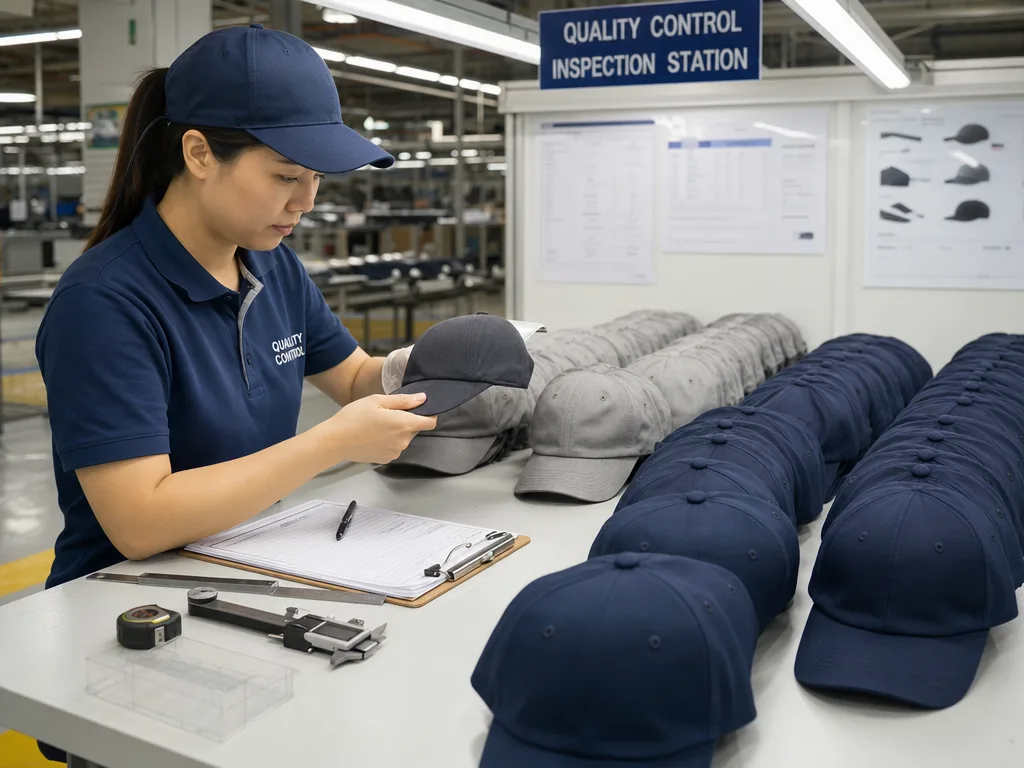
The real value of custom cap pp sample approval is not “seeing a nicer version” of the hat; it is freezing the exact production standard before the factory cuts bulk fabric. The PP sample should lock crown pattern, panel symmetry, visor curve, stitch density, logo placement, sweatband spec, closure type, and trim colors against a written tech pack with Pantone TCX references. I also insist on measuring critical dimensions: crown height, brim length, front panel width, and embroidery scale tolerance. If the sample only looks good on a desk but has no measurable spec sheet, you are not approving a production standard, you are approving a photo prop. A competent custom cap factory will also test whether the chosen fabric shrinks after steam, whether structured fronts hold shape after packing, and whether the buckle or snapback hardware matches the approved metal finish and tensile strength. The most common defects I see in cap pp sample approval are crooked center seams, off-register embroidery, loose thread tails, unbalanced visor stitching, wavy sweatbands, and color drift that is invisible on screen but obvious under a lightbox. A serious cap pp sample approval process includes inline checks for needle damage, embroidery backing, seam allowance consistency, and panel alignment before the sample is signed off. On the color side, use Delta-E targets, not guesswork; for production I usually want Delta-E under 1.5 for main body fabric and under 2.0 for contrast trims. If you are working with a private label hat supplier or headwear factory china, ask for the actual thread card, buckle sample, and fabric swatch lot number, because substitutions are where most rework starts. One wrong lot can shift the whole order, especially on washed cotton twill, pigment-dyed fabric, or contrast undervisor materials. To prevent late shipment, freeze the sample with a redline sheet that records every approved detail, then require a pre-production sample only if any material, machine setting, or decoration method changes. That matters at a custom hat manufacturer because a small adjustment like changing from 10,000 to 12,000 stitches on a front logo can alter puckering, needle breakage, and cycle time across a 5,000-piece order. Our standard practice is to treat approved PP samples as the reference for inline inspection and final AQL 2.5 checks, with rejection triggers for shade variation, misaligned labels, or oversized embroidery beyond tolerance. If the buyer signs off loosely, the factory may start bulk cutting with unresolved issues, and that is when you get carton hold-ups, relabeling, or air freight charges to recover a missed delivery window. Strong custom cap pp sample approval saves more money by eliminating rework than it costs in sampling.
Use a hard approval workflow: tech pack, physical swatches, stitched PP sample, signed spec sheet, and a dated approval email from the buyer. Without all five, the approval is weak and disputes become expensive once bulk starts. I have seen orders where the client approved the look but never approved the internal tape color, seam type, or label position, then demanded changes after 3,000 units were already in cutting. At that stage, the only choices are scrap, rework, or margin loss. A disciplined custom hat manufacturer will ask for confirmation on packaging, carton marks, barcode placement, and polybag suffocation warnings at the same time, because shipping compliance errors cause delays as often as sewing defects do. If you are sourcing from a private label hat supplier, make sure the PP sample includes the exact folding method and packing ratio; a good cap can still arrive crushed if the pack-out was never approved. For inspection, I check three layers: material, construction, and presentation. Material means fabric weight, interlining stiffness, sweatband GSM, visor board thickness, and print or embroidery color match. Construction means stitch count per inch, seam straightness, back opening symmetry, label placement, and whether the brim retains shape after a 24-hour rest. Presentation means cleanliness: no oil marks, no chalk lines, no loose lint, no skipped stitches, no broken needle holes, and no crooked hangtags. In a custom cap factory, the best way to reduce late shipment is to catch exceptions before bulk starts, not after the first carton is packed. If the factory has BSCI or Sedex SMETA exposure, ask them to show the same traceability discipline on your order: lot control, inspection records, and defect photos. That documentation is what lets you stop a bad run early instead of discovering 800 defective units at final packing.
The last thing buyers should freeze in custom cap pp sample approval is what happens when a defect is found. Define whether the factory must repair, remake, or seek written waiver, and set a response time of 24 to 48 hours for any deviation notice. If the hat sample passes visually but fails fit or wash testing, you need a decision tree before bulk production begins, not a phone argument during shipment week. I have lost less time with strict sample controls than with “flexible” approvals, because flexibility usually means the factory guesses and the buyer pays later. For streetwear runs, sports license jobs, and retail packs, that guesswork can also break consistency across repeat orders, which is why the PP sample must become the master reference for every reorder. If you want fewer surprises, require the headwear factory china to keep a retained approval sample, a trim master board, and a signed deviation log for the order. That gives QC a physical benchmark when bulk is running on multiple embroidery heads, especially with Tajima, Barudan, or ZSK machines where thread tension and operator setup can drift shift to shift. The most effective prevention is boring: lock the spec, control the materials, inspect early, and do not approve based on a pretty picture. A clear custom cap pp sample approval process protects delivery dates, reduces rework, and keeps the production line from making assumptions that the buyer later has to pay to fix.
MOQ, lead time, and cost drivers
MOQ is the first thing that changes your unit cost, and people routinely underestimate it. On a 300-piece run, setup time for crown cutting, visor board die-cutting, embroidery digitizing, and machine threading gets spread across too few caps, so your sewing and decoration overhead can add $0.80 to $2.50 per piece compared with a 1,000-piece order. A serious custom cap manufacturer will quote differently for 5-panel versus 6-panel, structured versus unstructured, and flat visor versus pre-curved, because each option changes labor minutes and trim consumption. For custom cap pp sample approval, I freeze the silhouette, panel count, stitch density, sweatband spec, and closure type first; if you let those float, the PP sample becomes a moving target and the cost model is meaningless.
Trim choices can swing the cost more than the fabric itself. A woven label is cheap at $0.05 to $0.12, but TPU patches, high-density embroidery, metal clamps, embossed vegan leather, and custom taping all add labor and rejection risk; a simple Velcro closure is faster than a matte black snapback with branded metal buckle and woven tab. From a headwear factory China perspective, the hidden cost is not the trim price alone but the handling: every extra component means another inbound check, another sewing operation, and more AQL 2.5 inspection points. CrownsForge’s standard practice is to lock the bill of materials at PP stage, because once the cap pp sample approval is signed, any trim change can move the line and force a partial rework on the first production lot.
Lead time is driven by critical-path items, not just sewing capacity. If your crown fabric is stock, sampling can be 5 to 7 days and production 20 to 30 days; if you need custom-dyed twill in a specific Pantone TCX with Delta-E under 2.0, add 10 to 15 days for lab dips and bulk approval. Labor steps matter too: chain stitching, sandwich visors, applique, 3D puff embroidery, and taped inner seams each add minutes per piece, and those minutes become real money when you are running a private label hat supplier order with mixed SKUs. If the factory has to hit BSCI or Sedex documentation, or run needle detection and carton drop testing, that also adds overhead that should be priced into the unit.
Shipping is the last place buyers get surprised. Carton configuration, polybagging, silica gel, insert cards, and master carton strength all affect dimensional weight, so a $0.35 packaging upgrade can become a $1.20 landed-cost problem once you move from FOB to DDP by air. For a custom cap factory, the smartest move is to freeze pack-out at PP sample approval: carton count, bag style, size sticker format, barcode placement, and whether caps are stuffed or flat-packed. That lets the factory calculate pallets, CBM, and freight class correctly, which matters more than people think when you are moving 3,000 to 10,000 caps. If those details are still open, the quote is not really a quote; it is a placeholder with risk hidden inside it.
How CrownsForge manages this order type
At CrownsForge, custom cap pp sample approval is treated as a production lock, not a casual green light. We freeze the critical variables first: crown block, panel shape, visor curve, stitch count, logo placement, thread color mapped to Pantone TCX, and the exact fabric lot or approved substitute. If a buyer signs off on a 6-panel structured cap in 260 gsm brushed cotton twill with a 7 cm pre-curved brim, that spec goes into the traveler exactly as approved; otherwise, small “harmless” changes become the reason a 5,000-piece order drifts off target. Our standard practice is to send physical PP samples with a photo sheet, measurement report, and trim card so procurement teams can compare needle count, seam allowance, sweatband width, and closure type without guessing.
As a custom hat manufacturer and private label hat supplier, we document the sample in a way that survives handoffs between sales, development, and production. The PP packet normally includes size spec, fabric composition, trim BOM, decoration file references, and QC checkpoints tied to AQL 2.5 for bulk inspection. For embroidery, we verify digitized files on Tajima, Barudan, or ZSK heads, because thread tension and fill density can change the hand feel even when the logo looks identical on screen. For buyers working with a headwear factory China team for the first time, I always recommend freezing the sample against three items: approved artwork, approved material swatches, and approved measurements. If one of those is missing, the order is not really frozen, and the first bulk lot usually proves it.
Communication after approval is mechanical and boring in the best way. We send the confirmed PP sample photos, final packing method, carton markings, and reorder code so the next run can be duplicated without revalidating every detail. On repeat orders, the biggest value is speed: if the buyer wants the same cap body and closure, we pull the archived BOM, match the previous fabric shade within Delta-E limits, and reuse the last approved embroidery program unless the logo has changed. For a custom cap factory, that kind of recordkeeping is what protects margin and delivery dates. It also makes dispute handling cleaner, because when a buyer asks why a re-order looks different, we can point to the signed PP file, the archived lab dip, and the inspection photos instead of arguing from memory.
Frequently Asked Questions
Can I order a sample before bulk production?
Yes. We strongly recommend approving a pre-production sample before mass production. Samples are charged at 35 to 60 USD each plus express shipping, fully refundable against confirmed bulk orders over 500 pieces.
How long does production take?
Sampling takes 7 to 12 days. Bulk production runs 20 to 30 days depending on quantity, fabric availability and decoration complexity. Inspection and packing adds another 3 to 5 days before shipment.
What logo decoration techniques do you offer?
3D puff embroidery, flat embroidery, woven patch, leather patch, PVC patch, screen printing, sublimation, applique and laser etching, all in-house with no subcontracting.
What is the minimum order quantity (MOQ) for custom hats?
Our standard MOQ is 100 pieces per design and color, with sampling available from 1 piece. For complex multi-color logos or premium fabric upgrades, the MOQ can be lowered with a small per-piece surcharge.
Do you support sustainability certifications?
Yes. We work with GOTS organic cotton, GRS-certified recycled polyester, OEKO-TEX Standard 100 fabrics, and are BSCI and Sedex audited. Certification documentation can be provided per order.
How do I find a reliable custom waterproof cap manufacturer?
When evaluating custom waterproof cap manufacturer, the key considerations are construction quality, decoration capability, MOQ flexibility and lead time. Explain custom cap pp sample approval in the context of a custom headwear RFQ, with the production details a buyer should verify before sampling. Cover dimensions, materials, tolerances, decoration files, carton requirements, AQL level, and the evidence a capable factory should provide.
How do I find a reliable custom hat manufacturer usa?
When evaluating custom hat manufacturer usa, the key considerations are construction quality, decoration capability, MOQ flexibility and lead time. Explain custom cap pp sample approval in the context of a custom headwear RFQ, with the production details a buyer should verify before sampling. Cover dimensions, materials, tolerances, decoration files, carton requirements, AQL level, and the evidence a capable factory should provide.
How does ordering custom made trucker hat work?
When evaluating custom made trucker hat, the key considerations are construction quality, decoration capability, MOQ flexibility and lead time. Explain custom cap pp sample approval in the context of a custom headwear RFQ, with the production details a buyer should verify before sampling. Cover dimensions, materials, tolerances, decoration files, carton requirements, AQL level, and the evidence a capable factory should provide.
What should buyers know about china cap?
When evaluating china cap, the key considerations are construction quality, decoration capability, MOQ flexibility and lead time. Explain custom cap pp sample approval in the context of a custom headwear RFQ, with the production details a buyer should verify before sampling. Cover dimensions, materials, tolerances, decoration files, carton requirements, AQL level, and the evidence a capable factory should provide.
Ready to start your custom hat project?
Send us your tech-pack, sketch or even just an inspiration photo. We will respond with a detailed quotation and digital mock-up within 24 hours.
Request a free quoteRelated guides
Custom Fitted Cap No Minimum: A 2026 B2B Sourcing Guide
Read article →
Cap Visor Curve Specification for Retail-Ready Headwear
Read article →
Cap Defect Catalog: 32 Production Issues to Inspect For
Read article →Sourcing custom hats does not have to be complicated. With the right manufacturing partner, clear specifications and a small upfront investment in sampling, you can launch a retail-quality product in 30 to 45 days.