
Country Hats For Men Reorder Planning Guide for Custom Hat Buyers
Country Hats For Men Reorder Planning Guide for Custom Hat Buyers is one of the most-asked questions we receive from international buyers, and for good reason. With dozens of factories competing for your order and an alphabet soup of technical terms in every supplier quote, even experienced importers can feel lost. This guide consolidates what we have learned producing custom hats for clients in 40+ countries.
Why country hats for men reorder planning guide needs a separate sourcing plan
A country hats for men reorder planning guide needs a separate sourcing plan because these programs behave less like one-off promo caps and more like seasonal retail replenishment. The buyer is usually not asking, “Can you make 500 hats?” They are asking whether the same Richardson-style trucker shape, rope color, sweatband feel, crown height, and embroidery density can be repeated after the first sell-through without visible batch drift. For country hats for men, small changes matter: a 5 mm shift in front panel height can make a patch look too low, and a fabric change from 260 gsm cotton twill to 220 gsm poly-cotton can make the cap feel cheaper immediately. Generic hat sourcing often chases the lowest unit price; reorder planning protects continuity, so the real decision is whether to lock fabric lots, thread colors, foam stiffness, patch molds, and carton marks before the first PO ships.
Cost and lead time move differently on reorders than on first production. Bulk custom trucker hats with existing digitizing, approved patterns, and stored trims can often save $0.20–$0.60 per piece versus a new development order, but only if the buyer does not change too many variables between drops. A 3D puff front logo on Tajima or Barudan heads may require the same underlay, foam height, and stitch count to keep the raised look consistent; changing from flat embroidery to woven patch or leatherette patch resets sampling time. For custom bulk trucker hats, I normally advise buyers to separate evergreen SKUs from experimental SKUs: keep black/white mesh, loden/khaki, navy/white, and camo stable, then test new colors in smaller runs. A clean reorder plan should reserve 25–35 days for production, 7–10 days for pre-production sample confirmation if materials change, and 18–32 days for ocean plus final-mile DDP depending on U.S. coast and warehouse location.
Compliance is another reason this category should not be treated like generic bulk custom embroidered hats. Country lifestyle brands often sell through boutiques, farm stores, outdoor retailers, rodeo events, and licensed team channels, so labeling, fiber content, restricted substances, and social compliance can become purchase-order requirements instead of optional paperwork. A custom hat manufacturer should confirm CPSIA relevance for youth sizes, Prop 65 risk for leatherette patches or metal buckles, azo-free dye declarations, nickel release where applicable, and audit status such as sedex-audit-cap-supplier-guide.html">BSCI 2.0 or Sedex SMETA 4-Pillar before repeat volume grows. Our standard practice at CrownsForge is to keep approved Pantone TCX references, Delta-E tolerances within 1.0–1.5 for critical fabrics, embroidery thread codes, AQL 2.5 inspection photos, and sealed samples tied to each reorder SKU. That documentation prevents the common factory-floor problem: the second shipment passes basic inspection, but the buyer rejects it because it no longer matches the hat their customers already bought.
Factory capability checks before quoting
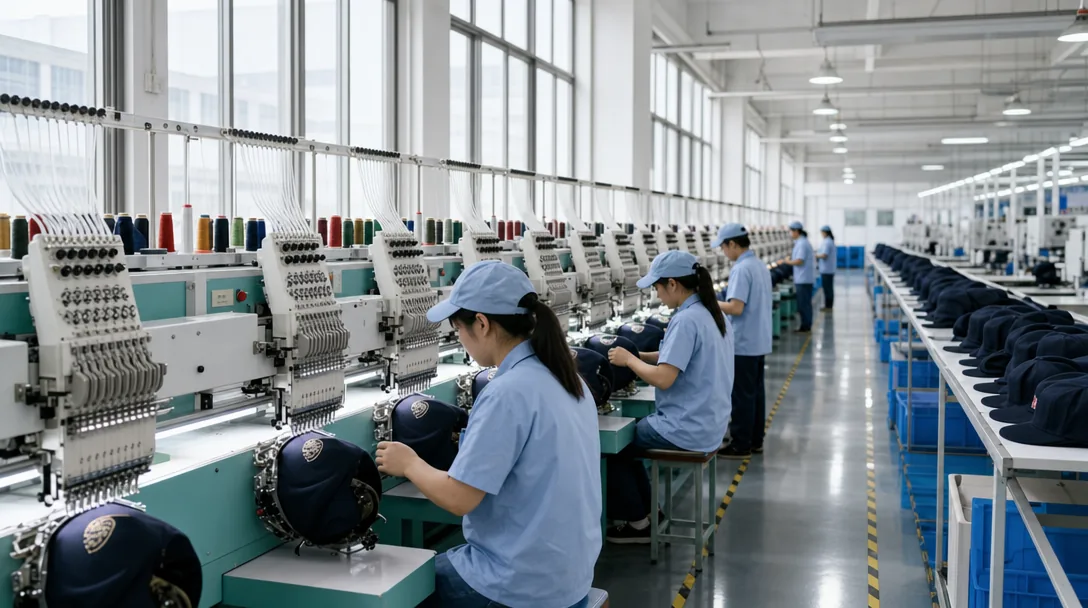
The first factory capability check is decoration capacity, because country hats for men often carry dense front logos, rope details, and patch programs that expose weak production control. Ask which machines run the work: Tajima, Barudan, and ZSK heads behave differently on foam-front truckers, brushed cotton twill, and 5-panel structured caps. For bulk custom embroidered hats, I want to see stitch-count limits, thread brand, backing type, and whether the digitizer can reduce a 14,000-stitch chest-style logo into a clean 6,000–8,500 stitch cap file without puckering. Patch capability should be equally specific: woven patches need edge-merrow control, leatherette patches need consistent laser depth, and PVC patches need mold tolerance of about ±0.3 mm. If a supplier only says “we can do all logos,” they are not ready for a reorder program.
Fabric and construction checks matter more than most buyers realize, especially for bulk custom trucker hats where repeat orders must match the first shipment. Confirm fabric source, gsm, Pantone TCX reference, and acceptable Delta-E, preferably under 1.5 for solid-color crown panels and under 2.0 for camouflage or heather fabrics. For country hats for men, common builds include 100% cotton twill at 220–260 gsm, polyester-cotton foam fronts, 5-panel rope caps, and 6-panel structured truckers with 100–120 denier mesh. Ask the factory to show panel cutting tolerances, buckram stiffness options, sweatband width, crown height, and whether they can hold visor curve consistency after steaming. Closure choices should be quoted separately: plastic snapback, brass buckle, Velcro, elastic Flexfit-style band, and metal clip all change labor, failure rate, and landed cost.
A serious country hats for men reorder planning guide should include sample room discipline and audit readiness before price negotiation. The sample room must handle pattern adjustment, embroidery strike-off, patch placement, color-card approval, and pre-production sample sealing in one controlled workflow, not by sending every change to a subcontractor. Our standard practice at CrownsForge is to lock a sealed PP sample with measurements, thread codes, panel fabric lot, closure spec, carton mark, and AQL 2.5 inspection checklist before mass cutting. For custom bulk trucker hats, communication speed is also a capability test: a reliable custom hat manufacturer should answer technical questions within 24 hours, provide photos from cutting, embroidery, sewing, shaping, and packing, and understand FOB Ningbo/Shanghai versus DDP delivery. Audit documents should be current, not “available later”; ask for BSCI 2.0, Sedex SMETA 4-Pillar, payroll records, fire drill logs, needle-control policy, and subcontractor disclosure before placing repeat seasonal volume.
MOQ, pricing and sample approval
MOQ should be planned by fabric, colorway, and decoration method, not just total hat quantity. For country hats for men, a practical factory MOQ is 144 pieces per color for standard cotton twill or polyester mesh truckers, 300 pieces per color when dyeing fabric to Pantone TCX, and 500–1,000 pieces when the buyer wants custom camo, waxed canvas, corduroy, or private-mold trims. Bulk custom trucker hats are usually cheapest in 600-piece bands because cutting loss, embroidery setup, and carton utilization start to normalize. As a working FOB Ningbo/Yiwu range, a 5-panel foam trucker with one flat embroidery may land around $3.20–$4.80 at 300 pieces, while a structured 6-panel cotton twill cap with raised embroidery, woven label, and custom back strap is more often $5.20–$7.80. DDP to the U.S. can add roughly $0.70–$1.60 per cap by sea depending on carton volume and final ZIP code.
Setup costs are where many reorder plans go wrong. Digitizing for bulk custom embroidered hats is normally $25–$60 per logo, but that does not include patch molds, woven label looms, or screen charges for under-visor prints. Raised 3D embroidery needs enough satin column width and foam clearance; if a buyer sends a thin cattle brand mark, we may need to convert 0.4 mm lines into 0.8–1.0 mm stitch-safe shapes before running on Tajima, Barudan, or ZSK heads. Stitch density should be checked in real production thread, not just on a PDF mockup: a front logo over 10,000 stitches can pucker lightweight 180 gsm cotton twill unless backing, needle size, and hoop tension are adjusted. Pantone matching also has limits. Thread cards match closer to Pantone Coated than TCX fabric books, and bulk fabric should be judged under D65 light with Delta-E under 1.5–2.0 for strict programs.
PPS approval is the buyer’s last cheap correction point, so treat it like a production gate, not a courtesy sample. A proper pre-production sample should confirm crown height, brim curve, seam taping, sweatband quality, embroidery placement tolerance, label wording, hangtag barcode, polybag warning, carton mark, and master carton pack ratio. Our standard practice at CrownsForge is to photograph the PPS beside the approved Pantone reference, measure key points in millimeters, and lock a signed approval sheet before bulk cutting. For a country hats for men reorder planning guide, I would budget 7–10 days for artwork cleanup and sampling, 3–5 days for PPS courier transit, 18–30 days for bulk production after approval, and 25–38 days for ocean DDP to the U.S. West or Midwest. A custom hat manufacturer can rush custom bulk trucker hats, but trims like leather patches, brass buckles, and printed inside taping often add 5–12 days if they are not pre-booked.
Quality inspection and shipping risk
The biggest reorder risk is not the sewing itself; it is accepting a shipment without a disciplined AQL gate. For country hats for men, I normally set final inspection at AQL 2.5 for major defects and AQL 4.0 for minor defects, with a tighter internal check on logo placement because crooked front embroidery is what customers notice first. Measure crown height, visor length, sweatband width, back strap length, and front panel symmetry against the approved pre-production sample, not against a vague tech pack. A realistic tolerance is ±5 mm on visor length, ±3 mm on crown height, and ±2 mm on embroidered patch placement. If the hat uses foam-front trucker construction, also check panel bubbling after steam shaping, because it can look fine at the machine but collapse in cartons after ocean transit.
Color and embroidery failures usually show up when buyers reorder bulk custom trucker hats from memory instead of documentation. Keep Pantone TCX or TPX references, fabric swatches, thread brand codes, and a Delta-E target on file; for dark cotton twill or washed canvas, I prefer Delta-E under 1.5 against the approved standard when possible, though garment-washed lots may need a signed tolerance band. Colorfastness should be tested for rubbing and perspiration, especially on black, olive, rust, and denim blue country hats for men, where sweatband staining can create claims. Embroidery inspection should include thread breaks, bird-nesting, puckering, skipped stitches, distorted small text, and loose backing. Tajima, Barudan, and ZSK heads all produce clean work when the digitizing is right, but a 3D puff logo on a 5-panel cap needs different underlay and density than flat embroidery on twill.
Shipping risk is controlled before the cartons leave the packing line. Carton markings should include PO number, style code, color, size breakdown if applicable, quantity, gross/net weight, carton number, and destination mark; for Amazon or retail DC delivery, barcode and carton label placement must match the routing guide. Our standard practice at CrownsForge is to photograph master cartons, inner polybags, hangtags, and carton marks during final inspection so reorder teams are not guessing six months later. FOB Yiwu/Ningbo works when the buyer has a strong forwarder and wants control over consolidation; DDP is cleaner for smaller custom bulk trucker hats orders but hides duties, remote-area fees, and customs timing inside one quote. A serious country hats for men reorder planning guide should archive the approved sample, BOM, digitized embroidery file, thread chart, carton specs, inspection report, and shipping documents for every run of bulk custom embroidered hats from the same custom hat manufacturer.
Buyer checklist for the next RFQ
The fastest RFQ is not the one with the longest story; it is the one with measurable specs. For a country hats for men reorder planning guide, send your previous PO, target reorder quantity by SKU, cap style, closure type, panel construction, and exact decoration method before asking for a firm quote. A useful line item reads like this: 5-panel foam trucker, high crown, 100% polyester front at 180 gsm, nylon mesh at 100 denier, snapback, 5,000 pcs, 3D embroidery front logo, woven side label, carton-packed 24 pcs inner / 144 pcs master. If you are buying bulk custom trucker hats or custom bulk trucker hats, separate the quote by colorway and size curve instead of giving one blended quantity. Factories cost thread changes, fabric dye lots, patch molds, and carton CBM separately; vague “assorted colors” pricing usually comes back padded by $0.15–$0.40 per cap.
Send production-ready artwork, not screenshots from Instagram. For embroidery, provide AI, EPS, or PDF vector files plus a previous DST file if the old run was acceptable; include stitch count, logo width in millimeters, thread brand preference such as Madeira or Isacord, and whether puff foam is 2 mm or 3 mm. For patches, specify woven, sublimated, PVC, leather, or embroidered edge, with Pantone TCX references and acceptable Delta-E tolerance, normally under 1.5 for brand-critical colors and under 2.0 for promotional work. Photos should include front, side, back, inside sweatband, label, closure, underbrim, and any known defect from the last shipment. A custom hat manufacturer can quote bulk custom embroidered hats more accurately when the buyer also shares target FOB Ningbo/Shanghai or DDP destination, requested Incoterms, hangtag/barcode rules, and whether the order must pass AQL 2.5 final inspection.
Before finalizing the RFQ, state the commercial boundaries that affect the production calendar: required in-hands date, approval sample deadline, tolerance on over/under shipment, packaging method, audit requirements, and payment terms. If the program needs BSCI 2.0 or Sedex SMETA 4-Pillar production, say it early because compliant sewing lines may add 3–7 days of queue time during peak season. Our standard practice at CrownsForge is to quote tooling, pre-production sample, bulk lead time, and freight as separate lines so the buyer can see where cost is actually moving. For country hats for men, also confirm whether the fit should follow a retail western/outdoor profile or a promotional giveaway profile; crown height, brim curve, and mesh stiffness change the perceived value more than most buyers expect. A complete country hats for men reorder planning guide should finish with approved sample photos, signed spec sheet, AQL checklist, and reorder trigger point based on weekly sell-through.
Working with CrownsForge
Reorder planning works only when the first production lot is treated as the control sample, not as a one-time job. At CrownsForge, we lock the approved country hats for men reorder planning guide program around a physical gold sample, a trim card, a stitch file archive, and a measurement spec with tolerances of ±3 mm on crown height, visor length, and sweatband width. For country hats for men, the most common reorder risk is not the front patch or embroidery; it is fabric drift between lots. We record cotton twill weight in gsm, mesh denier for trucker backs, Pantone TCX references for panels, and acceptable Delta-E limits, usually under 1.5 for dark colors and under 2.0 for heather or washed fabrics. If the buyer plans seasonal drops, we recommend approving two fabric alternatives before the first PO ships, because mills can change dye lots or discontinue mesh shades with little warning.
Sampling should prove repeatability before the buyer scales into bulk custom trucker hats or custom bulk trucker hats. A normal path is one digital mockup, one embroidery or patch strike-off, one full pre-production sample, then a size-run or color-run sample if the reorder will include multiple SKUs. Flat embroidery on Tajima or Barudan heads is stable for most western text and livestock graphics, but raised 3D puff needs wider satin columns, usually 4.5 mm or more, and fewer tight corners. Leather patches need a different approval logic: we confirm deboss depth, edge burn, adhesive compatibility, and stitch margin before bulk cutting. For bulk custom embroidered hats, we keep the digitized DST/EMB file, thread brand, backing type, and needle count in the job file so reorders do not get reinterpreted by a different operator six months later.
QC and export coordination need to be planned backward from the buyer’s selling season. For repeat orders, we still run incoming fabric checks, inline inspection after panel cutting, decoration inspection before assembly, and final AQL 2.5 inspection on major defects, with critical defects set at zero tolerance. Common fails on country hats include off-center patches over 2 mm, warped visors, loose mesh joins, oil marks near eyelets, and carton crushing from weak export packaging. A serious custom hat manufacturer should also align documentation early: PO, proforma invoice, carton marks, HS code, packing list, and any retail compliance files requested by the buyer’s warehouse. FOB Ningbo or Shanghai is usually cleanest for established importers; DDP works for smaller promotional resellers but needs realistic quoting because U.S. duty, customs clearance, and final-mile delivery can add $0.65 to $1.40 per cap depending on carton volume and destination zone.
Frequently Asked Questions
What is the minimum order quantity (MOQ) for custom hats?
Our standard MOQ is 100 pieces per design and color, with sampling available from 1 piece. For complex multi-color logos or premium fabric upgrades, the MOQ can be lowered with a small per-piece surcharge.
What logo decoration techniques do you offer?
3D puff embroidery, flat embroidery, woven patch, leather patch, PVC patch, screen printing, sublimation, applique and laser etching, all in-house with no subcontracting.
Can I order a sample before bulk production?
Yes. We strongly recommend approving a pre-production sample before mass production. Samples are charged at 35 to 60 USD each plus express shipping, fully refundable against confirmed bulk orders over 500 pieces.
What file format should I send for my logo?
Vector files (AI, EPS, PDF) are ideal. High-resolution PNG or JPG at 300 dpi on transparent background works as a fallback. Provide Pantone color references for accurate reproduction.
Which shipping methods do you support?
We support FOB, CIF and DDP shipping. Air express for samples and small orders, sea LCL for 100 to 500 pieces, sea FCL for 5,000+ pieces. Door-to-door DDP available for US, EU, UK, Canada and Australia.
How does ordering custom embroidered trucker hat work?
When evaluating custom embroidered trucker hat, the key considerations are construction quality, decoration capability, MOQ flexibility and lead time. Explain the buyer intent behind country hats for men reorder planning guide, when it differs from generic hat sourcing, and what decisions affect cost, lead time and compliance. Cover embroidery, patch, fabric, panel construction, closure options, sample room capability, audit readiness and communication checks.
What should I know about custom trucker hats bulk?
When evaluating custom trucker hats bulk, the key considerations are construction quality, decoration capability, MOQ flexibility and lead time. Explain the buyer intent behind country hats for men reorder planning guide, when it differs from generic hat sourcing, and what decisions affect cost, lead time and compliance. Describe how CrownsForge manages country hats for men reorder planning guide programs with sampling, decoration, QC and export coordination.
What's the MOQ for custom embroidered trucker hats no minimum?
When evaluating custom embroidered trucker hats no minimum, the key considerations are construction quality, decoration capability, MOQ flexibility and lead time. Explain the buyer intent behind country hats for men reorder planning guide, when it differs from generic hat sourcing, and what decisions affect cost, lead time and compliance. Describe how CrownsForge manages country hats for men reorder planning guide programs with sampling, decoration, QC and export coordination.
What should I know about custom rope hat wholesale bulk?
When evaluating custom rope hat wholesale bulk, the key considerations are construction quality, decoration capability, MOQ flexibility and lead time. Explain the buyer intent behind country hats for men reorder planning guide, when it differs from generic hat sourcing, and what decisions affect cost, lead time and compliance. Cover embroidery, patch, fabric, panel construction, closure options, sample room capability, audit readiness and communication checks.
Looking for a reliable hat manufacturer in China?
CrownsForge has produced custom hats for 800+ brands across 40 countries. From 100-piece launches to 100,000-piece retail programs, we deliver on time and on spec.
Get in touchRelated guides
5 Panel Camp Cap Wholesale: A 2026 B2B Sourcing Guide
Read article →
Pantone Color Matching for Custom Caps: A Manufacturer's Reference
Read article →
Fedora Hats For Men Export Shipping Checklist for Custom Hat Buyers
Read article →If you are ready to take the next step on country hats for men reorder planning guide for custom hat buyers, our team can put a tailored quotation and digital mock-up in your inbox within 24 hours. Send the inquiry form on our contact page or message us directly on WhatsApp.