
What's in a Cap Tech-Pack: A Specification Template for Buyers - Supplier Checklist - Cost & MOQ Breakdown
What's in a Cap Tech-Pack: A Specification Template for Buyers - Supplier Checklist - Cost & MOQ Breakdown is one of the most-asked questions we receive from international buyers, and for good reason. With dozens of factories competing for your order and an alphabet soup of technical terms in every supplier quote, even experienced importers can feel lost. This guide consolidates what we have learned producing custom hats for clients in 40+ countries.
Why a tech-pack saves you weeks of email back-and-forth
A proper cap tech pack template prevents the most expensive factory mistake: finding out the spec was wrong after the first sample is already sewn and embroidered. If you send only a sketch and a logo file, the supplier still has to guess crown height, panel count, visor curve, stitch density, sweatband width, closure type, and whether the front panel needs buckram or foam. Those guesses become real money fast. I have seen a buyer ask for a 100 mm front logo, only to get a 115 mm digitized file that runs into the front seam because nobody stated the placement tolerance. A clean headwear tech pack removes that ambiguity before cutting starts, which is why a competent factory can usually move from inquiry to sample in about 7 to 10 days instead of the 14 to 21 days that drag on when specs are incomplete.
The time savings come from fewer revision loops, not magic. Without a proper hat specification sheet, the first sample often comes back with the wrong crown structure, a visor that is 3 to 5 mm too flat, or fabric that matches the color chip but feels wrong because the gsm was never stated. Then you spend another round explaining what should have been specified once. A complete custom cap spec sheet gives the technician a usable target: panel map, seam allowance, embroidery placement, Pantone TCX references, closure hardware, sweatband width, label or wash requirements, and tolerances for key measurements like crown depth and brim length. In practice, that usually means one focused correction cycle instead of three or four email threads arguing over the same sample photos.
In production, the cap design specification becomes the control document, not the sales thread. Our standard practice is to treat the cap tech pack template as the source of truth because it keeps sampling, quoting, and bulk approval aligned. When the pack includes artwork files, measurement points, tolerances, and material callouts like cotton twill, polyester mesh, brushed chino, or 240 gsm crown fabric, the factory can price more accurately and build to the same standard the buyer approved. Miss those details and you get delayed quotations, avoidable re-sampling, and extra calls about things that should have been fixed on page one. For buyers comparing suppliers, that difference usually shows up as cleaner quotes, fewer sample disputes, and a shorter path to production approval.
The seven sections of a complete cap tech-pack
Packaging and labels are where vague specs become chargebacks, relabeling, and retail delays. The tech pack should define polybag thickness, insert card size, carton pack ratio, carton dimensions, barcode location, tissue paper, hangtag string, and whether the cap ships with a retail clip or desiccant pack. Labeling should cover woven label size, care label content, country-of-origin marking, fiber composition, and logo placement on the inside taping or sweatband. Our standard practice is to lock those items before the first pre-production sample, because changing them afterward usually adds one more approval round and 7 to 10 days. That is the practical value of a cap tech pack template: it turns the quote into a controlled BOM instead of a loose promise, and it cuts the back-and-forth that typically burns two to three weeks before bulk approval.
Buyers who want fewer surprises should treat the tech pack as the contract for sample approval, not a styling note. If the factory has to infer visor curvature, stitch density, closure type, label content, or packaging format, the result will be extra revisions and avoidable cost drift. A usable cap tech pack template also helps sourcing compare suppliers on the same basis, because the quote can be traced to measurable inputs: 260 gsm twill versus 230 gsm, 7,800 stitches versus 11,500, buckram versus non-fused front panels, woven patch versus flat embroidery. That level of detail is what keeps the factory from pricing assumptions into the order. It also gives production a clean line from approved sample to bulk run, which is where most headwear projects either stay controlled or start bleeding time.
Tech sketches: front, side, back, optional underbrim
A usable cap tech pack template starts with clean vector sketches at scale, not product photos or mood-board composites. Show front, side, back, and optional underbrim views like working drawings: panel count, seam placement, topstitch rows, eyelets, button, closure type, seam tape, contrast inserts, rope, and sweatband construction should be labeled directly on the art. Keep one scale across the page, ideally 1:1 for dimensioning or a stated reduction such as 1:2, so the pattern maker is not reverse-engineering proportions from a pretty image. If the sketch leaves room for interpretation, the factory will default to its standard build, which is how you end up with the wrong visor profile, a back opening that is too small, or a five-panel shape quoted like a six-panel. Material zones belong on the drawing too, because crown fabric, brim board, underbrim, and sweatband often use different specs and cost differently.
Measurement points need to live on the drawing, not buried in notes. In a working cap tech pack template, I expect crown depth, front panel height, brim length, brim curve, back opening width, strap length, and visor sandwich thickness marked with dimension lines and millimeters. For curved caps, state whether crown depth is taken along the center front seam to the back seam, and whether brim length is measured from the stitch line or the finished edge; those are not interchangeable and they change both fit and quotation. If the style uses a structured front, specify buckram weight, usually 180 to 220 gsm, because that changes how hard the front stands after sewing. If there is an underbrim print or color-blocking, call out the exact Pantone TCX or Pantone TPX reference so the sample room is not guessing from a monitor.
Factories do not need art direction; they need an unambiguous handoff that a technician can check against a ruler. A good hat specification sheet shows what changes from view to view: flat visor versus pre-curved visor, structured versus unstructured front, contrast underbrim, rope placement, or a different closure hardware set, with notes tied to the same sketch callouts used in the BOM. Our standard practice is to keep the sketch set dense and mechanically readable, then cross-check it against sample comments before quoting. That matters because one loose dimension can trigger a second round of embroidery digitizing on Tajima or Barudan heads, or force a new brim mold if the curvature was never specified. If the page cannot survive a factory QA review and a pattern-room trace, it is not ready for production pricing, no matter how polished it looks on screen.
Fabric and color spec: GSM, weave, Pantone references
A useful cap tech pack template does not say “premium cotton” or “good wool.” It names the shell by fiber content, yarn count if known, weave, finished weight, and finish: 100% cotton twill, 16x12 yarns, 3/1 left-hand twill, 260 gsm, enzyme-washed; or 70/30 wool-poly blend, 320 gsm, brushed, with a 4% shrinkage allowance after steam pressing. That level of specification matters because a 260 gsm twill behaves very differently from a 260 gsm canvas, and a brushed 320 gsm cloth changes crown recovery, brim stiffness, and how much bulk lands at the sweatband seam. The tech pack should also state hand feel, shrinkage tolerance, and any coating or wash that affects needle penetration, because embroidery on a resin-finished fabric and embroidery on a raw twill are not the same job on the machine.
Color must be controlled with physical references, not a screenshot or RGB file. In the cap tech pack template, use Pantone TCX for fabric targets, then attach a lab dip approval, strike-off, or mailed chip for any order above proto quantity; digital files drift too much once a mill starts dyeing on its own recipe. One Pantone code per fabric zone is usually enough, but call out whether the undervisor, sweatband, eyelets, top button, and closure hardware are meant to match, tone down, or contrast. If the buyer measures color, set a Delta-E target: under 2.0 for close-match work, and under 3.0 only for washed, heathered, pigment-dyed, or heavily textured materials. Without a sealed standard, “Navy 19-4035 TCX” is just a label, not a production control.
The clean version of this section separates fabric identity from color control and lists every material line item: shell fabric, contrast panels, undervisor, sweatband, seam tape, visor insert, and trim, each with gsm, construction, finish, and Pantone TCX reference where applicable. Heather yarn, melange, garment dye, acid wash, and pigment-dyed cloth need explicit callouts because they will not read the same under a daylight booth, under factory LEDs, or after a wash test. Our standard practice is to freeze the approved fabric card before bulk cutting and keep a sealed sample in the order file, because once production moves to another line or shift, that reference is what stops color disputes and fabric substitutions from turning into chargebacks.
Decoration spec: technique, placement, dimensions, color count
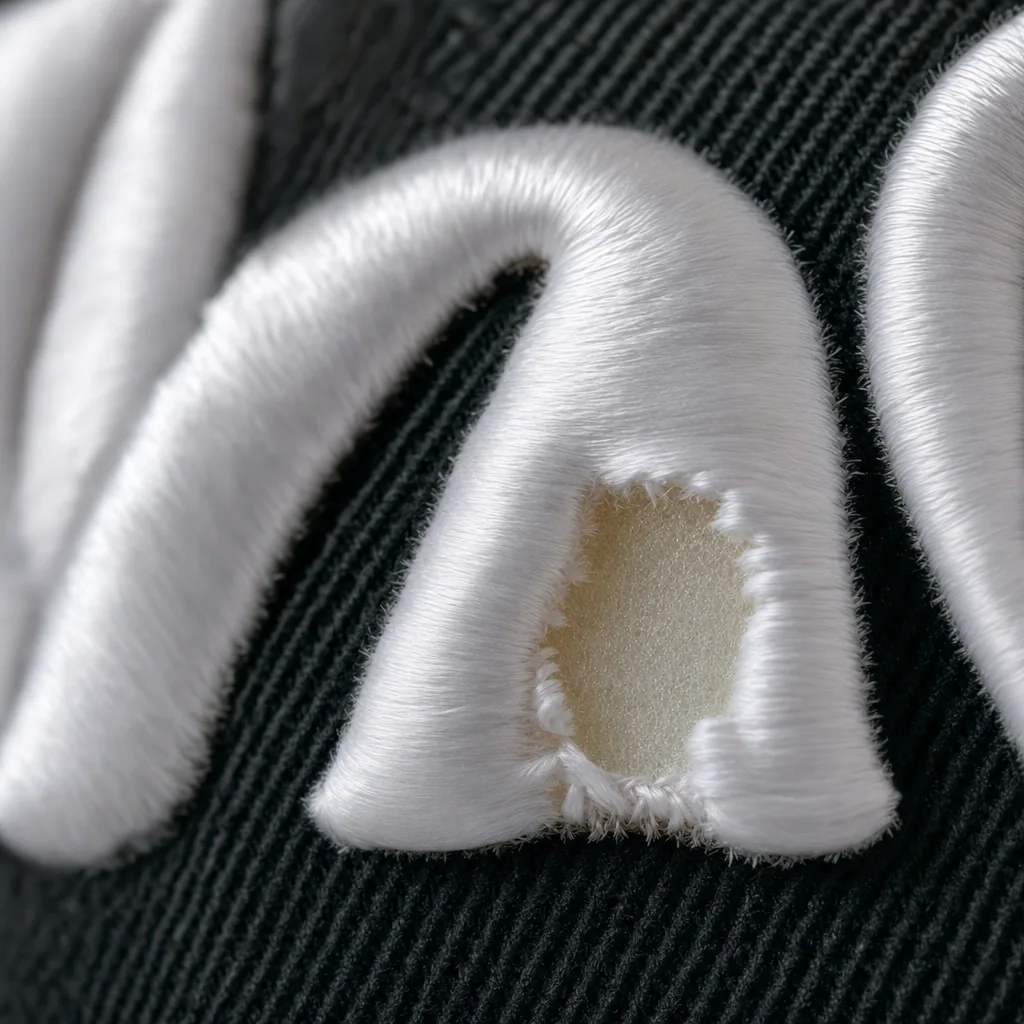
Decoration specs are where a cap tech pack template either becomes quoteable or turns into a guessing game. “Embroidered logo on front” is not a production spec. Name the decoration method first: flat embroidery, 3D puff, woven patch, PVC patch, appliqué, sublimation, or heat-transfer print. Then state where it goes in factory terms: front center, left or right side panel, rear arch above the closure, or under-brim if that is intentional. Give the finished artwork box in millimeters, not the casual on-screen logo size. A 60 x 30 mm mark and a 65 x 35 mm mark behave differently once digitized and pulled across a curved 6-panel crown, especially if the design crosses a seam and needs split hooping or re-sequenced stitching.
For embroidery, stitch count and thread count drive cost, hand-feel, and machine time. A clean flat front logo often lands around 6,000 to 9,000 stitches; 3D puff usually runs 9,000 to 14,000 depending on satin width, density, and underlay. The cap tech pack template should list every thread color with Pantone TCX or Pantone C references, plus whether the factory may match from stock rayon or polyester shades or must custom-dye thread. If you are using a patch, specify the base material and edge construction: twill, felt, woven jacquard, TPU, merrowed border, embroidered border, heat-cut edge, or laser-cut backing. That is the difference between a clean quote and a round of corrections after sampling.
Keep each logo variant separate instead of collapsing the whole cap into one decoration line. Front art might be 3D puff in two colors, the side mark flat embroidery at 20 mm high, and the rear slogan a single-color hit above the strap or buckle. If stitch count is not fixed, give a target visual density, maximum thread colors, and minimum readable letter height; below about 3 mm, small text usually degrades on Tajima, Barudan, or ZSK heads. A good cap tech pack template ties each callout to one approved vector file and one sample reference, so the supplier is not deciding scale, fill, or edge finish on the fly.
Packaging and label spec: polybag, hangtag, sticker, carton
Packaging belongs in the cap tech pack template with the same discipline as crown height or visor curve, because it affects labor, freight, and retail presentation. For the polybag, specify flat size in millimeters, film resin, thickness, and seal type instead of writing “clear bag.” A standard 5-panel or 6-panel cap usually fits a 220 x 280 mm or 240 x 300 mm LDPE bag at 25 to 30 microns; high-crown or foam-front truckers often need a deeper bag so the front panel does not crease in packing. If you want recycled content, call out rLDPE or PCR percentage, then define the recycle mark, print position, and ink color. On the factory side, we also note suffocation warning text, vent holes, and whether the bag needs a resealable flap, because those details change both compliance and pack-out speed.
Hangtags need the same control as the cap body. Put finished size, paper stock, GSM, coating, print method, and attachment method into the cap tech pack template instead of a vague note like “tag included.” A useful spec is 350 to 400 gsm C1S board with matte aqueous coating, 4/0 or 4/4 print, rounded corners, and a 3 mm hole for cotton string or a plastic fastener. If the tag carries a barcode, SKU, or country-of-origin statement, define the quiet zone and require scannability after lamination or spot UV. For stickers, state the placement on the brim, under-brim, or polybag, plus diameter, die-cut shape, and adhesive grade. If the sticker touches coated fabric, specify low-residue permanent adhesive; otherwise you get lift, curl, or glue transfer in transit.
Carton spec is where buyers lose money by writing only “export carton.” A proper cap tech pack template should state inner count, carton dimensions, gross weight target, carton grade, and shipping marks in full. Forty-eight pieces per carton works for soft unstructured caps, but structured truckers or foam-front styles often need 36 pieces to protect the crown and keep gross weight under 12 kg for easier handling. Add whether the carton is single-wall or double-wall, the flute grade, and the print color for carton marks, then list the exact fields required: style number, colorway, size run, PO number, carton number, and packing ratio if sizes are mixed. If palletization is required for DDP or warehouse delivery, specify pallet size, layer count, and stretch-wrap standard. That is what makes supplier quotes comparable instead of guesswork.
Frequently Asked Questions
What file format should I send for my logo?
Vector files (AI, EPS, PDF) are ideal. High-resolution PNG or JPG at 300 dpi on transparent background works as a fallback. Provide Pantone color references for accurate reproduction.
How long does production take?
Sampling takes 7 to 12 days. Bulk production runs 20 to 30 days depending on quantity, fabric availability and decoration complexity. Inspection and packing adds another 3 to 5 days before shipment.
Can I order a sample before bulk production?
Yes. We strongly recommend approving a pre-production sample before mass production. Samples are charged at 35 to 60 USD each plus express shipping, fully refundable against confirmed bulk orders over 500 pieces.
What is the minimum order quantity (MOQ) for custom hats?
Our standard MOQ is 100 pieces per design and color, with sampling available from 1 piece. For complex multi-color logos or premium fabric upgrades, the MOQ can be lowered with a small per-piece surcharge.
Which shipping methods do you support?
We support FOB, CIF and DDP shipping. Air express for samples and small orders, sea LCL for 100 to 500 pieces, sea FCL for 5,000+ pieces. Door-to-door DDP available for US, EU, UK, Canada and Australia.
How does ordering custom patch trucker hat work?
When evaluating custom patch trucker hat, the key considerations are construction quality, decoration capability, MOQ flexibility and lead time. Technique (3D puff / flat embroidery / patch), placement (front center, side, back), dimensions (e.g. 5cm wide × 3cm tall), stitch count if known, color count and Pantone references. Without a tech-pack, your factory invents details that contradict your assumptions. With one, sampling lead time drops from 14 days to 7 and revision rounds drop from 4 to 1.
How does ordering baseball cap custom work?
When evaluating baseball cap custom, the key considerations are construction quality, decoration capability, MOQ flexibility and lead time. Without a tech-pack, your factory invents details that contradict your assumptions. With one, sampling lead time drops from 14 days to 7 and revision rounds drop from 4 to 1. Tech sketches, fabric spec, color spec, decoration spec, construction spec (panels, closure, eyelets, sweatband), packaging spec, label/hangtag spec.
How does ordering custom baseball cap motorcycle helmet work?
When evaluating custom baseball cap motorcycle helmet, the key considerations are construction quality, decoration capability, MOQ flexibility and lead time. Without a tech-pack, your factory invents details that contradict your assumptions. With one, sampling lead time drops from 14 days to 7 and revision rounds drop from 4 to 1. Tech sketches, fabric spec, color spec, decoration spec, construction spec (panels, closure, eyelets, sweatband), packaging spec, label/hangtag spec.
How does ordering custom bucket hat embroidered work?
When evaluating custom bucket hat embroidered, the key considerations are construction quality, decoration capability, MOQ flexibility and lead time. Without a tech-pack, your factory invents details that contradict your assumptions. With one, sampling lead time drops from 14 days to 7 and revision rounds drop from 4 to 1. Tech sketches, fabric spec, color spec, decoration spec, construction spec (panels, closure, eyelets, sweatband), packaging spec, label/hangtag spec.
What should be included in a techpack?
A tech-pack generally includes flat sketches, CADs (computer aided designs), colour-ways, sizing information, reference images, labelling and packing information, as well as a bill of materials. Some designers will include more information within their standard tech-pack service, but the above should be a bare minimum.
Ready to start your custom hat project?
Send us your tech-pack, sketch or even just an inspiration photo. We will respond with a detailed quotation and digital mock-up within 24 hours.
Request a free quoteRelated guides
Custom Made Trucker Hat: The 2026 Sourcing & Manufacturing Playbook (2026 Update) - Cost & MOQ Breakdown
Read article →
Blank Hats MOQ And Pricing Plan for Custom Hat Buyers
Read article →Ball Caps for Women: A 2026 Sourcing Playbook for International Buyers
Read article →If you are ready to take the next step on what's in a cap tech-pack: a specification template for buyers - supplier checklist - cost & moq breakdown, our team can put a tailored quotation and digital mock-up in your inbox within 24 hours. Send the inquiry form on our contact page or message us directly on WhatsApp.