
Buckram vs Foam vs Unstructured: Cap Crown Construction Compared (2026 Update)
For brand owners, wholesalers and procurement teams entering the custom headwear category, buckram vs foam vs unstructured: cap crown construction compared (2026 update) is one of the highest-leverage decisions you will make. Get it right and your unit economics, retail story and reorder cycle all improve. Get it wrong and you carry the cost for years.
What buckram is and why it matters
Buckram is the hidden interlining that makes a cap look structured instead of slouchy. On the factory floor, it is usually a polyester scrim with a thermoplastic resin coating, die-cut and fused behind the two front crown panels at roughly 125 to 145°C for 8 to 14 seconds, depending on shell fabric and press pressure. That layer sets the front rise, locks the center seam into shape, and helps the crown recover after export packing. When buyers evaluate buckram cap construction, the real question is shape retention: will the cap still hold a clean forehead line after embroidery, carton compression, and weeks on a retail shelf. If the buckram is too light, badly fused, or mismatched to the shell, you see it fast—puckering at the center seam, collapse above the sweatband, and a crown that already looks worn before sell-through starts.
Thickness matters, but pairing matters more. Most workable buckram for caps falls in the 0.40 to 0.70 mm range. Lighter 0.40 to 0.45 mm grades suit mid-profile athletic caps in 180 to 220 gsm cotton twill or performance poly, while 0.60 to 0.70 mm is more common for high-profile promo, licensed team product, and shelf-display programs that need a harder hand. Go too stiff behind a lighter shell and the panel turns boardy, with seam stress whitening and an unnatural break at the fold; go too soft under dense 3D embroidery and the logo sinks after packing. Good buckram cap construction gives Tajima, Barudan, or ZSK heads a flatter sewing field, reduces flagging, and keeps 3 to 4 mm satin text readable at commercial densities around 0.35 to 0.40 mm stitch spacing.
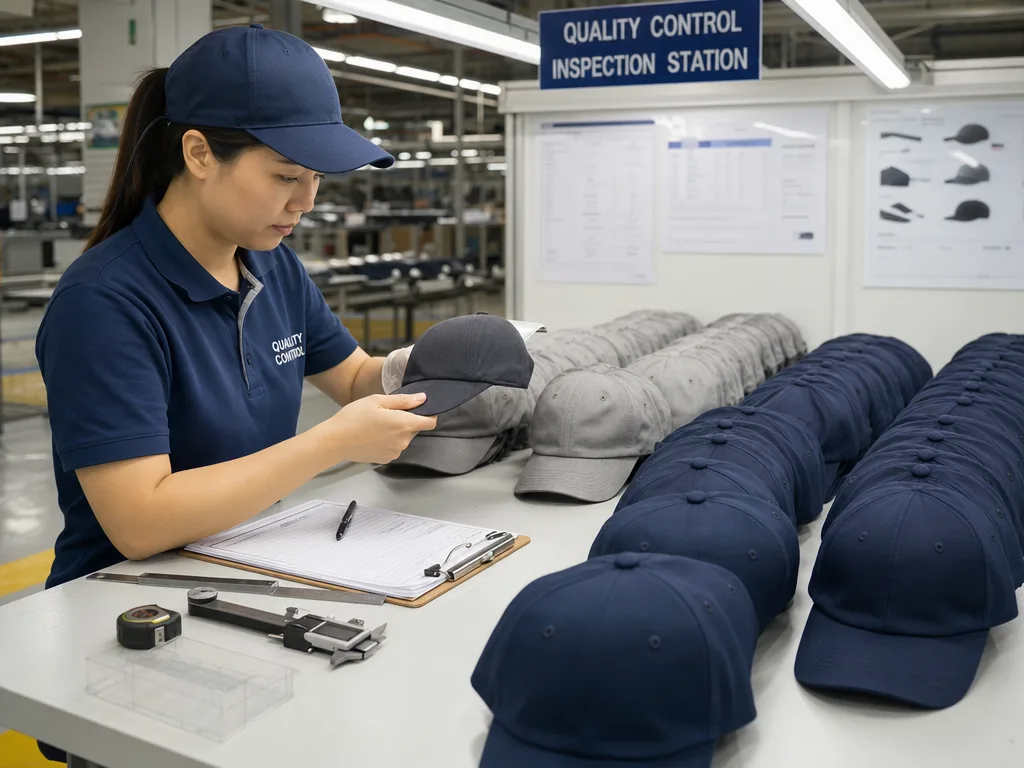
Resin quality is where cheap buckram usually fails. A low-grade adhesive can pass inline inspection, then bubble or delaminate after container temperatures climb past 50°C or after humid storage above roughly 70% RH. Uneven coating also causes inconsistent fusing from left to right panel, which leads to center-seam torque, variable crown height, and lot-to-lot shape drift that no final steaming can fully hide. Polyester buckram is the modern default because it handles moisture, repeated flexing, and transit better than cotton versions; cotton buckram still shows up in heritage programs where buyers want a softer break and less synthetic hand. At CrownsForge, standard QC is to check fused panels for hand feel, edge cut integrity, post-press smoothness, and shade consistency lot by lot, because structured crowns fail in transit long before they fail at sewing if those basics are ignored.
Foam-front construction (trucker caps)
Foam-front trucker caps hold a tall, flat advertising face because the structure comes from laminated foam, not classic buckram cap construction. In factory terms, the front two panels are usually backed with 3-5 mm closed-cell EVA or PE foam, then joined to a high-profile crown that lands around 11.5-12.5 cm from visor seam to top button on an adult OSFM shape. That build stands up fast after sewing and recovers better from light packing pressure than woven buckram, which tends to take a softer curve unless the base cloth and fusing are very firm. On most bulk orders, 3 mm remains the practical standard because it die-cuts cleaner, feeds more consistently at the sewing station, and keeps cost under control; at 5,000 pieces, stepping up from 3 mm to 5 mm foam usually increases FOB by about $0.06-$0.12 per cap. The visual difference is real: 5 mm gives a more aggressive front wall, sharper top corners, and a more obvious retail silhouette, but it also telegraphs crush damage faster if cartons are overloaded or packed without enough crown support.
Decoration is where foam-front construction clearly separates itself from both buckram and unstructured crowns. A properly laminated 5 mm front panel gives embroidery extra loft, which is why trucker programs often carry 3D puff so well; with clean digitizing, a satin column over 2-3 mm EVA puff underlay can create about 4-6 mm of apparent rise. The downside is that foam magnifies bad embroidery settings. On Tajima or Barudan heads, too much density can tunnel the foam, split the face fabric, or leave visible needle cuts and heat shine, especially on polyester twill or interlock around 180-220 gsm. In production, puff zones are usually safer around 0.38-0.42 mm stitch spacing, but that number means nothing unless the actual laminated panel is test-sewn, because two suppliers can both quote 5 mm foam and deliver very different density and rebound. For retail-grade truckers, I would specify foam density at 35-45 kg/m3, front-height tolerance within +/-3 mm, and AQL 2.5 checks focused on panel symmetry, lamination wrinkles, and top-corner creasing; uneven lamination is one of the fastest ways to make a foam-front cap look cheap.
Unstructured construction (dad hats)
Unstructured dad hats work because the front crown is deliberately left unsupported: no buckram cap construction, no EVA foam lamination, and usually no fusible interlining behind the two front panels. On the sewing line, that means crown memory comes almost entirely from the shell fabric, top button tension, and the 25 to 32 mm sweatband seam, so the shape relaxes as soon as the cap comes off-head. That collapse is not a defect; it is the product. Buyers who want the soft, broken-in profile should spec fabrics with natural drape and recovery—brushed cotton twill at 180 to 240 gsm, washed chino at 7 to 9 oz, nylon taslan at 110 to 160 gsm, or 14 to 21 wale corduroy. Try the same pattern in 10 oz canvas, heavy acrylic blend, or rigid poly-cotton drill and the front panels often telegraph center-seam drag lines, a hard visor hinge, and uneven panel roll after washing or packing compression.
The cost difference is real but modest. Removing buckram cap construction and the fusing step usually saves about $0.08 to $0.20 per cap at 5,000 units, depending on whether the structured version used single buckram, laminated buckram, or foam-backed reinforcement. The bigger operational win is fewer process variables: one less cut component, no heat-press distortion, and fewer rejects for bubbling, delamination, or mismatched handfeel after enzyme wash or garment wash. Decoration is where unstructured crowns punish bad specs. On Tajima or Barudan heads, front embroidery usually needs lower fill density, lighter underlay, and tighter control of stitch count—especially within 15 to 20 mm of the center seam. A soft dad hat can carry clean flat embroidery, a woven label, or a thin patch under about 1.2 mm; it will not hold sharp 3D puff, thick TPU badges, or heavy merrowed emblems with the edge definition buyers expect from a structured crown.
How crown construction interacts with decoration
Decoration quality is set by the crown architecture before the first needle strike. In buckram cap construction, the front panel is reinforced with a resin-finished woven interlining—typically cotton or poly-cotton buckram around 160-220 gsm—which keeps the sew field flat under Tajima, Barudan, or ZSK embroidery heads. That stability becomes decisive when artwork moves past basic flat embroidery: logos above roughly 8,000 stitches, satin columns wider than 4 mm, high-density fills, or 3D puff using 2-3 mm EVA all punish a weak front immediately. A properly supported crown holds registration through color changes, limits needle deflection, and reduces tunneling or edge lift on wide fills. On the inspection table, that translates into sharper borders, less post-steam rippling, and fewer front-panel twist rejects when the lot is checked to AQL 2.5. Buckram is not inherently “better” decoration-wise; it is better when the design needs a stable platform that will survive sewing tension, finishing heat, and carton pressure without losing shape.
Foam fronts solve a different decoration problem. Most trucker builds use 2-4 mm EVA or polyurethane foam laminated to polyester tricot, giving the crown more loft, more face height, and more rebound under the needle. That makes foam ideal for oversized sports marks, bold chain fills, and high-profile 3D embroidery, but standard flat embroidery has to be digitized more carefully; small text below about 5 mm cap height or dense underlay can close up once the panel rebounds and the cap is compressed in packing. Foam also performs well for sublimation and heat transfer because the print surface is integrated into the panel; on white polyester foam, a realistic target is Delta-E under 1.5 against the approved Pantone reference. Unstructured crowns sit at the opposite end: with no internal scaffold, washed cotton twill at 180-260 gsm, canvas, or taslon will telegraph every pull from the thread path. On those bodies, a 4,000-6,000 stitch tonal logo, woven patch, or thin leather label usually outperforms a dense 10,000-stitch crest. The rule on the factory floor is straightforward: use buckram cap construction for crisp, high-definition logos; use foam for height and printability; use unstructured only when the silhouette matters more than aggressive decoration.
Per-piece cost differential by construction
The real cost spread shows up in labor control more than in the raw insert. On a 1,000-piece FOB order for a standard 6-panel cap in 240 gsm brushed cotton twill, buckram cap construction typically lands at $2.85 to $3.35 per piece using 0.35 to 0.45 mm PE-coated buckram on the front two panels, fused tricot backing, a 6 mm polyester sweatband, woven size tape, and either a PP snap or self-fabric tuck strap with brass slider. The buckram sheet itself may add only $0.04 to $0.07 per cap, but fusing, front-panel cooling, crown pressing, and tighter panel alignment before topstitch add measurable minutes and rejection risk. Once you run a 7,000 to 10,000 stitch logo on Tajima or Barudan heads, the structured front must hold crown height and seam centerline more consistently, or you start seeing torque, needle deflection, and visible seam drift after embroidery.
Foam-front truckers usually price $0.15 to $0.28 below a like-for-like structured twill cap because the back four panels switch to polyester mesh in the 100 to 140 gsm range and the assembly SAM drops. A 3 to 5 mm EVA or PU foam front still creates factory-floor issues—hoop marks, heat shine, compression lines after carton loading, and occasional puckering if the underbill stitch tension is too high—but total handling is usually lighter than with a buckram-supported crown. In our standard practice, unstructured caps deliver the biggest material-and-labor savings: remove buckram and fusing, use washed chino, enzyme-washed cotton twill, or light canvas at 180 to 220 gsm, and the same 1,000-piece program often comes in $0.22 to $0.42 below the structured version with identical closure and trim. That gap widens fast when the structured cap also carries high-density embroidery, Pantone TCX-matched labels, or tighter visual standards such as front-panel symmetry and crown height tolerance within +/- 3 mm under AQL 2.5 inspection.
Durability and wash characteristics
Wash durability is where bad front support gets exposed fast. In proper buckram cap construction, the front two panels are backed with resin-finished cotton or poly-cotton buckram, usually 180-220 gsm, then locked in before the sweatband closes the crown. When the mill finish and binder chemistry are right, the crown profile will usually hold through 25-30 gentle hand-wash cycles with only moderate softening at the pinch. The weak point is almost never the front seam; it is the resin package. Low-cost polyester buckram at 120-150 gsm, common in promo-grade caps under about $2.20 FOB China, starts to relax after 10-15 washes. The first symptoms are predictable: center-front pinch goes soft, the A-frame break rounds off, and the panel above the eyelets begins to cave. Buyers who care about consistent crown height should ask for buckram gsm, fiber blend, and whether the factory is using a water-based or solvent-based binder instead of accepting a vague “structured” claim.
Foam fronts keep shape by thickness rather than resin retention. Most use 3-5 mm PU or EVA foam laminated to tricot, so in cold-water washing they can outlast cheap buckram visually, especially on trucker styles. Heat is the real failure mode. One machine-dry cycle above roughly 60°C can warp the front panel, shrink the tricot backing, or trigger delamination near the seam tape and top stitch. Dense embroidery makes the problem worse: on Tajima or Barudan heads, fill areas run too tight can compress foam unevenly and leave visible logo telegraphing or wash-out puckering after care tests. Unstructured crowns behave differently again. In enzyme-washed chino, brushed cotton twill, or light canvas at 180-260 gsm, post-wash softness is expected, not a defect. The correct standard is balanced recovery, clean seam memory, minimal brim torque, and controlled shade change—typically Delta-E under 1.5 after wash testing—not whether the cap stands up like buckram cap construction.
Frequently Asked Questions
What file format should I send for my logo?
Vector files (AI, EPS, PDF) are ideal. High-resolution PNG or JPG at 300 dpi on transparent background works as a fallback. Provide Pantone color references for accurate reproduction.
What logo decoration techniques do you offer?
3D puff embroidery, flat embroidery, woven patch, leather patch, PVC patch, screen printing, sublimation, applique and laser etching, all in-house with no subcontracting.
Which shipping methods do you support?
We support FOB, CIF and DDP shipping. Air express for samples and small orders, sea LCL for 100 to 500 pieces, sea FCL for 5,000+ pieces. Door-to-door DDP available for US, EU, UK, Canada and Australia.
How long does production take?
Sampling takes 7 to 12 days. Bulk production runs 20 to 30 days depending on quantity, fabric availability and decoration complexity. Inspection and packing adds another 3 to 5 days before shipment.
Do you support sustainability certifications?
Yes. We work with GOTS organic cotton, GRS-certified recycled polyester, OEKO-TEX Standard 100 fabrics, and are BSCI and Sedex audited. Certification documentation can be provided per order.
How does ordering baseball cap custom logo work?
When evaluating baseball cap custom logo, the key considerations are construction quality, decoration capability, MOQ flexibility and lead time. Buckram-structured 6-panel: baseline cost. Foam-front trucker: -$0.15 to -$0.30 per cap (cheaper foam + cheaper mesh back). Unstructured dad hat: -$0.20 to -$0.40 per cap (no buckram, no fusing). Construction is a meaningful cost lever for buyers comparing $3 retail-grade vs $5 streetwear-grade. Buckram is a stiff woven fabric impregnated with adhesive, fused to the inside…
What should buyers know about cotton twill baseball cap?
When evaluating cotton twill baseball cap, the key considerations are construction quality, decoration capability, MOQ flexibility and lead time. Buckram is a stiff woven fabric impregnated with adhesive, fused to the inside of front panels to maintain the crown's structured shape. Polyester buckram is the modern standard; cotton buckram still appears in heritage/retail brands. Buckram thickness ranges 0.4-0.7 mm; thicker = stiffer = more retail-grade feel. Buckram-structured 6-panel: baseline cost. Foam-front…
What should buyers know about nike heritage cotton twill cap?
When evaluating nike heritage cotton twill cap, the key considerations are construction quality, decoration capability, MOQ flexibility and lead time. Buckram is a stiff woven fabric impregnated with adhesive, fused to the inside of front panels to maintain the crown's structured shape. Polyester buckram is the modern standard; cotton buckram still appears in heritage/retail brands. Buckram thickness ranges 0.4-0.7 mm; thicker = stiffer = more retail-grade feel. Buckram-structured 6-panel: baseline cost. Foam-front…
What should buyers know about vintage washed baseball cap?
When evaluating vintage washed baseball cap, the key considerations are construction quality, decoration capability, MOQ flexibility and lead time. Buckram-structured 6-panel: baseline cost. Foam-front trucker: -$0.15 to -$0.30 per cap (cheaper foam + cheaper mesh back). Unstructured dad hat: -$0.20 to -$0.40 per cap (no buckram, no fusing). Construction is a meaningful cost lever for buyers comparing $3 retail-grade vs $5 streetwear-grade. Buckram is a stiff woven fabric impregnated with adhesive, fused to the inside…
What is a buckram on a cap?
Buckram is the stiff material or fabric behind a hat's front panels that provides shape and structure. The buckram helps to ensure the hat holds its shape over time and maintains a sleek appearance.
Need a low-MOQ test order?
We help emerging brands launch with as few as 100 pieces. Premium fabric, in-house embroidery, retail-ready packaging.
Start a small orderRelated guides
BSCI vs Sedex vs WRAP vs WCA: Compliance Audit Standards Compared (2026 Update)
Read article →
Primark Bucket Hat: A Vertical-Specific Sourcing Guide
Read article →
Custom Hat Embroidery: The 2026 Sourcing & Manufacturing Playbook - Supplier Checklist
Read article →We hope this guide demystifies buckram vs foam vs unstructured: cap crown construction compared (2026 update) and helps you move forward with confidence. If you have questions specific to your project, our English-speaking sales engineers are one message away.