
Bucket Hat Corduroy Decoration QC Checklist for Custom Hat Buyers
Every week, our sales team answers detailed questions about bucket hat corduroy decoration qc checklist for custom hat buyers. We wrote this guide so that wholesalers, streetwear brands, corporate buyers and promotional resellers can compare options with full information, and avoid the traps that show up only after production has started.
Why bucket hat corduroy decoration qc checklist needs a separate sourcing plan
Cost, lead time, and compliance decisions should be made together, not after the sample is approved. Organic cotton hat programs need transaction certificates, GOTS or OCS scope confirmation, and segregated cutting records; those controls can add 5–12% to fabric cost and one week to document review. A normal bucket hat corduroy order at 500–1,000 pcs may land around US$3.20–5.80 FOB depending on lining, sweatband, embroidery stitch count, and wash process, while heavy applique or garment wash can push it above US$6.50. QC should include AQL 2.5 major / 4.0 minor inspection, carton drop testing for DDP shipments, nickel-free metal trims if used, and sedex-audit-cap-supplier-guide.html">BSCI 2.0 or Sedex SMETA 4-Pillar factory eligibility for retail buyers. The same buyer who sources cotton beanie men for winter promos may accept simple fabric checks, but corduroy bucket programs need earlier decisions because decoration defects cannot be repaired cleanly after assembly.
Factory capability checks before quoting
A quote is only useful if the factory has the decoration equipment to match the corduroy pile, not just a low FOB number. For a bucket hat corduroy decoration qc checklist, I first ask what machines will actually run the logo: Tajima, Barudan, or ZSK heads, needle count, maximum hoop area, and whether they have experience reducing stitch density on 8-wale or 11-wale corduroy. Dense satin columns that look fine on twill will crush the ribs and create shiny pressure marks on a corduroy bucket hat. For embroidery, request a stitch simulation, thread chart, backing spec, and one physical sew-out before approving bulk. For patches, check whether they can handle woven labels, felt appliqué, TPU, faux leather, silicone, and chenille without edge curling after pressing. Heat press settings matter: 130–150°C for 10–15 seconds may be safe for some cotton corduroy, but too much dwell time can flatten the nap permanently.
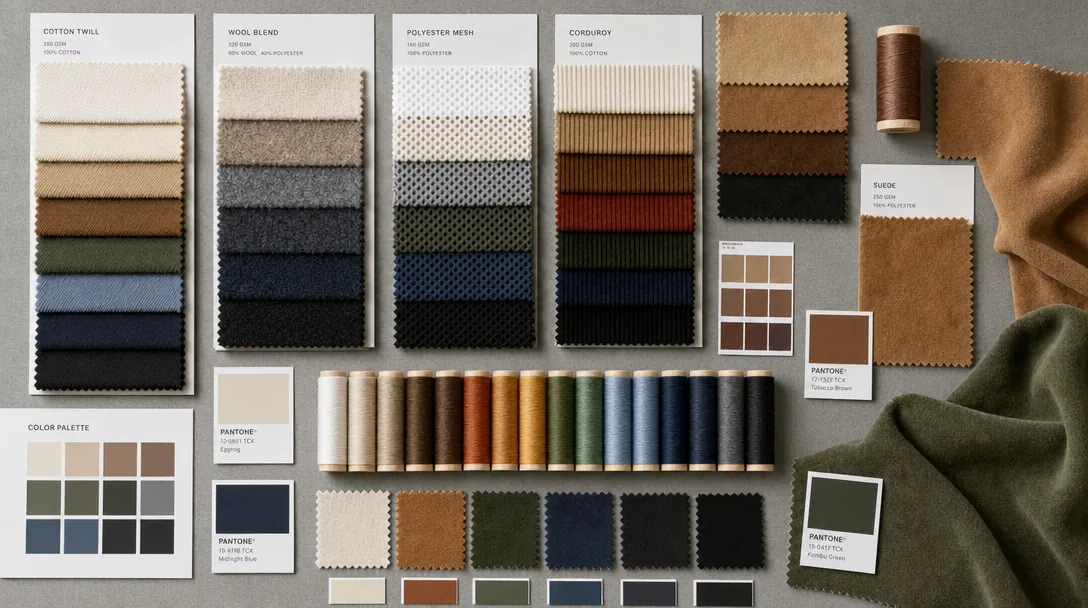
Fabric capability should be verified before artwork pricing, especially if the buyer wants a premium bucket hat corduroy look rather than a promotional giveaway. Ask for wale count, fabric weight in gsm, composition, shrinkage test data, and available Pantone TCX lab dips under D65 lighting. A brown shade is risky: a corduroy hat brown can shift red or green between dye lots, so I normally set Delta-E under 1.5 for repeat orders and under 2.0 for first development. If the project claims organic cotton hat positioning, require GOTS or OCS transaction documents, not just a hangtag promise. Panel construction also needs factory proof: bucket hats usually need consistent crown height, brim width tolerance within ±3 mm, clean bias binding, and seam allowance control so the ribs line up instead of twisting around the crown. Closure options are limited compared with baseball caps, but chin cords, toggle stoppers, sweatband material, reversible construction, and hidden size tape all affect sewing time and reject rates.
The sample room tells you more than the sales deck. A serious factory should be able to make a fit sample, decoration sample, pre-production sample, and sealed gold sample, then explain what changed between each round. Our standard practice at CrownsForge is to keep approved fabric swatches, thread cones, patch masters, and measurement specs together so QC can inspect against the same reference during inline and final checks. Audit readiness is also part of capability: ask for current BSCI 2.0 or Sedex SMETA 4-Pillar reports, needle control procedure, metal detection records, and subcontractor disclosure for dyeing, embroidery, washing, or patch production. Communication is the last filter in a bucket hat corduroy decoration qc checklist. If the merchandiser cannot answer whether cotton beanie men samples are made in the same sewing line as bucket hats, or cannot provide AQL 2.5 inspection photos by defect category, expect delays once bulk problems appear.
MOQ, pricing and sample approval
MOQ is where most custom hat buyers misread corduroy economics. For a bucket hat corduroy program, 300 pcs per color is usually the practical floor if you want stable fabric shade, clean cutting yield, and a factory that will take decoration QC seriously. At 300–499 pcs, expect higher unit prices because embroidery setup, pattern grading, and trim sourcing are spread over fewer hats; a basic corduroy bucket hat with one front embroidery often lands around US$4.80–6.20 FOB Ningbo/Shanghai. At 500–999 pcs, pricing may drop to US$4.10–5.40, while 1,000+ pcs can reach US$3.60–4.80 depending on wale count, lining, sweatband, and packing. Organic cotton hat fabric normally adds US$0.35–0.80 per piece, and GOTS-certified material can require 500–1,000 pcs per dyed shade. Colors like corduroy hat brown are safer than neon shades, but brown still needs lab-dip control because pile direction can shift the visual color by Delta-E 1.0–1.8 under D65 lighting.
Decoration setup must be approved before bulk cutting, not after the sewing line is already loaded. A digitizing charge for Tajima, Barudan, or ZSK embroidery heads is typically US$35–80 per logo, with metallic thread, 3D puff, or appliqué adding trial cost because corduroy ribs can distort small letters under 4 mm. For the bucket hat corduroy decoration qc checklist, I require a PPS sample showing final fabric, final embroidery file, final thread brand, final trims, and final packaging, not a “similar quality” mockup. Stitch density should usually stay around 0.38–0.45 mm for satin areas; too dense and the needle cuts the corduroy pile, too loose and the ribs show through the logo. Pantone matching should be based on Pantone TCX for fabric and Pantone C/U or Madeira/Rayon thread charts for embroidery, with written tolerance such as Delta-E under 1.5 for solid-dyed cotton corduroy when achievable.
Lead time should be counted from approved PPS, deposit, and confirmed artwork, not from the first WhatsApp quote. For 500–1,000 pcs, a realistic schedule is 5–7 days for lab dips, 7–10 days for PPS, 18–25 days for bulk production, and 5–7 days for final inspection and export packing; peak season can add 10–15 days. Our standard practice at CrownsForge is to lock trims during PPS approval: woven label, care label, size sticker, hangtag, polybag warning text, carton mark, and any FSC paper claim must match the buyer’s purchase order. Packaging affects both cost and QC: individual polybags add about US$0.08–0.15, kraft hangtags US$0.05–0.12, and custom inner boxes much more. Do not copy packaging assumptions from cotton beanie men projects; bucket hats crush differently, and corduroy pile can pressure-mark if cartons are overpacked. Final AQL 2.5 inspection should include decoration placement, brim symmetry, shade consistency, loose threads, and barcode readability.
Quality inspection and shipping risk
A bucket hat corduroy decoration qc checklist should start with AQL, not with pretty photos from the sewing line. For export orders we normally use AQL 2.5 for major defects and AQL 4.0 for minor defects, with 100% checking only on metal trims, embroidery placement, and carton count when the order is under 500 pieces. On a corduroy bucket hat, the measurement tolerance I accept is usually ±0.5 cm on brim width, ±0.7 cm on crown height, and ±1.0 cm on circumference after steaming; wider tolerance makes the fit feel inconsistent between sizes. Corduroy pile direction must be checked panel by panel because a reversed panel can pass under weak warehouse lighting but look like a different shade under D65 light. For organic cotton hat programs, the inspector should also verify transaction certificate references and fabric gsm, usually 260–320 gsm for 11-wale corduroy, rather than trusting a hangtag claim.
Color and decoration failures are the expensive ones because buyers usually find them after launch photos are taken. A corduroy hat brown order, for example, should be checked against a Pantone TCX target with Delta-E under 1.5 for approved lab dips and under 2.0 for bulk shade bands; brown, olive, and washed black are the colors where mills most often drift. Colorfastness should be tested to rubbing and perspiration, with dry rubbing Grade 4 and wet rubbing Grade 3–4 as a practical minimum for bucket hat corduroy. Embroidery inspection needs more than counting stitches: look for thread breaks, birdnesting, puckering around satin columns, crooked logos over seam joins, and backing paper showing through the wale. On Tajima, Barudan, or ZSK heads, poor tension will crush corduroy ribs around dense fills, so digitizing should reduce density to about 0.38–0.42 mm spacing and use topping film for clean edges.
Shipping risk is mostly documentation discipline. Carton markings must match the purchase order, style code, color name, size ratio, carton number, gross/net weight, and country of origin; I have seen customs delays caused by one carton label saying “cotton beanie men” when the actual shipment was a corduroy bucket hat. Our standard practice at CrownsForge is to photograph carton faces, inner polybag labels, final packed quantity, and random carton weights before release. FOB works when the buyer controls consolidation and insurance, while DDP is safer for small streetwear drops where a missed HS code or unpaid duty can kill the launch date; expect DDP freight to add roughly US$0.80–2.50 per hat depending on destination and carton cube. For reorders, keep the approved sample, bulk fabric swatch, Pantone reference, embroidery DST file, thread color numbers, packing method, inspection report, and defect photos together so the second run is not rebuilt from memory.
Buyer checklist for the next RFQ
A firm RFQ starts with a tech pack, not a mood board. For a bucket hat corduroy decoration qc checklist, send crown height, brim width, panel count, size range, tolerance table, and whether the brim needs soft drape or structured snap. Corduroy must be specified by wale count and weight: 8-wale at 280–320 gsm feels chunky and streetwear-heavy, while 14-wale at 220–260 gsm is cleaner for embroidery but shows needle marks faster. State fabric composition clearly, such as 100% cotton, 98/2 cotton-spandex, recycled cotton blend, or organic cotton hat requirement with GOTS/OCS documentation. If asking for a corduroy hat brown, provide Pantone TCX or a physical swatch; “coffee brown” can mean anything from 19-1118 TCX to 18-0937 TCX, and Delta-E over 1.5 is visible on pile fabric.
Decoration files decide price and risk more than buyers expect. Send vector artwork in AI/EPS/PDF, original fonts or outlined text, stitch direction notes, and placement dimensions measured from the brim seam or side seam, not just “center front.” For embroidery, include target width in millimeters, thread colors by Madeira/Isacord or Pantone reference, and whether you want flat embroidery, 3D puff, chenille, woven patch, leather patch, or rubber badge. A Barudan or Tajima head can run small lettering on corduroy, but anything under 5 mm height will start sinking into the ribs unless we add underlay and increase density. For applique or patches, send close-up photos of edge finish, backing type, heat-press temperature limits, and wash expectations. Our standard practice at CrownsForge is to request one decoration mockup and one physical strike-off before bulk, especially on dark corduroy bucket hat colors where lint and contrast thread expose every defect.
For quoting, include quantity by color and size, target FOB or DDP delivery location, packaging method, barcode or polybag requirements, and inspection standard. If you expect AQL 2.5 for major defects and 4.0 for minor defects, write it into the RFQ before sampling, because QC labor and replacement allowance affect unit cost by roughly $0.08–$0.18 per piece on small runs. Attach reference photos from the front, side, inside seam tape, sweatband, label area, brim underside, and any wash or distressing effect. Also state compliance needs: BSCI 2.0, Sedex SMETA 4-Pillar, REACH, CPSIA, Prop 65, or brand-specific restricted substance lists. Do not mix unrelated benchmarks like cotton beanie men photos unless they show a label, stitch density, or packaging rule you want copied. A good bucket hat corduroy RFQ should let the factory quote fabric, decoration, trims, carton CBM, sample fee, mold fee if any, lead time, and realistic defect controls without guessing.
Working with CrownsForge
For a bucket hat corduroy decoration qc checklist program, the first control point is not final inspection; it is the pre-production sample. Our standard practice at CrownsForge is to lock the fabric, pattern, decoration file, and packing spec before bulk cutting starts. For bucket hat corduroy, I normally ask buyers to approve wale size, pile direction, weight, and shade under D65 lighting, because a corduroy hat brown can look 1–2 Delta-E darker when the nap is brushed downward. Common specs are 100% cotton corduroy at 260–320 gsm, 11-wale or 14-wale, with fusible interlining on the brim if the buyer wants a cleaner streetwear shape. If the program claims organic cotton hat positioning, we separate GOTS or OCS-certified fabric lots and keep supplier transaction certificates tied to the PO, not just the sample room swatch. Sampling usually includes one fit sample, one decoration strike-off, and one sealed pre-production sample before bulk approval.
Decoration on a corduroy bucket hat needs tighter rules than twill because the pile hides small stitches and distorts thin artwork. For flat embroidery, we digitize with higher underlay density and avoid tiny 2 mm lettering unless the buyer accepts reduced clarity; Tajima, Barudan, and ZSK heads all run it, but the file must be built for corduroy, not copied from a canvas cap. Chenille patches, woven labels, leather patches, and puff embroidery each need separate pull tests and placement checks, especially near the crown seam where the bucket curve changes tension. A practical bucket hat corduroy decoration qc checklist should include artwork Pantone matching, thread color approval, stitch count confirmation, logo position tolerance within ±3 mm, backing removal, loose thread trimming, and seam symmetry. For programs with mixed products, I do not recommend using the same decoration standard from cotton beanie men orders, because stretch knit accepts distortion that corduroy bucket panels will not hide.
Bulk QC is managed in three passes: inline inspection after decoration starts, midline inspection after sewing and brim shaping, and final AQL inspection before carton sealing. For export orders, we usually use AQL 2.5 for major defects and AQL 4.0 for minor defects, but decoration-critical licensee orders often tighten logo defects to AQL 1.5. Inspectors check pile crushing, shade bands between panels, skipped stitches, needle cuts, brim waviness, label alignment, and carton assortment accuracy by SKU, color, and size. Export coordination includes polybag warning text, GS1 barcode scans, carton drop-test sampling for DDP shipments, and document matching across commercial invoice, packing list, COO, and booking details. If the buyer requires audit coverage, the production line can be mapped to BSCI 2.0 or Sedex SMETA 4-Pillar records, including working-hour logs and subcontractor declarations for embroidery or patch application. The best result comes when decoration tolerances, QC photos, and shipping marks are approved before the factory buys bulk corduroy, not after production is already on the tables.
Frequently Asked Questions
What logo decoration techniques do you offer?
3D puff embroidery, flat embroidery, woven patch, leather patch, PVC patch, screen printing, sublimation, applique and laser etching, all in-house with no subcontracting.
Which shipping methods do you support?
We support FOB, CIF and DDP shipping. Air express for samples and small orders, sea LCL for 100 to 500 pieces, sea FCL for 5,000+ pieces. Door-to-door DDP available for US, EU, UK, Canada and Australia.
Can I order a sample before bulk production?
Yes. We strongly recommend approving a pre-production sample before mass production. Samples are charged at 35 to 60 USD each plus express shipping, fully refundable against confirmed bulk orders over 500 pieces.
How long does production take?
Sampling takes 7 to 12 days. Bulk production runs 20 to 30 days depending on quantity, fabric availability and decoration complexity. Inspection and packing adds another 3 to 5 days before shipment.
What is the minimum order quantity (MOQ) for custom hats?
Our standard MOQ is 100 pieces per design and color, with sampling available from 1 piece. For complex multi-color logos or premium fabric upgrades, the MOQ can be lowered with a small per-piece surcharge.
What should buyers know about organic cotton bucket hat?
When evaluating organic cotton bucket hat, the key considerations are construction quality, decoration capability, MOQ flexibility and lead time. Explain the buyer intent behind bucket hat corduroy decoration qc checklist, when it differs from generic hat sourcing, and what decisions affect cost, lead time and compliance. Describe how CrownsForge manages bucket hat corduroy decoration qc checklist programs with sampling, decoration, QC and export coordination.
What should buyers know about brown corduroy bucket hat?
When evaluating brown corduroy bucket hat, the key considerations are construction quality, decoration capability, MOQ flexibility and lead time. Explain the buyer intent behind bucket hat corduroy decoration qc checklist, when it differs from generic hat sourcing, and what decisions affect cost, lead time and compliance. Describe how CrownsForge manages bucket hat corduroy decoration qc checklist programs with sampling, decoration, QC and export coordination.
What should buyers know about bucket hat men nike?
When evaluating bucket hat men nike, the key considerations are construction quality, decoration capability, MOQ flexibility and lead time. Explain the buyer intent behind bucket hat corduroy decoration qc checklist, when it differs from generic hat sourcing, and what decisions affect cost, lead time and compliance. Describe how CrownsForge manages bucket hat corduroy decoration qc checklist programs with sampling, decoration, QC and export coordination.
What should buyers know about acrylic beanie hat?
When evaluating acrylic beanie hat, the key considerations are construction quality, decoration capability, MOQ flexibility and lead time. Explain the buyer intent behind bucket hat corduroy decoration qc checklist, when it differs from generic hat sourcing, and what decisions affect cost, lead time and compliance. Describe how CrownsForge manages bucket hat corduroy decoration qc checklist programs with sampling, decoration, QC and export coordination.
Looking for a reliable hat manufacturer in China?
CrownsForge has produced custom hats for 800+ brands across 40 countries. From 100-piece launches to 100,000-piece retail programs, we deliver on time and on spec.
Get in touchRelated guides
Custom Hat Embroidery: The 2026 Sourcing & Manufacturing Playbook
Read article →
Country Hats For Men Retail Packaging Guide for Custom Hat Buyers
Read article →
Cap Embroidery Stitch Density Guide for Private Label Buyers
Read article →We hope this guide demystifies bucket hat corduroy decoration qc checklist for custom hat buyers and helps you move forward with confidence. If you have questions specific to your project, our English-speaking sales engineers are one message away.