
BSCI vs Sedex SMETA: Which Audit Does Your Cap Supplier Actually Need? - 2026 Buyer's Guide
BSCI vs Sedex SMETA: Which Audit Does Your Cap Supplier Actually Need? - 2026 Buyer's Guide is one of the most-asked questions we receive from international buyers, and for good reason. With dozens of factories competing for your order and an alphabet soup of technical terms in every supplier quote, even experienced importers can feel lost. This guide consolidates what we have learned producing custom hats for clients in 40+ countries.
The four audits you'll actually be asked for
The four audit names that actually stop cap orders are amfori sedex-audit-cap-supplier-guide.html">BSCI, Sedex SMETA 4-Pillar, WCA, and WRAP, and buyers waste weeks when they treat them as substitutes. They overlap on wages, working hours, grievance mechanisms, and fire safety, but the commercial gate is usually administrative, not moral: the report has to match the buyer’s vendor-onboarding rules exactly. A bsci hat factory can still be rejected if the retailer requires a live SMETA report in Sedex, with the correct legal entity, production address, business license translation, audit date, and CAP status. I have seen onboarding freeze for 21 to 35 days because the audit was under a related company name or an old workshop address, even though the site itself was compliant. The real checkpoint comes after samples, when sourcing or legal asks for the audit number, validity window, follow-up status, and whether the report is uploaded to the right platform. If any of those fields miss, the PO does not move.
BSCI remains the default baseline for a lot of EU private-label headwear because amfori buyers want site visibility and a management-system review, not just a one-day snapshot. The grading runs A to E, and anything below C usually triggers corrective-action pressure or blocks nomination outright. Auditors reconcile payroll, attendance, labor contracts, social insurance, machine guarding, emergency exits, and worker interviews; they also check whether overtime records match pay slips and whether younger workers are screened against China’s legal minimum age. Sedex SMETA 4-Pillar is often stricter in documentation flow because it covers labor, health and safety, environment, and business ethics in a format UK compliance teams know how to process fast. On a cap floor, the details are practical and unforgiving: fire-drill logs must tie to headcount, needle-control records on Tajima or Barudan embroidery lines cannot have unexplained gaps, SDS files should be current in Chinese and English, and chemical storage, canteen hygiene, dormitories, and first-aid expiration dates all get checked against what is physically on site.
WCA catches a lot of first-time U.S. buyers because its scorecard is not comparable to BSCI’s letter grade; a factory that looks acceptable under one protocol can still miss a retailer threshold under the other. That usually happens on working-hours controls, dormitory standards, management-system evidence, or inconsistency between handbook policy and payroll reality. WRAP sits in a different lane again: many North American apparel programs and some licensed supply chains like it because the certification format is easy for legal teams to recognize and file. In practice, none of the four should be quoted as an equivalent replacement without checking the buyer’s manual first. The safe move is to verify the audit version, expiry date, CAP closure, site name, and legal-entity chop before pricing FOB Ningbo or DDP. If the report address does not match the business license, or the audit covers a subcontractor instead of the main sewing site, expect immediate escalation from compliance.
What the auditor actually checks
Auditors start by testing whether the factory roster matches the people actually sewing, embroidering, and packing. In a bsci hat factory, that means employee-by-employee cross-checks of labor contracts, attendance records, payroll registers, overtime calculations, and bank remittance slips; they do not accept a cleaned-up HR spreadsheet at face value. On most cap-factory audits in Zhejiang, the sample is large enough to expose patterns, not isolated mistakes: worker interviews plus file reviews across permanent staff, student workers if any, and dispatch labor. The common findings are rarely dramatic underpayment. More often it is overtime above the legal cap without proper consent, missing social-insurance payment evidence, unsigned contract renewals after a wage change, or piece-rate sheets that do not reconcile to monthly pay. Age verification is another pressure point. Auditors will inspect original ID scans, onboarding forms, medical checks where required, and personnel lists for inconsistencies. One blurred ID copy or mismatched hire date can trigger a nonconformity because it suggests the factory cannot prove who entered the workforce and under what controls.
The second pass moves beyond payroll into living conditions, worker voice, and floor-level safety, where staged compliance falls apart fast. Under Sedex SMETA 4-Pillar, dormitories and canteens are checked for occupancy density, fire exits, hot-water access, hygiene logs, and gender-separated sanitation where applicable; then auditors interview workers privately to see whether grievance channels are real. If operators cannot name the complaint contact, do not know the wage-dispute process, or say worker representatives were appointed by management rather than elected, the poster on the wall counts for nothing. Missing handbook acknowledgments, no election minutes, and no closure records for prior complaints are routine findings because they show weak management systems, not clerical sloppiness.
On the production floor, auditors walk cutting, sewing, embroidery, heat-transfer, washing, and packing with a very practical checklist. For cap manufacturing, they focus on guarded eyelet setters, needle-control logs on Tajima or Barudan embroidery heads, compressor receiver inspections, boiler certificates if steam is used, first-aid stock, and chemical management for spot removers, spray adhesives, inks, and cleaning agents. They will look for current SDS files, secondary containment, clear labeling, and whether flammables are stored separately instead of under a workstation. Fire safety is judged by evidence, not promises: drill frequency, evacuation records, extinguisher service tags, illuminated exits, and aisle clearance during peak season when finished cartons start to crowd the packing area. Our standard practice is to treat these as daily controls, because a sloppy needle log or blocked exit will outweigh a polished opening presentation every time.
Reading an audit report: red flags vs accepted-with-CAR
Do not reject a supplier because an audit shows CARs; reject them when the report shows a control system that does not work. In a real bsci hat factory, an accepted-with-CAR outcome is routine because BSCI 2.0 and Sedex SMETA 4-Pillar auditors are expected to log every deviation, including stale first-aid inspection records, an outdated evacuation layout, or missing training signatures. Those are minor findings if the underlying mechanism exists and can be verified. What matters is the severity profile, the root cause, and the closure window. A 1,000-worker cap plant with six minor CARs and documented closure inside 30 to 60 days is often lower risk than a 150-worker workshop with one major CAR tied to payroll, timekeeping, or juvenile worker controls. Read beyond the score. Check whether the finding is referenced against local labor law, client code, or BSCI performance areas such as Working Hours, Fair Remuneration, Occupational Health and Safety, and Special Protection for Young Workers. Then ask for objective evidence: revised SOPs, retraining logs, photos, invoices for corrective work, and management sign-off dated within the auditor’s CAP timeline, not vague promises that the issue was “handled.”
Major CARs are where buyers should stop reading the executive summary and start reconciling source documents line by line. If the report cites overtime above legal limits, unpaid weekday or rest-day premiums, missing labor contracts, blocked fire exits, dormitory density beyond local standard, falsified timecards, or failed age verification, that is not an administrative blemish; it is shipment risk. In cap manufacturing, these failures usually surface from August to November, when sports, licensed, and promotional orders stack up and Tajima or Barudan embroidery lines run deep into the night. I want payroll registers, bank transfer stubs, attendance exports, signed contracts, worker ID files, and production output reports matched against each other by employee number and pay period. If an auditor sampled 20 personnel files and found 2 payroll discrepancies, that is a 10% defect rate in the sample; on the factory floor, that usually points to a systemic weakness, not a one-off data entry error. Repeat findings across audit cycles are worse. The same machine-guarding, PPE, or overtime-control CAR for two consecutive years means management is closing CAPs cosmetically instead of fixing the process at the line, dormitory, or payroll level.
Audit duration and what you can verify by video
A real social-compliance audit for a cap plant is measured in auditor-days, not in a quick showroom visit. For a factory with roughly 150 to 300 workers, a Sedex SMETA 4-Pillar audit typically needs 2 to 3 auditor-days, and that stretches longer if the same legal entity includes dormitories, canteens, washing, embroidery, and finished-goods warehousing. Auditors are not just checking fire extinguishers and exit signs; they are triangulating payroll, timecards, labor contracts, age-verification files, social-insurance payments, disciplinary records, grievance channels, environmental permits, chemical registers, and machine guarding, then cross-checking that paperwork through private worker interviews off the production floor. The same time logic applies to a bsci hat factory review under amfori BSCI 2.0. If the site is running multiple Juki sewing lines, eyelet and button stations, heat-transfer tables, steam finishing, and 12- to 24-head Tajima, Barudan, or ZSK embroidery machines, no competent auditor can validate labor, health and safety, and management-system controls in three or four hours.
Video is useful for site verification and consistency checks, but it does not replace an audit trail. A 20- to 40-minute live walkthrough can confirm the audited address, building layout, approximate headcount density, and whether the factory actually has the claimed process capability. Buyers should ask for one continuous, unedited route: exterior signboard, security gate, business license, cutting room, embroidery, sewing, finishing, packing, warehouse, and shipping area. On camera, you can verify basics such as 1.2-meter evacuation aisles, dated extinguisher inspection tags, emergency lighting, first-aid stations, needle-control boards, locked chemical cabinets with SDS in Chinese, and clear segregation of fabric, trims, rejects, and finished cartons. What video will not prove is where most nonconformities sit: double books, peak-season overtime above legal limits, piece-rate underpayment, missing social insurance for dispatch labor, or hidden subcontracting after PO release. Our standard practice is to compare the live tour against the audit summary, legal entity name, site address, worker count, and CAP or CAPR status, then backstop that with order-level controls such as inline QC photos, carton range records, and AQL 2.5 final inspection reports.
Cost: who pays for the audit?
Baseline social-compliance cost should sit on the factory P&L, not on your cap price line. In Zhejiang, a routine BSCI 2.0 or Sedex SMETA 4-Pillar audit for a mid-size headwear plant typically runs about $1,200 to $3,200 per cycle when booked with an APSCA member firm such as SGS, Intertek, TÜV Rheinland, or Bureau Veritas. The fee moves with site size, worker count, dormitory scope, payroll sampling depth, and whether the auditor must review peak-season overtime across multiple workshops. A legitimate bsci hat factory treats that the same way it treats metal-detection logs, needle policy, evacuation drills, and payroll traceability: non-negotiable compliance overhead. It should not reappear after quotation as a hidden $0.08 to $0.20 per cap surcharge. When a supplier suddenly adds an audit fee only after you ask for current BSCI or SMETA status, that usually signals a gap: the report expired, the site has never been audited under the claimed standard, or the factory is trying to push ordinary operating cost into your PO. Ask for the audit firm, audit date, site name, validity window, and CAP status before you approve pre-production samples. If the factory cannot match the legal entity on the report to the entity on the proforma invoice, treat the claim as unverified. On the factory floor, that mismatch matters more than any sales promise, because a pass report tied to the wrong site does nothing when your brand team starts document review.
Buyer-nominated audits are different, and this is where cost arguments become legitimate. Programs such as Walmart-related assessments, Target FCCA, Disney ILS, NBCUniversal requirements, or customer-specific social-compliance protocols may reject an existing BSCI or SMETA report even when the same facility already passed a recent audit. These audits often add platform registration fees, stricter timecard and wage reconciliation, management interviews, subcontractor disclosure, and more aggressive corrective-action follow-up. If the site includes dormitories, canteens, embroidery units, washing, or outsourced sewing, audit scope expands fast and so does the budget. A realistic number for an initial buyer-required audit is usually $1,500 to $5,000, with re-audits commonly adding another $800 to $2,000 after major nonconformities. The cleanest approach is to settle the cost allocation before bulk order approval, not after cartons are booked FOB Ningbo or FCA Yiwu. Your quote and PO should name the exact protocol, audit company, audited site, validity requirement, and who pays if the buyer requests a follow-up audit or a second site audit for subcontractors. Also define whether the charge is a one-time onboarding cost, an amortized cost over the first order, or entirely factory-borne. If that language stays vague, suppliers will often bury the expense in a revised unit price, miscellaneous compliance line, or debit note issued after ex-factory inspection, when you have the least leverage to dispute it.
What changes with the 2026 UFLPA and EU CSRD
The biggest shift in 2026 is that passing a social audit is no longer enough by itself; importers now need documentary proof that every tier of the cap supply chain is clean. Under UFLPA, the burden sits with the U.S. importer, not the factory, so a bsci hat factory still gets rejected if it cannot back up cotton, recycled polyester, buckram, sweatband, and even sewing thread with traceable purchase records. In practical terms, buyers are asking for spinning mill declarations, fabric mill invoices, country-of-origin statements, and shipment-level packing data that tie back to each PO. A compliance audit cap factory china may score well on BSCI 2.0 or Sedex SMETA 4-Pillar, but if its document trail breaks at the fabric converter or trim vendor, the risk shifts straight to Customs review and cargo hold.
EU CSRD pushes the pressure in a different direction: large brands now have to publish supplier-risk and due-diligence data, so audit reports are being pulled into board-level reporting instead of staying in the sourcing department. That means a sedex smeta cap supplier is increasingly being asked for more than the standard corrective action plan. Buyers now want facility IDs, subcontractor disclosure, working-hour trends, grievance mechanism records, and evidence that wage and recruitment practices are monitored over time, not just on audit day. For a social audit hat manufacturer, the new reality is quarterly data requests in structured templates, often alongside wastewater, energy, and recycled-content declarations. We track these retailer and licensee templates by account because the fields are no longer uniform: one buyer asks for SMETA pillar details, another wants BSCI rating history, and a third adds forced-labor traceability questions on top.
The operational consequence is that factories with only a basic ethical hat manufacturer audit are starting to look incomplete, while factories with disciplined record control move faster through approval. Our standard practice is to map every active material supplier against the buyer's required disclosures each quarter, including whether they accept BSCI, require Sedex registration, or recognize alternatives such as a wca audit cap supplier profile for lower-risk programs. On the factory floor, this means tighter lot coding, sharper inbound document checks, and retention of payroll, timecard, and material files for at least 24 months, sometimes 36 months for private-label retail programs. The cost impact is real but manageable: maintaining audit readiness and traceability usually adds around $0.03 to $0.08 per cap on mid-volume orders, far less than a delayed shipment, failed vendor setup, or retailer compliance escalation.
Frequently Asked Questions
What logo decoration techniques do you offer?
3D puff embroidery, flat embroidery, woven patch, leather patch, PVC patch, screen printing, sublimation, applique and laser etching, all in-house with no subcontracting.
Can I order a sample before bulk production?
Yes. We strongly recommend approving a pre-production sample before mass production. Samples are charged at 35 to 60 USD each plus express shipping, fully refundable against confirmed bulk orders over 500 pieces.
Do you support sustainability certifications?
Yes. We work with GOTS organic cotton, GRS-certified recycled polyester, OEKO-TEX Standard 100 fabrics, and are BSCI and Sedex audited. Certification documentation can be provided per order.
What file format should I send for my logo?
Vector files (AI, EPS, PDF) are ideal. High-resolution PNG or JPG at 300 dpi on transparent background works as a fallback. Provide Pantone color references for accurate reproduction.
Which shipping methods do you support?
We support FOB, CIF and DDP shipping. Air express for samples and small orders, sea LCL for 100 to 500 pieces, sea FCL for 5,000+ pieces. Door-to-door DDP available for US, EU, UK, Canada and Australia.
What should I know about wholesale custom baseball cap?
When evaluating wholesale custom baseball cap, the key considerations are construction quality, decoration capability, MOQ flexibility and lead time. BSCI (amfori), Sedex SMETA 4-Pillar, WCA (Walmart), and WRAP. Each retailer requires a specific format. We hold all four and refresh annually. Buyers who don't ask are the ones who get surprised by retailer onboarding. Working hours, wage records, contract documentation, dormitory conditions, fire-safety drills, chemical storage, factory-floor safety equipment, child-labor…
How does ordering custom dad hat work?
When evaluating custom dad hat, the key considerations are construction quality, decoration capability, MOQ flexibility and lead time. BSCI (amfori), Sedex SMETA 4-Pillar, WCA (Walmart), and WRAP. Each retailer requires a specific format. We hold all four and refresh annually. Buyers who don't ask are the ones who get surprised by retailer onboarding. Working hours, wage records, contract documentation, dormitory conditions, fire-safety drills, chemical storage, factory-floor safety equipment, child-labor…
How does ordering custom baseball cap motorcycle helmet work?
When evaluating custom baseball cap motorcycle helmet, the key considerations are construction quality, decoration capability, MOQ flexibility and lead time. BSCI (amfori), Sedex SMETA 4-Pillar, WCA (Walmart), and WRAP. Each retailer requires a specific format. We hold all four and refresh annually. Buyers who don't ask are the ones who get surprised by retailer onboarding. Working hours, wage records, contract documentation, dormitory conditions, fire-safety drills, chemical storage, factory-floor safety equipment, child-labor…
How does ordering custom baseball hats for men work?
When evaluating custom baseball hats for men, the key considerations are construction quality, decoration capability, MOQ flexibility and lead time. BSCI (amfori), Sedex SMETA 4-Pillar, WCA (Walmart), and WRAP. Each retailer requires a specific format. We hold all four and refresh annually. Buyers who don't ask are the ones who get surprised by retailer onboarding. Working hours, wage records, contract documentation, dormitory conditions, fire-safety drills, chemical storage, factory-floor safety equipment, child-labor…
Ready to start your custom hat project?
Send us your tech-pack, sketch or even just an inspiration photo. We will respond with a detailed quotation and digital mock-up within 24 hours.
Request a free quoteRelated guides

Custom Logo Hats: When to Use It, Costs, and What to Ask Your Factory (2026 Update)
Read article →
Mesh Caps Wholesale: Trucker Cap Manufacturing Specifications and Pricing
Read article →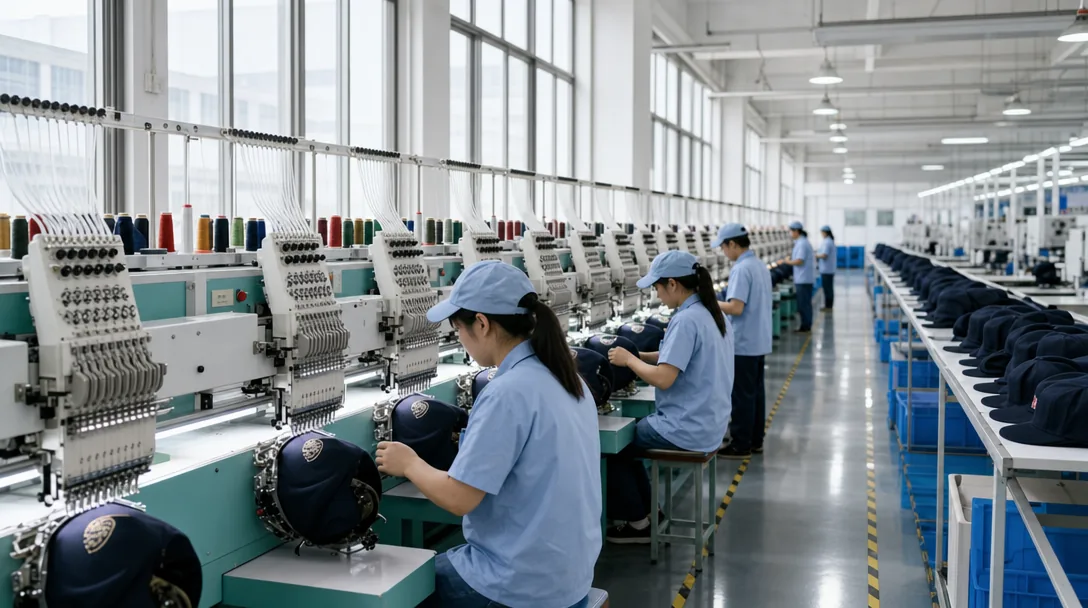
Country Hats For Men Fabric And Trim Spec Guide for Custom Hat Buyers
Read article →If you are ready to take the next step on bsci vs sedex smeta: which audit does your cap supplier actually need? - 2026 buyer's guide, our team can put a tailored quotation and digital mock-up in your inbox within 24 hours. Send the inquiry form on our contact page or message us directly on WhatsApp.