Sun Visor Wholesale Supplier Sustainability Sourcing Criteria for Canada
By Vincent Xi, Editorial Author https://crownsforge.com/authors/vincent-xi/
Canadian B2B buyers should treat sustainability sourcing criteria as a written visor cap specification, not brochure language, and withhold visor cap wholesale supply approval until the sun visor wholesale supplier files evidence for the exact SKU destined for Canada. Require a component-level bill of materials with recycled or bio-based percentages, mill or composite certificates, chain-of-custody records, a current third-party audit pack, restricted-substance test reports, and a pre-production sample built from the same construction as bulk. Award the purchase order only after those artifacts describe the visor cap that will ship.
This page is a procurement decision aid for Canadian teams buying visor cap wholesale supply. It does not rank factories, estimate keyword demand, or add factory-visit, laboratory-program, or customer-result claims. Vincent Xi is named here as Editorial Author; no other credentials, awards, or first-person production stories are attached to this article.
How the data were derived. Selection criteria and material examples come from three public source contexts only: a wholesale sun visors supplier overview (manufacturing hubs, in-house production, ISO 9001 as a quality-management certificate, UV-protection evidence, SGS-type audits, scalability, and pre-production samples); a surface-material discussion framed around a 2026 outlook (recycled polyester, vegan leather, kenaf-type composites, and VOC/PFAS pressure); and a bulk sun visor cap sourcing guide (ISO and ethics language, dry-fit and moisture-wicking sweatbands, wash-shape retention, and sports, corporate, and hospitality program context). Hub names, audit types, and material examples are taken from those pages. Percentages, certificate-age windows, thickness bands, and test windows below are labeled as example assumptions to replace with the buyer’s own policy and to verify in the supplier quote.
Limitations / what to verify. Directory copy and market-outlook language can lag mill status, certificate expiry, and restricted-substance updates. Every number, audit date, and test method must be confirmed on the exact visor cap construction and the shipment into Canada. The cited pages are not Canadian customs, labeling, or substance authorities. This page is not legal advice on Canadian entry, labeling, or chemical rules; the importer of record must check current requirements. Manufacturing-origin names below are questionnaire facts, not sales-market targets.
Approve the supplier only if the sustainable bill of materials, certificates, restricted-substance tests, audit pack, and pre-production sample all describe the same visor cap. Withhold approval if the quote uses “eco” without a numeric content and evidence type, if the sample uses a different cloth or brim than bulk, if a quality or social/environmental document is expired or out of scope, if the audit or certificate address does not match the sewing unit, or if packing-list mill names do not match the chain-of-custody file.
Why Canadian visor cap wholesale supply needs written sustainability sourcing criteria
When Canadian teams buy visor cap wholesale supply for corporate, hospitality, sports, or private-label programs, purchasing still has to document material origin and production controls. A sun visor wholesale supplier that offers only the word “eco” leaves later gaps: an ESG questionnaire that cannot be answered, a failed composition test on arrival, or a visor that does not survive wash. Put sustainability sourcing criteria in the RFQ, the technical pack, and the purchase order so substitution is a contract breach rather than a surprise.
Price and test the trade-offs. Recycled polyester may be processed differently from virgin PET; specify an acceptable color tolerance and require a bulk-lot strike-off, not only a lab dip. Kenaf or other natural-fiber composites are described in surface-material reporting for lightweighting and recyclability, but brim stiffness and humidity recovery are not proven by a material name; specify a flex and recovery test on the quoted board. Extra audit reports and mill certificates can change calendar time and minimum order quantity. Ask the quote to show those items as visible lines so “sustainable” is not an unexplained premium.
The Accio wholesale overview describes China as dominating global sun visor manufacturing, with key hubs in Fujian, Hebei, and Guangdong; Guangdong is noted there for agility on niche eco-friendly materials. The bulk-sourcing guide describes Indian producers competing on ISO certification language, ethics, and wash-durable brims for bulk sports, corporate, and hospitality programs. Those origins are manufacturing facts for the questionnaire, not sales-market targets. Canadian landed cost, mode, and broker process remain the buyer’s model to complete after the technical pack is fixed; this page does not set freight, duty, or tax figures.
Material specifications inside sustainability sourcing criteria
Start with the visor cap bill of materials. Each part—crown fabric, visor top, brim board or composite, sweatband, closure, and thread—needs a content statement, a unit, and an evidence type.
Recycled polyester (rPET) is cited on the surface-material page as gaining traction in sun visor surface materials as brands pursue carbon-neutrality and circular-economy goals. Ask for content by mass (weight) of the named component, feedstock type (post-consumer versus pre-consumer), spinner or recycler identity, and a composition test method. If a mill holds a chain-of-custody scheme, collect the transaction certificate; if it does not, still collect invoices and lot numbers that tie fabric rolls to the visor cut. A generic “recycled fabric” sentence is not a specification.
Vegan leather is likewise described on that page as gaining traction. Do not assume a construction. Ask for face chemistry, backing type, thickness, whether the polyurethane system is water-based or solvent-based if PU is used, and VOC data. Surface-material reporting links this shift to VOC and PFAS regulatory pressure; nominate a restricted-substance list and require a finished-visor test, not only a greige-fabric test.
Bio-based materials and natural-fiber composites such as kenaf are described for lightweighting and recyclability. For a visor brim, specify fiber type, bio-based percentage by mass, target thickness, flexural stiffness, and whether the composite can be separated at end of life or is a bonded sandwich. A working visor-board thickness band of 1.5–3 mm is an example assumption to verify in the supplier quote and on the pre-production sample, not a universal standard and not a measured mill result.
Sweatbands in the bulk sun visor cap sourcing guide are expected to wick moisture and, in some programs, use dry-fit constructions. Extend the same criteria to the sweatband yarn: recycled content by mass, dye class, and whether the band still meets wicking after the wash count in your policy. A visor that uses recycled crown fabric but a conventional foam band with a failing restricted-substance result is not a complete pack.
Example specification (replace with your policy): a floor of 50% recycled polyester by fabric mass for the crown, mill certificate dated within 12 months of bulk, and a composition test on the production lot. The 50% and 12-month figures are example assumptions to verify in the supplier quote; they are not regulatory minima in this article and they are not CrownsForge production data.
Attributed material context: sustainability is described as a defining trend in sun visor surface materials, with vegan leather and recycled polyester fabrics gaining traction, and with kenaf-type composites used for lightweighting and recyclability amid VOC and PFAS regulations. pmarketresearch surface-material outlook
Production, packaging, and impact controls to request in writing
A factory questionnaire should cover process, not slogans.
Dyeing and finishing: ask whether wastewater is treated on site or by a permitted plant and whether the visor colors you need can be dyed in the nominated recycled yarn without extra carriers that would fail your restricted-substance list. Cutting: visor patterns leave brim and crown offcuts; ask for a utilization percentage or a documented scrap route. Packaging: specify inner wrap (paper band versus polybag), carton recycled content, and whether mixed plastics are prohibited. Cube still matters for ocean or air moves into Canada; a “green” pack that doubles carton count is a freight cost the buyer must see before award. This article does not publish carton-per-container yields, freight rates, or duty rates.
None of these controls replace function. The wholesale overview still lists UV-protection evidence, durability, and pre-production samples; the bulk guide still lists moisture-wicking sweatbands and brims that retain shape after multiple washes. A recycled-content visor that collapses after laundry or fails UV is a failed visor cap wholesale supply lot. Put wash cycles, brim set, and UV claim in the same RFQ block as recycled percentage.
Attributed manufacturing context: wholesale sun visor selection criteria include verifying in-house manufacturing, ISO 9001 and UV-protection certifications, scalability, third-party SGS-type audits, and pre-production samples to test UV resistance and durability, with China hubs in Fujian, Hebei, and Guangdong and Guangdong noted for eco-material agility. Accio wholesale sun visors
Audits, in-house production, and sample discipline
ISO 9001, where it appears in supplier directories, is a quality-management standard. Its requirements are those of the standard; a supplier’s practice is proven only by the current certificate PDF. ISO 9001 is not an environmental product declaration and it is not proof of recycled content. Request the current certificate, scope, site address, and expiry. If the buyer’s policy also requires an environmental or social audit, name the protocol and the maximum age of the report (for example, within 12 months—again an example window to set in your policy). Record open non-conformities. Never imply a plant is certified unless the current document is on file.
Third-party audits named in wholesale guidance (including SGS-type inspections) should be mapped to the actual sewing unit, not a group headquarters. In-house cutting and sewing, as opposed to a trading desk over mixed subcontractors, reduces one layer of opacity when you are tracing rPET rolls or kenaf boards.
Pre-production samples must use the sustainable bill of materials. Test UV, colorfastness, sweatband wicking, brim flex, and wash recovery on that sample. Indian bulk-sourcing guidance emphasizes ISO certification language, ethics, customization at scale, dry-fit and moisture-wicking sweatbands, and brims that retain shape after multiple washes for sports, corporate, and hospitality programs. Put ethics and wash performance in the same pack as material sustainability. All About Sports Global bulk visor guide
Concrete data points used in this page (with unit, scope, as-of context, and source):
- Three named Chinese provincial hubs—Fujian, Hebei, and Guangdong—are listed as key locations in global sun visor manufacturing, with Guangdong highlighted for eco-friendly material agility (unit: count of named hubs; scope: wholesale manufacturing map in the Accio overview; as-of: as presented on that page, not a government census year; source: Accio wholesale sun visors page).
- Surface-material reporting frames 2026 as the outlook year in which recycled polyester, vegan leather, kenaf composites, and VOC/PFAS pressure are treated as defining commercial trends (unit: calendar outlook year; scope: global sun visor surface materials discussion; as-of: the page’s 2026 framing; source: pmarketresearch surface-material page).
- Example RFQ floors used above—50% recycled polyester by fabric mass, mill cert within 12 months, brim thickness band 1.5–3 mm—are example calculations/assumptions to verify in the supplier quote and on lot tests, not measured factory results and not CrownsForge production data (units: percent by mass; months; millimetres; scope: buyer-policy placeholders for one visor cap construction; as-of: set at RFQ, then replaced by quote and sample dates).
Buyer decision table for sun visor wholesale supplier sustainability sourcing criteria
| Criterion | Specify in the RFQ | Evidence to file | Trade-off to price | Verify before PO |
|---|---|---|---|---|
| Recycled polyester in crown/visor fabric | % by mass; post- vs pre-consumer; spinner name | Mill cert, composition test, roll-to-cut trail | Dye variation, possible MOQ step-up | Test the bulk lot, not only the lab dip |
| Kenaf or bio-based brim | Fiber % by mass, thickness (mm), stiffness, separability | Composite datasheet, flex test | Different hand; humidity recovery unknown until tested | Wash + humidity cycle on PPS |
| Vegan leather / coated face | Chemistry; water- vs solvent-based if PU; thickness; backing | VOC test, peel, hydrolysis if claimed | Cost, odor, PFAS/VOC scrutiny | Restricted-substance list on finished visor |
| Sweatband | Recycled yarn yes/no; wicking after buyer-set wash count | Yarn cert + wicking test | Comfort vs. composition | Wash PPS with the visor |
| Chain of custody | Origin of melt, spin, weave, board | Invoices and/or scheme certificates | Admin time; some mills lack schemes | Names must match packing list |
| Quality vs environment certificates | ISO 9001 as quality only; separate env/social audit if required | Current PDFs, site, expiry | Audit calendar vs. ship window | Address must match sewing unit |
| Third-party inspection | Protocol, recency, social + environmental scope | Full report and corrective-action plan | Cost and possible facility change | Open non-conformities closed or accepted |
| Packaging | Recycled carton %; polybag policy; cube | Carton spec and packed photos | Protection vs. freight into Canada | Measure first export carton |
| Durability (mandatory) | Wash cycles, brim set, UV claim | Lab reports + PPS | Recycled yarns must still pass | Independent or buyer lab on PPS |
| No-substitution / PPS match | Bulk equals approved PPS construction | Signed construction sheet | Blocks last-minute virgin swap | Side-by-side PPS vs bulk cut |
| Capacity for the exact visor cap | Monthly output for this construction | Capacity note; similar-style capability (no customer names required) | Niche eco runs vs. large hub scale | Pilot order before peak |
Use the table to score completeness of evidence. Do not award on adjectives.
RFQ checklist for visor cap wholesale supply (Canada buyer task)
Each line should produce a file you can keep with the purchase order.
- Component bill of materials with sustainability fields for crown, visor surface, brim, sweatband, closure, and thread (content % by mass, recycled vs virgin, bio-based %, country of each process step).
- Numeric recycled-content floor for fabric (insert your policy number; do not copy the 50% example without checking mill capability).
- Brim construction: fiber, thickness in mm, stiffness target, and whether the board is conventional paper/plastic or a kenaf/bio composite.
- Nominated restricted-substance list and recent tests covering VOC and PFAS-related concerns identified in surface-material research; require the finished visor, not greige only.
- Current ISO 9001 certificate (quality management only) plus any environmental or social audit your policy requires, with date, standard, and factory address matching the sewing unit.
- In-house versus subcontracted process map; list any outsourced dyeing, board making, or embroidery.
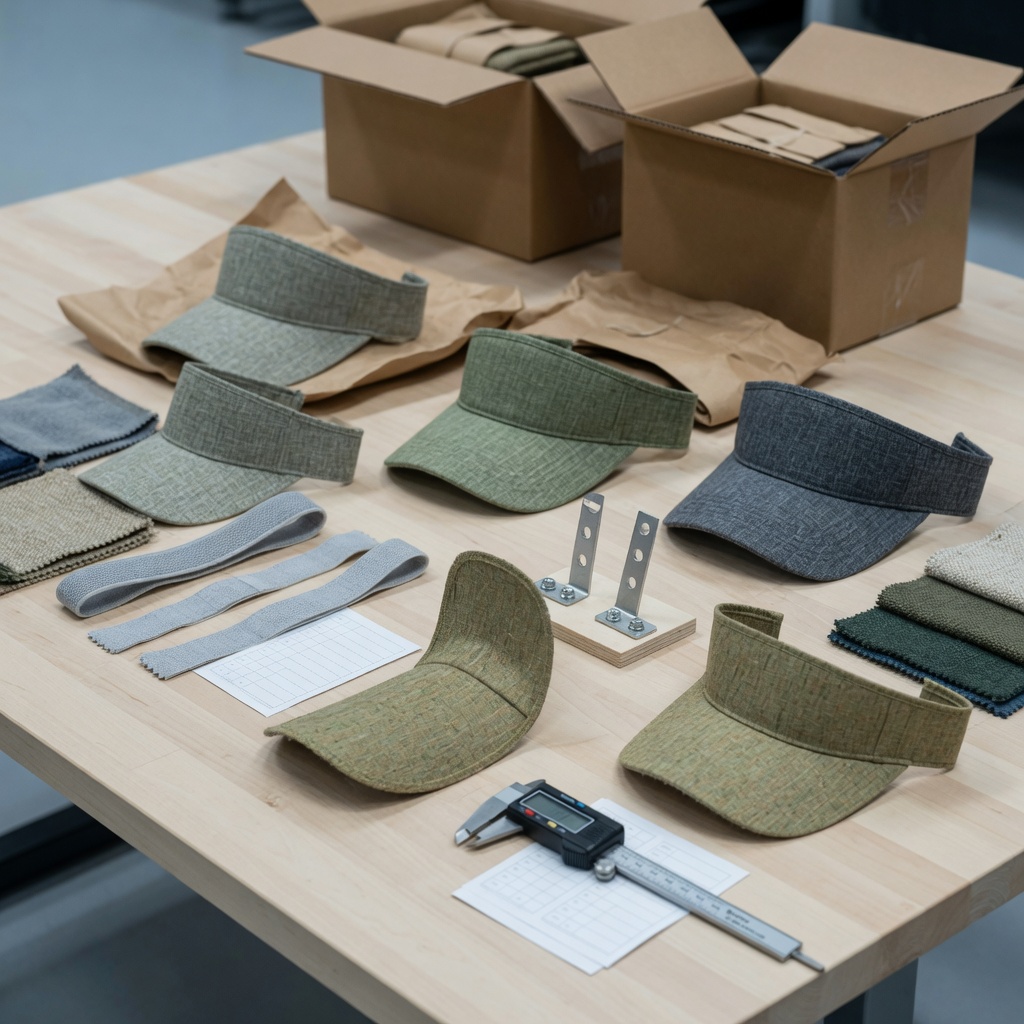
- Pre-production sample in the proposed sustainable materials; written test plan for UV, wash/shape retention, colorfastness, brim flex, and sweatband wicking.
- Traceability method: how a visor lot or polybag code maps to fabric rolls and brim lots.
- Packaging spec: inner wrap, carton recycled content, carton dimensions, and estimated cartons per container for Canadian inbound cube planning (cube only; this checklist does not set duty rates or bilingual label copy).
- Lead time and MOQ with the sustainable bill of materials versus a conventional bill of materials so the trade-off is explicit.
- No-substitution clause: bulk must match the approved pre-production sample; virgin fabric or conventional visor board cannot replace the approved recycled or bio-based components.
- Corrective-action path if a production lot fails composition, restricted-substance, UV, or wash tests, including who pays for retest and whether the lot is quarantined.
- Color and lot control: acceptable delta, bulk-lot strike-off requirement, and dye-lot identification on packing lists.
- Inspection protocol mapped to the sewing unit (name the third-party scheme your policy uses; do not treat a group-headquarters certificate as unit proof).
- Archive format your Canadian team can store (searchable PDFs of certificates, tests, sample photos, and the signed construction sheet).
Score returned quotes on whether each checklist item has an artifact. Run the pre-production sample. Only then place the visor cap wholesale supply order.
Canadian buyers should keep performance primary. Sustainability sourcing criteria add material, audit, and packaging evidence on top of a visor that must still shade, wick, and hold its brim. Incomplete certificates, expired audits, or samples made from different cloth than bulk are grounds to withhold approval, regardless of origin hub or marketing language.
Discuss Your Requirements
Review our manufacturing capabilities, then share your specifications for a supplier-fit review.