Trucker Cap Wholesale Supplier Sustainability Sourcing Criteria for United States Buyers
By Vincent Xi, Editorial Author, CrownsForge (author profile)
United States B2B buyers should award a trucker cap wholesale supplier on sustainability sourcing criteria only when three independent gates pass for the same production lot: (1) material identity, with recycled or organic content named by component and backed by chain-of-custody transaction certificates; (2) a named sewing-factory social-audit file whose site matches the commercial invoice; and (3) United States origin, fiber, environmental-claim, and landed-cost documents that match the bill of materials. Treat sustainability as a lot-level documentation package, not a catalog adjective.
Award when the RFQ, tech pack, and purchase order name recycled or organic content by component (front panel, mesh, visor cover, visor insert, binding, sweatband, snap, thread, labels), require certificate IDs that match the shipment lot, freeze the pre-production (PP) sample, and attach dye and packaging claims that can be substantiated for United States marketing and import review. Hold when a GRS, OCS, or GOTS paper exists but the mill, percentage, colorway, or factory does not match the PP. Reject a GRS or OCS scope certificate with no transaction certificate (TC) for this mesh lot, a WRAP or SMETA file that does not name the sewing plant for this purchase order, a “recycled trucker cap” headline that ignores virgin foam and snaps, or a “biodegradable bag” line with no test method, timeframe, and disposal environment.
This page is for United States wholesale, promo, corporate, and retail-private-label buyers who specify, compare, verify, approve, and order adult trucker caps. It does not claim factory visits, client results, laboratory tests, or CrownsForge production capacity, and it does not assert first-hand production or audit work. Manufacturer education pages already describe the RFQ control set: organic cotton and GRS-verified rPET, WRAP or SMETA audits, and spec sheets listing recycled percentages per component, certification IDs, dye details, and packaging (Jointophat). Factory pages list post-consumer rPET, organic cotton, hemp blends, GRS or OCS certificates, closed-loop or azo-free / OEKO-TEX-type dye claims, GOTS cotton, TENCEL or hemp options, and biodegradable packaging as menu items—not as proof that a quoted lot uses them (ESS Caps; Exploretex). Do not reprint catalog language on a United States hangtag. Percentages, gram weights, carton counts, lead times, and cost lines below are example calculations or thresholds to confirm in the supplier quote, mill invoice, and current United States rules.
Sustainability sourcing criteria for crown, mesh, visor, and trim
A trucker cap is a multi-material assembly. Sustainability sourcing criteria fail if they are written only as “recycled hat” or “organic cap.” Specify each bill-of-materials line, then choose product-level versus component-level claims before hangtag copy is drafted.
Name this construction in the tech pack: foam-laminated front panel (face fabric, polyurethane foam, backing), polyester mesh rear panels, pre-curved visor (fabric cover plus insert), visor binding, sweatband, plastic snap or buckle, sewing thread, and labels. Recycled content usually concentrates in the mesh and sometimes the visor cover or binding. Organic content, when used, usually concentrates in a cotton front. Foam, snaps, and visor inserts are frequently fossil-based even when the fabric face is certified. A recycled visor insert or recycled snap must be a separate, testable line—not inferred from a GRS hangtag on the mesh.
Decide, in writing, which claim architecture the United States program will use:
- Component-only: GRS (or named equivalent) applies to named fabrics; the finished cap is not described as a certified recycled product; consumer copy may name only the certified parts.
- Product-level: the finished cap is offered as a GRS-certified product. Recycled-content math must cover the claimed product scope, and the TC must match that scope.
Distinguish a mill scope certificate from a transaction certificate. A scope certificate shows a site is licensed for a process during a stated period. It does not prove that this mesh roll or this cap lot is certified. The buyer control is the TC tied to the purchase order, mill, colorway, percentage, and invoice lot.
Textile Exchange GRS texts in current industry use are commonly read as allowing GRS product certification from a 20% recycled-material floor (percent recycled material under the standard’s mass rules), with a higher recycled-content floor (often discussed as 50%) before a GRS logo is used on finished goods. Confirm both thresholds, allowed claim wording, the licensed process scope, and the mill’s certificate as of the RFQ date against the current Textile Exchange GRS text and logo-use rules. Do not accept “GRS certified factory” as lot evidence.
GRS and OCS are chain-of-custody tools for recycled and organic content; GOTS adds processing rules for organic textiles. A catalog that lists hemp, TENCEL, rPET, or GOTS cotton is a menu of options, not evidence that the quoted lot uses them. Mark each menu item as quoted / not quoted and claimed / not claimed.
Example calculation (assumption to verify in the mill invoice and GRS transaction certificate; not a measured CrownsForge result; as-of the quote date): a 2,500-piece adult trucker cap wholesale order destined for a United States fulfillment center; assumed finished mass 110 g per cap (275 kg finished-goods mass for the lot: 2,500 pieces × 110 g); mesh specified as 80 g/m² fabric, 70% GRS recycled PET / 30% virgin PET by fabric mass; front panel conventional polyester; visor cover matching the mesh claim; foam, visor insert, and snap excluded from the recycled-content claim. Require the GRS (or equivalent) TC to list the same percentages, colorways, and shipment lot as the commercial invoice. If marketing wants a product-level recycled percentage, require a mass-contribution table in grams (component mass × recycled fraction) and treat any number not on that table as unclaimed.
Example calculation (assumption to verify in the mill invoice and GOTS or OCS transaction certificate; as-of the quote date): if the front panel is specified as 100% GOTS-certified organic cotton face laminated to foam, the organic claim applies to the fiber, not automatically to the foam, adhesive, or mesh. Request the GOTS or OCS scope certificate plus the TC covering the fabric lot.
Higher recycled PET content can change mesh stiffness, dye uptake, and shade continuity across lots. Approve recycled-mesh shade bands under a named illuminant (commonly D65) on the PP. Embroidery, patches, or print need extra BOM rows; decoration thread, backing, ink, and any subcontracted stitch house are outside a mesh certificate unless named and evidenced.
Factory social audits are not material certificates
WRAP, SMETA, BSCI, and similar tools evaluate a facility’s labor and health-and-safety systems for a defined period and scope. GRS and OCS primarily evidence recycled or organic material identity and chain of custody. GRS social modules and GOTS site rules do not replace a current sewing-plant file for the factory named on this purchase order when that plant is outside certificate scope or the social report is expired.
United States wholesale buyers should request:
- The legal name and address of the sewing factory that will produce this purchase order, not a group headquarters.
- The current WRAP, SMETA, or BSCI report or certificate, including expiry or last audit date, audit type, and whether subcontracted embroidery, washing, or visor forming is in scope.
- A statement that no unauthorized subcontracting will occur after tech-pack freeze.
- Alignment between the social-audit site and the sites named on GRS/GOTS transaction certificates when both are claimed.
- A lot-level supply-chain map for United States forced-labor due diligence: fiber or recycler source, yarn mill, fabric mill, and sewing plant for this purchase order.
Treat that map as an input to importer due diligence under the Uyghur Forced Labor Prevention Act (UFLPA) and current U.S. Customs and Border Protection guidance as of the planned entry date. A WRAP, SMETA, or BSCI PDF is not a UFLPA defense file. A passing social audit does not prove recycled percentages. A GRS mesh certificate does not prove wage practices at a sewing line outside GRS scope.
If a United States corporate vendor manual is stricter than WRAP/SMETA, attach that code to the RFQ and require a gap letter.
United States labeling, environmental claims, and landed-cost controls
Keep the product decision primary: the same trucker cap wholesale supply file must survive United States import, origin marking, fiber identification where applicable, and environmental-marketing review.
Import and origin. Finished textile caps are typically entered under heading 6505 of the Harmonized Tariff Schedule of the United States; the statistical suffix depends on fiber, construction, and other attributes. Confirm classification with a licensed United States customs broker or a CBP ruling before the commercial invoice is locked. Country-of-origin marking must meet 19 CFR Part 134. A sustainability story does not replace origin marking. Include any additional United States duties that apply to the declared origin and the confirmed 6505 statistical suffix as of the planned entry date on the landed-cost worksheet.
Example landed-cost assumption (verify with broker and carrier quotes; not a quoted CrownsForge price; as-of the quote and planned entry date): model one export carton of 144 caps, entered value as stated on the commercial invoice, MFN duty per the confirmed 6505 statistical suffix, merchandise processing fee, harbor maintenance fee if ocean, origin inland, ocean or air freight, United States drayage to a named United States distribution center, document-courier costs, and any additional origin-specific duties. Compare DDP versus FOB plus buyer-controlled freight. Do not hide “eco surcharges” outside the line-item quote. Do not insert an assumed duty percentage; use the broker’s rate for the confirmed suffix and origin.
Environmental marketing. Recycled, organic, biodegradable, compostable, and closed-loop claims used in United States B2B sell sheets or downstream retail hangtags are subject to FTC environmental marketing guidance in 16 CFR Part 260 and Section 5 of the FTC Act. Competent and reliable evidence must match the claim’s scope under the Green Guides in force as of the sell-sheet date. A mill’s GRS certificate for mesh does not automatically support a “100% recycled trucker cap” headline. A “biodegradable polybag” claim needs the test method, timeframe, and disposal environment.
Fiber identification. Where the Textile Fiber Products Identification Act and related rules apply, fiber percentages must match the lab dip and the BOM, including recycled PET disclosed in a manner consistent with those rules and the Green Guides.
Restricted substances and state rules. If the program sells into California or other states with Proposition 65 or similar warnings, add a chemical-management file (RSL, test reports on foam, visor paint, snap, and dyes). OEKO-TEX or equivalent fabric reports help but must name the tested article and date; they are not recycled-content chain-of-custody documents. Azo-free dye language from a manufacturer blog is not a test report.
Delivery. State production calendar days from fabric approval and tech-pack freeze, plus transit days to the named United States port or airport. Certified yarns and organic cotton often add lead time versus conventional polyester. Require the supplier to quantify that delta in days on the quote.
Example lead-time assumption (replace with the quoted calendar; not a measured CrownsForge result; as-of the quote date): conventional polyester mesh path versus GRS yarn path—ask the supplier to state extra days as a number on the Gantt (a buyer planning placeholder often used in RFQs is +10 to +21 calendar days for certified yarn booking; verify, do not treat as industry fact). Build replenishment on the longer path.
Closed-loop dyeing, packaging, and lot traceability
Closed-loop or low-liquor dyeing, wastewater treatment, and azo-free recipes are process claims. They need mill names, process descriptions, and, where promised, OEKO-TEX, ZDHC, or mill wastewater reports. They do not replace GRS content percentages. If the quote cannot attach evidence, mark the process “not claimed.”
Packaging criteria for wholesale trucker caps should be written as measurable lines:
- Individual bag: material, thickness or grammage, recycled content percentage if claimed, and whether the bag is required for dust protection in ocean transit.
- Carton: recycled content, burst or ECT rating needed for United States distribution-center handling, test method if a numeric rating is required, and print inks.
Example calculation (assumption to verify in the pack-out quote; as-of the quote date): 2,500 caps, 144 caps per export carton → 2,500 ÷ 144 = 17.36 cartons, so plan 18 export cartons if the last carton is a partial, plus 2% spare bags (50 bags on 2,500 caps). If the buyer forbids PVC and requests a recycled PE bag with a stated post-consumer percentage, the quote must show the bag SKU, the recycled percentage, and whether the claim is GRS-certified packaging or an unverified mill statement.
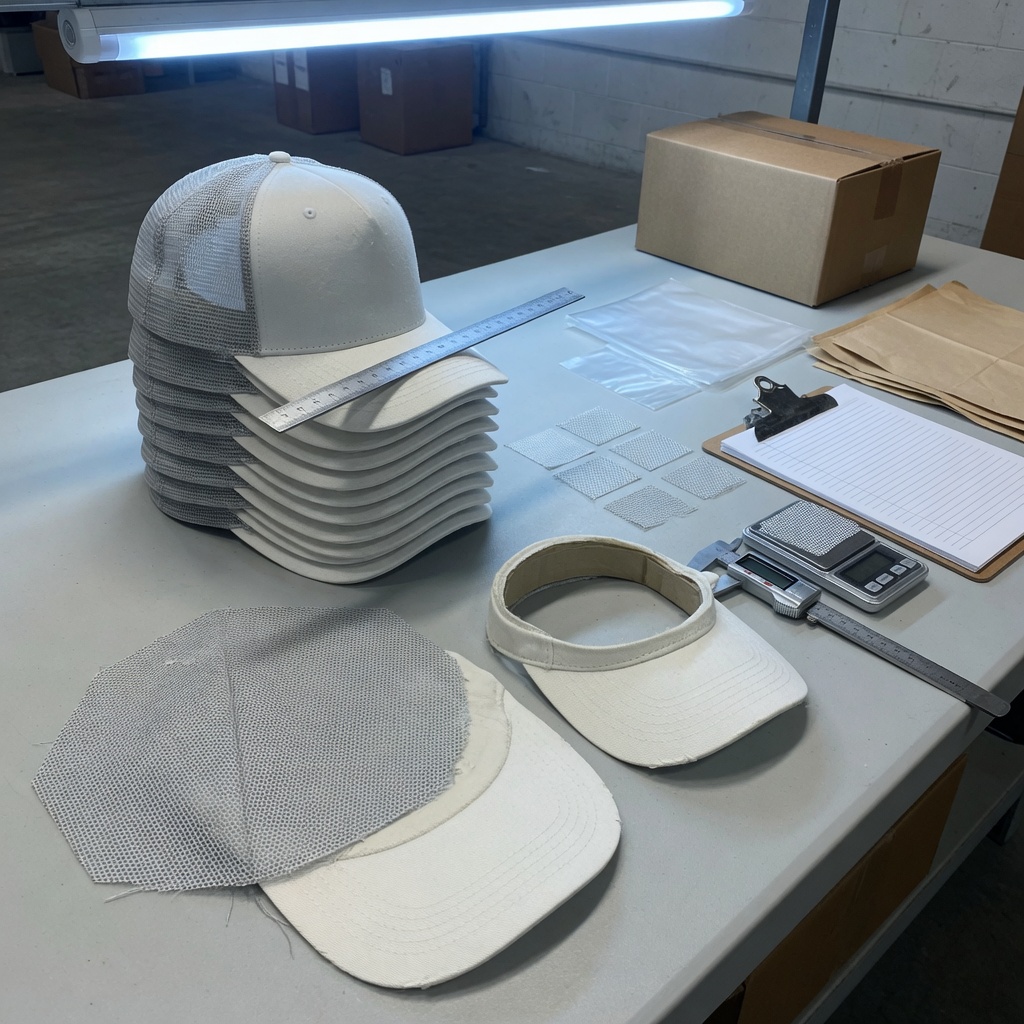
Lot traceability: require a packing list that maps carton numbers to colorway, purchase order, GRS/GOTS transaction certificate numbers, and sewing-factory name. That map is what a United States quality or ESG team will use if a retailer asks for evidence months later. Require retain samples: one frozen PP (gold seal) and a shipment retain from the production lot, stored for the warranty window named in the purchase order. At PP, require a cut-and-weigh report of mesh, front panel, and visor in grams to 0.1 g, plus a visor cross-section photo that shows insert type.
Buyer decision table: scoring a trucker cap wholesale supplier
Use this table in vendor comparison. Do not average a strong mesh certificate with a missing sewing-factory audit into a single “sustainability score.”
| Criterion | Specify in the RFQ | Evidence that can be verified | Common fail / greenwash risk | United States buyer control |
|---|---|---|---|---|
| Claim architecture | Product-level GRS vs component-only | BOM mass math in grams if product-level | “Sustainable trucker cap” covering virgin foam | Approve consumer words only for claimed parts |
| Mesh recycled content | Fiber %, pre- vs post-consumer, g/m², colorways | GRS TC matching mill, lot, and invoice | “GRS factory” with no TC for this lot | Hold shipment until TC is on the packing list |
| Front-panel fiber | Organic vs conventional; foam in or out | GOTS/OCS TC; BOM splits face vs foam | Organic claim covering the whole cap | Approve hangtag copy only after BOM split |
| Visor cover and insert | Cover claim separate from insert | Material data sheet + any recycled TC | Recycled hat photo with virgin visor board | Visor cross-section at PP sample |
| Sewing-factory labor | Named plant, no unauthorized subcontract | Current WRAP, SMETA, or BSCI file | Certificate for a sister plant | Match factory name on the commercial invoice |
| Forced-labor due diligence | Fiber/recycler, yarn, fabric, sewing sites | Map aligned to TCs, invoices, UFLPA/CBP as of entry | Group map that omits the mesh mill | Do not load until names match the import file |
| Dyes and foam chemistry | RSL; azo-free; foam VOC if required | Lab reports dated for the production window | Catalog “OEKO-TEX dyes” with no report | Conditional PP approval pending tests |
| Packaging claim | Bag/carton material, recycled %, test method | Spec + test method + who tested | “Eco bag” with no standard | Delete unverifiable words from the United States sell sheet |
| Origin and classification | Country of origin; confirm HTS 6505 suffix | Invoice, packing list, broker memo | DDP quote with no HTS | Broker sign-off before first shipment |
| Inspection plan | Named AQL or ISO 2859-1 level if used | Written QC plan on the PO | Unnamed “factory standard AQL” | Do not treat ISO 2859-1 as implied without naming it |
| Claim language | Allowed United States B2B vs hangtag phrases | Review against FTC Green Guides (16 CFR Part 260) | Copy-paste from a mill blog | Separate B2B spec from consumer copy |
Practical RFQ checklist for sustainability sourcing criteria
Copy these items into the RFQ. Each item should produce a document, a number, or a yes/no gate before purchase order.
- Name the product family as adult trucker cap wholesale supply: panel count, foam-front or alternative, mesh type, closure type, visor curve, and target finished mass in grams.
- Attach a BOM table with one row each for front face, foam, backing, mesh, visor cover, visor insert, binding, sweatband, thread, snap, labels, and any embroidery/patch/print; require recycled or organic percentage on each row or an explicit “not claimed.”
- State claim architecture: component-only versus product-level GRS (or named equivalent). If product-level, require mass-contribution math in grams and confirm any GRS logo threshold as of the RFQ date. If component-only, forbid product-level recycled headlines.
- Require GRS/OCS/GOTS scope certificates and transaction certificates for the production lot; list TC numbers on the commercial invoice and packing list; reject a scope certificate offered as lot proof.
- Name the sewing factory legal entity and address; attach the current WRAP, SMETA, or BSCI file; require a no-unauthorized-subcontract letter covering embroidery, visor forming, and washing.
- Require a lot-level supply-chain map (fiber or recycler, yarn mill, fabric mill, sewing plant) aligned to the certificates, for United States importer due diligence including UFLPA checks as of planned entry.
- Require dye-house and foam supplier names, RSL acknowledgement, and test reports (method, lab, date) for azo dyes, heavy metals, and any foam-related tests the customer code demands; state who pays for third-party tests. If closed-loop dyeing is claimed, require a one-page process note plus any mill wastewater or ZDHC-type evidence; treat absence as “not claimed.”
- Specify packaging: bag polymer, recycled content, carton ECT or burst if the United States DC requires a numeric rating, marks (no consumer environmental claims unless approved), and whether polybags may be omitted for United States DC programs that use inner packs.
- Require PP sample in the production mill, with cut-and-weigh of mesh vs front vs visor to 0.1 g, a photo of visor insert type, and a named shade-band illuminant for recycled mesh; freeze the PP in writing; require a gold-seal retain and a production-lot retain.
- State inspection sampling (name ISO 2859-1 level and AQL only if that is the PO method), shade-band, mesh hole consistency, visor curve recovery, and snap function tests; state which tests are done in mill QC versus a third-party lab. Distinguishing ISO 2859-1’s sampling tables from this supplier’s own practice is required; do not imply a certification by naming the standard.
- Provide Incoterms 2020, named United States port or DC, requested production days, transit days, and extra days for certified yarn; require a Gantt with fabric booking date. Require a landed-cost worksheet: FOB or EXW, freight, insurance, estimated 6505 duty (broker to confirm), MPF, HMF if applicable, additional origin-specific United States duties as of planned entry date, and domestic delivery; label any sustainability surcharge.
- Attach approved and prohibited United States claim language for recycled, organic, biodegradable, and carbon statements; split B2B spec language from consumer hangtag language. Require carton-level traceability and document due dates: certificates at order confirmation, tests at PP, transaction certificates before on-board, and a complete import file 5 business days before United States arrival (buyer-specified control; confirm against the broker’s cutoff as of the planned entry date). State rejection rights if the shipped lot’s certificate names a different mill, percentage, or factory than the PP. Require written notice before mill, yarn, foam, or decoration-house substitution; substitution reopens PP. Ask for MOQ per colorway in pieces and the surcharge table below MOQ.
How this article was prepared, and what to verify
Source context 1. Manufacturer educational pages describing sustainable trucker and custom-cap programs tell B2B buyers to request component-level recycled percentages, GRS/OCS/GOTS IDs, WRAP/SMETA-type audits, dye details, and packaging specs (Jointophat; ESS Caps).
Source context 2. A cap-manufacturer partnership guide lists GOTS organic cotton, rPET, and hemp or TENCEL blends and treats sustainability as a documented supply-chain requirement rather than a finished-goods slogan (Exploretex).
Methodology. Criteria, document names, and buyer questions were derived by mapping those publicly described B2B practices onto a United States wholesale RFQ: material certificates versus factory social audits, scope certificates versus transaction certificates, product-level versus component-level claims, FTC-style claim control, HTS/origin/landed-cost checkpoints, UFLPA/forced-labor traceability fields, and lot traceability. No laboratory testing, factory audit, or price collection was performed for this editorial. Exact numbers in the article are example calculations or thresholds to confirm against the current GRS/GOTS texts, the mill invoice, carrier quotes, and a licensed United States customs broker.
Limitations. Certificate scopes, audit expiry, recycled-content minimums, on-product logo rules, OEKO-TEX versions, FTC Green Guides application, HTS statistical suffixes, duty rates, MPF/HMF amounts, additional origin-specific duties, UFLPA enforcement guidance, and retailer RSLs change and must be read as of the RFQ, ship, and entry dates. Manufacturer blogs can overstate closed-loop dyeing or future regulatory language; treat those phrases as prompts to request files, not as legal advice. CrownsForge is the publisher of this editorial; this page does not certify any factory, does not award GRS or WRAP, and does not replace counsel, a customs broker, or the nominated supplier’s current documents.
Approve the tech pack and the document pack together. If a trucker cap wholesale supplier cannot put recycled percentages, certificate IDs, factory name, supply-chain map, and United States-safe claim language on one spec sheet, the sustainability sourcing criteria are not met, regardless of the catalog photography.
Discuss Your Requirements
Review our manufacturing capabilities, then share your specifications for a supplier-fit review.