Trucker Cap OEM Product Development Capability for Australia RFQs
By Vincent Xi, Editorial Author, CrownsForge
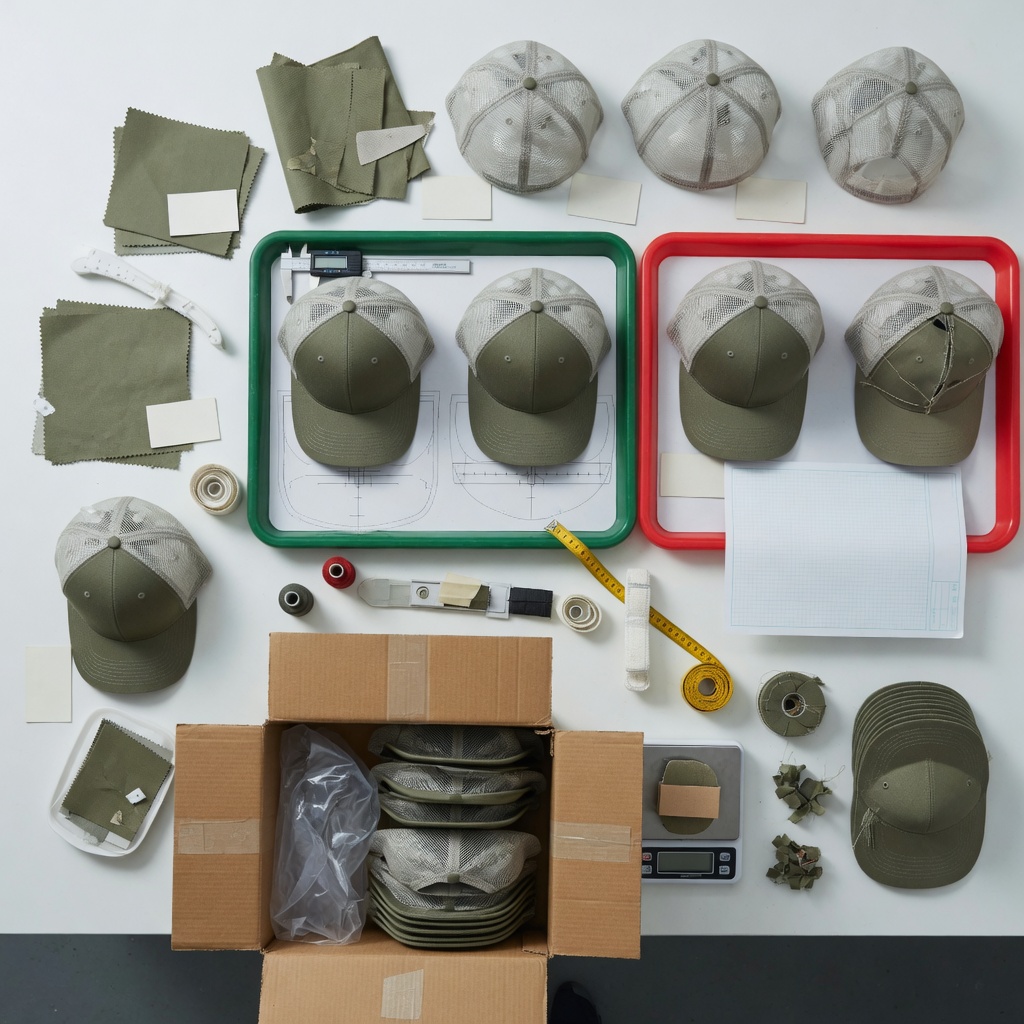
For Australian B2B buyers, trucker cap OEM product development capability is an RFQ evidence question: can the proposed supplier translate the buyer's files, material choices, decoration, dimensions, labels, and packing requirements into an approved production reference, then keep bulk manufacturing aligned with it?
A catalogue or an OEM or ODM label does not answer that question. The RFQ response needs a marked-up specification, documented feasibility exceptions, defined sample terms, measurable approval results, MOQ allocation, change control, inspection logic, and packing data for the exact quoted configuration.
When that evidence is missing, place the RFQ on hold. A hold means the record is incomplete; it does not prove that the supplier lacks capability.
Australia RFQ Gates for Product Development Capability
The following gates are proposed buyer controls. They are not requirements attributed to a law, certification, or inspection standard.
| Decision gate | Evidence the quoted supplier should return | Hold condition |
|---|---|---|
| Development route | Buyer-specified elements, retained supplier base-style elements, and newly developed elements | OEM or ODM terminology appears without a defined development scope |
| Specification review | Marked-up construction, material, dimension, decoration, label, and packing requirements, including assumptions and exceptions | Files are acknowledged without unresolved details or unavailable features being identified |
| Sample proof | Sample type, production-intent differences, fee, currency, timing basis, timing trigger, revision scope, and courier basis | Timing has no starting event, or sample-to-bulk differences are undisclosed |
| Commercial scope | MOQ allocation, unit-price scope, setup charges, payment terms, quote validity, and exclusions | MOQ is not allocated by style, colour, artwork, material, or packing configuration |
| Bulk release | Approved sample identifier, specification version, measured results, material references, and written change control | Production may begin without a locked approval record or written substitution approval |
| Inspection transfer | Inspection owner, timing, lot scope, sampling method, defect definitions, decision rules, report format, and remedies | The response gives only an acronym or a general quality statement |
| Australia handoff | Named destination, dispatch point, packing configuration, carton data, freight basis, and document responsibilities | Manufacturing, packing, freight, and import-related inclusions cannot be separated |
An advance decision should apply only to the quoted style, materials, artwork, quantity, packing configuration, and dated supplier response. A change to any of those inputs should reopen the affected gates.
Practical Australia RFQ Checklist for Product Development Capability
Send this checklist with the specification and artwork for each quoted trucker cap configuration. Each checked item should point to a supplier response, drawing, sample record, quote field, inspection document, or packing record. This is a proposed procurement control, not an Australian legal requirement or an inspection standard.
Buyer inputs to attach
- [ ] Identify the buyer entity, RFQ owner, quote deadline, and named Australian delivery destination.
- [ ] Attach the current specification version, artwork files, colour references, measurement method, label artwork, and packing instructions.
- [ ] Mark each feature as buyer-specified, retained from a supplier base style, or requiring new development.
- [ ] State the requested materials, mesh, crown profile, panel arrangement, brim geometry, closure, sweatband, decoration, and fit requirements.
- [ ] Identify required approval records and the buyer representative authorised to approve samples, exceptions, and changes.
Supplier responses to request
- [ ] Return a marked-up specification showing feasibility findings, assumptions, unavailable features, proposed alternatives, and unresolved questions.
- [ ] Identify the proposed pattern or base-style reference and the elements that require pattern, tooling, material, or process development.
- [ ] Allocate MOQ by style, colour, artwork, material, decoration, and packing configuration rather than providing only an order total.
- [ ] State sample type, fee, currency, included work, exclusions, revision charges, courier basis, timing unit, timing trigger, and production-intent differences.
- [ ] State unit-price scope, setup charges, payment terms, quote validity, exclusions, and the effects of approved revisions.
- [ ] Provide target and sample measurements, units, tolerances, measurement paths, material codes, artwork version, and decoration-placement results.
- [ ] Assign an identifier to the approval sample and link it to the controlling specification version, material references, measured results, and approval record.
- [ ] Confirm that substitutions and post-approval changes require a written proposal showing reason, affected production, evidence, cost, and schedule impact.
- [ ] Define the bulk-production trigger, material-booking trigger, factory-completion milestone, dispatch milestone, and excluded delays.
- [ ] Return the inspection owner, stage, lot definition, sample-selection method, defect definitions, decision rules, report format, remedies, and reinspection responsibility.
- [ ] State the trade term, named place, dispatch location, freight scope, insurance responsibility, clearance responsibility, and final-delivery exclusions.
- [ ] Provide caps per unit pack and carton, carton dimensions in centimetres, net and gross weight in kilograms, and whether those values are estimated or measured from approved packing.
- [ ] Identify the named company or factory, product and material scope, issuing body, and current validity for any requested certificate or report without implying certification from an unsupported claim.
Release check
- [ ] Confirm that all exceptions are resolved or explicitly accepted in writing.
- [ ] Confirm that the commercial quote, approved sample, specification, inspection plan, and packing record describe the same configuration.
- [ ] Place the RFQ on hold when a required field is missing, ambiguous, unsupported, or inconsistent.
- [ ] Reopen affected checks after any change to construction, material, artwork, quantity, price basis, schedule, inspection scope, or packing.
Supplier-Published Data Points to Verify
The figures below are attributed supplier statements. They are not independent benchmarks, CrownsForge performance data, or directly comparable offers. The cited source contexts did not provide publication or update dates, so current applicability remains unverified until the supplier issues a current, dated quote.
| Source context | Published figure, unit, and scope | As-of context | RFQ verification |
|---|---|---|---|
| CBOs custom trucker-hat development page | USD 60 per physical trucker-cap sample | Publication or update date unavailable in the cited context; current applicability unverified | Confirm included development work, material and decoration exclusions, revision charges, courier charges, and quote currency |
| CBOs custom trucker-hat development page | About 7 days per physical sample | Publication or update date unavailable in the cited context; current applicability unverified | Confirm whether the unit means working or calendar days and whether timing begins after payment, file approval, or material availability |
| CBOs custom trucker-hat development page | Starting from 50 pieces per bulk order | Publication or update date unavailable in the cited context; current applicability unverified | Confirm whether the minimum applies per style, colour, artwork, material, packing configuration, or total shipment |
| JoinTop OEM and ODM guide | 15-35 days per bulk order | Publication or update date unavailable in the cited context; current applicability unverified | Confirm the day type, production trigger, material-booking assumptions, excluded delays, and dispatch milestone |
| Wenext OEM trucker-hat page | About 576 pieces per OEM trucker-hat order as a starting MOQ | Publication or update date unavailable in the cited context; current applicability unverified | Confirm allocation across styles, colours, artwork variants, materials, and packing configurations |
Do not average these figures. The source pages do not establish identical specifications, inclusions, currencies, timing triggers, or order allocations. The USD sample figure should not be converted into an Australian-dollar planning amount without recording the exchange-rate source and conversion date.
Define the Development Route for the Quoted Trucker Cap
JoinTop describes OEM as production following a buyer's tech pack and contrasts it with supplier-developed ODM customisation JoinTop. That is JoinTop's description, not a universal definition that can be assigned to another supplier without confirmation.
CBOs describes manufacturing from scratch rather than decorating stock blanks and identifies choices involving panel configuration, foam or twill fabrics, mesh types, brim shapes, and decoration CBOs. These statements provide RFQ prompts; they do not establish that every supplier offers or controls the same options.
| Product-development area | Buyer input | Supplier return needed for a decision |
|---|---|---|
| Crown and panels | Crown profile, panel arrangement, seam references, structure, and measurement points | Proposed pattern or base-style identifier, target dimensions, sample measurements, tolerances, and unavailable features |
| Materials and mesh | Front-panel material, rear mesh, brim components, sweatband, closure, colours, and buyer-required attributes | Supplier material codes, swatch status, availability, minimums, lot controls, substitution risks, and approval process |
| Brim and fit | Brim geometry, fit reference, circumference range, closure type, and measurement method | Component references, measurement results, tolerances, adjustment range, and proposed corrections for unmet targets |
| Decoration | Artwork file, requested method, dimensions in millimetres, placement references, and colour references | Feasibility result, setup requirements, process limitations, revised-file requests, and sample-approval method |
| Labels and packing | Buyer-approved artwork, placement, unit packing, carton configuration, and channel requirements | Proofing method, responsibilities, setup charges, packing data, and exclusions |
| Reorder continuity | Required continuity for patterns, artwork, materials, colour, and approved references | Record-retention method, change-notification process, retained-reference status, and items requiring reapproval |
The supplier should return a marked-up specification rather than silently replacing unavailable materials or construction details. Accepted exceptions should be incorporated into the identified sample and specification version used for bulk release.
Product Development Capability at Sample Approval
Wenext describes a supplier process covering file review, sample development, revisions, material booking, assembly, branding, inspection, and export Wenext. This source-specific sequence supports separating sample approval, material commitment, and bulk release in the RFQ. It does not prove that another supplier follows the same process.
A decision-ready sample return should record:
- The files and physical references received by the supplier.
- The sample type and any differences from production-intent materials, components, decoration, or packing.
- The fee, currency, included work, excluded work, courier basis, and revision charges.
- The lead-time unit, working-day or calendar-day basis, and event that starts the clock.
- Material, tooling, or process differences that could affect bulk output.
- Measured dimensions, decoration size and placement, material codes, colour references, and label proof.
- The sample identifier, specification version, approval date, approver, and unresolved exceptions.
- The effect of revisions on MOQ, price, material availability, and schedule.
Bulk release should cite the approved record. A proposed substitution or post-approval change should identify the reason, affected production, price and schedule impact, replacement evidence, and the buyer representative authorised to approve it.
Measurement Evidence for Bulk Manufacturing
The cited sources do not establish universal trucker-cap dimensions or acceptance tolerances. Targets should therefore come from the buyer's tech pack or from supplier-proposed values that the buyer verifies and approves for the quoted order.
| Control point | Unit or reference | Supplier evidence |
|---|---|---|
| Crown height and profile | Millimetres and a defined measurement path | Target, sample result, tolerance, pattern or base-style identifier, and measurement image |
| Panel geometry and seams | Millimetres from agreed datum points | Panel arrangement, seam positions, symmetry result, target, actual result, and tolerance |
| Brim geometry | Width, depth, and agreed curvature definition in millimetres | Brim component description, measurement method, target, sample result, and tolerance |
| Fit and closure | Circumference range in millimetres and closure reference | Measurement condition, adjustment range, component code, result, and approval status |
| Decoration size | Width and height in millimetres | Artwork version, decoration method, target dimensions, actual dimensions, and tolerance |
| Decoration placement | Centreline and edge offsets in millimetres | Defined datum points, target offsets, actual offsets, tolerance, and approval image |
| Materials and colour | Supplier codes, approved swatches, and buyer-approved references | Material identity, lot or batch reference when available, availability status, and written substitution control |
| Labels | Dimensions and placement offsets in millimetres | Artwork version, proof, attachment method, placement result, and approval status |
| Unit and carton packing | Caps per pack and carton, carton dimensions in centimetres, and net and gross weight in kilograms | Approved packing configuration, measured or estimated status, carton marks, and quote inclusion |
A tolerance described only as standard or normal is not measurable RFQ evidence. Ask the supplier for the value, measurement method, and approval record that will control the order.
Inspection Evidence for Development Transfer
JoinTop states that its process uses AQL methods for inspection JoinTop. This is a statement about JoinTop's described practice. The cited context does not identify a standard and edition, inspection level, acceptance limits, sample size, defect definitions, inspection party, or current certification.
For the quoted trucker cap, ask the supplier to state:
| Inspection field | Evidence to return |
|---|---|
| Plan identity | Production stage, inspection location, inspection owner, and approved sample and specification references |
| Lot and sample | Lot definition, sample-selection method, proposed sample size, and party selecting the units |
| Defect rules | Product-specific defect categories, examples, and acceptance or rejection rules |
| Product checks | Dimensions, materials, colour, decoration, stitching, closure, labels, quantity, and packing checks |
| Decision and remedy | Report format, required images, escalation route, rework terms, and reinspection responsibility |
Do not treat AQL terminology as certification or as a complete inspection instruction. If a supplier names a standard, request its full designation and edition, then separate the standard's requirements from the supplier's own procedure. If a certificate or test report is required, verify the current document's named company or factory, product and material scope, issuing body, and validity.
Australia Manufacturing, Freight, and Packing Handoff
The cited supplier pages do not establish Australia-specific labelling, product-safety, climate-performance, import, or retailer requirements for the proposed trucker cap. No such requirement is prescribed here. The Australian buyer should verify current obligations for the exact product and sales channel through appropriate authoritative or professional sources before approving labels, tests, packaging, or shipment.
For the manufacturing quote, request:
- The named Australian destination postcode, port, warehouse, or delivery point.
- Separate factory-completion, dispatch, and delivery milestones.
- The quoted trade term, named place, currency, validity, and included and excluded costs.
- Manufacturing and dispatch locations, plus responsibility for freight, insurance, export handling, import charges, clearance, and final delivery.
- Caps per unit pack and carton, carton dimensions in centimetres, and net and gross weight in kilograms.
- Confirmation of whether carton dimensions and weights are estimates or results from the approved packing configuration.
- Carton marks, barcodes, inner packing, label application, proof approval, and buyer-supplied content responsibilities.
- The company, factory, product, material, production scope, issuing body, and validity covered by any requested report or certificate.
Keep the manufacturing price and logistics scope separately visible. A delivered total without a named destination, included services, exclusions, and document responsibilities is not ready for comparison.
RFQ Decision Record
These statuses are proposed procurement controls rather than legal or standards-based classifications.
| Status | Decision basis |
|---|---|
| Advance | The supplier has returned the marked-up specification, resolved exceptions, sample terms, measurable approval evidence, commercial allocation, bulk-release control, inspection plan, and Australia handoff for the quoted configuration |
| Hold | A required field is missing, ambiguous, unsupported by the named sample or document, or inconsistent with another part of the quote |
| Reopen | Material, artwork, construction, quantity, price basis, schedule, inspection scope, or packing changes after the original review |
The record should identify the quote date, specification version, approved sample, unresolved conditions, decision owner, and documents reviewed. Approval for one configuration should not be transferred to a changed configuration without reviewing the affected evidence again.
Methodology, Source Contexts, and Limitations
The cited pages were treated as first-party supplier statements, not independent benchmarks. The method was to retain attributed statements with their original qualifiers, units, and order scope; separate those statements from proposed buyer controls; and convert unknown inclusions, timing triggers, allocations, and process details into RFQ verification questions. Figures were not averaged or transferred between suppliers.
The source contexts are JoinTop's OEM and ODM trucker-cap guide for its descriptions of development route, bulk timing, and AQL inspection JoinTop; CBOs' trucker-hat development page for its descriptions of from-scratch development, construction choices, sample cost, sample timing, and starting order minimum CBOs; and Wenext's OEM trucker-hat page for its described process sequence and starting MOQ Wenext. The Vincent Xi author profile supports the visible author name, role, and profile URL only.
Limitations include unavailable source publication or update dates, no independent verification of the supplier statements, no current supplier quote, no physical sample review, no bulk inspection record, and no cited Australian regulatory source. Before committing funds, verify the exact specification, sample terms, MOQ allocation, price, currency, production triggers, material availability, lead time, inspection plan, packing data, freight scope, and applicable documents for the proposed product and order.
Discuss Your Requirements
Review our manufacturing capabilities, then share your specifications for a supplier-fit review.