Snapback Wholesale Supplier Sustainability Sourcing Criteria for United States Buyers
By Vincent Xi, Editorial Author
United States B2B buyers should score a snapback wholesale supplier against sustainability sourcing criteria before hangtags, cartons, or fabric deposits are approved. For this RFQ, define the product as a structured snapback—six-panel crown, flat visor, rear plastic snap—and map every component that might later support an organic, recycled, or process claim. Chain-of-custody certificates have to cover the fabric and trim lots that will actually ship. The social-audit report has to cover the sewing site that will cut and stitch. United States fiber-content, country-of-origin, and environmental-claim copy has to match that same bill of materials. Bulk fabric should wait until the sealed pre-production sample, the certificate pack, and the label set describe one product.
A BSCI, SEDEX, or WRAP listing is a factory-site social signal. It does not prove GOTS organic cotton or GRS recycled polyester in the crown, visor, mesh, or sweatband. Trade pages cite organic cotton, recycled polyester, waterless dyeing, GRS, GOTS, BSCI, SEDEX, WRAP, Better Work, OEKO-TEX, and ISO 9001 as selection filters; each filter still has to name a mill, a sewing site, a certificate scope, and a shipment lot. Tex Garment Zone on sustainable snapback materials and audits Accio snapback supplier selection guidance Foremost Hat 2026 sustainable collection announcement
The commercial trade-offs stay narrow. Organic and recycled fabrics can add mill minimums, shade-lot risk, and extra calendar days. Social audits do not correct visor warp, snap alignment, or sweatband color migration. Tighter traceability can raise FOB price while cutting the chance of a rejected United States environmental claim or a mismatched customs fiber description. The sections below convert those trade-offs into RFQ language, a bidder table, and an order checklist for snapback wholesale supply.
What a United States RFQ must lock as sustainability sourcing criteria
Write the RFQ so a sustainability claim is either proven for this purchase order or stripped from labels and cartons. List every part that might later appear in marketing copy: crown twill, visor cover, visor board, mesh (if used), sweatband, top button, eyelets, thread, rear plastic snap, woven label, hangtag, polybag, and carton. Put fabric mass in grams per square meter (gsm), visor length and width in millimeters, and crown height in millimeters on that same BOM so quality control and sustainability files describe one snapback. If only the crown is GOTS cotton and the visor board is conventional polyethylene, the hangtag cannot imply that the whole hat is organic. Treat plastic snaps, metal eyelets, and uncertified thread as conventional unless a certificate names them.
Keep four evidence layers on one RFQ:
- Product chemistry and fiber identity — component fiber content and whether a restricted-substance report covers the bulk dye lot.
- Chain of custody — whether GOTS or GRS certificates cover the mill and the specific fabric roll or trim lot, not only a parent company.
- Factory social conditions — whether BSCI, SEDEX, WRAP, or Better Work reports cover the sewing site that will cut and stitch.
- United States labeling and import language — whether sewn-in fiber content, country of origin, hangtag claims, commercial invoice, and packing list describe the same BOM.
Those layers are not interchangeable. WRAP and BSCI are factory social programs. GOTS is an organic textile standard with chain-of-custody rules. GRS is a recycled-content chain-of-custody standard. OEKO-TEX Standard 100, when used, is a human-ecological product test against a restricted-substance list; it does not prove organic farming or recycled feedstock. ISO 9001 is a quality-management system certificate, not an environmental product claim. A named standard is a document request, not proof that any mill or sewing site is currently certified.
If the program includes youth sizes, treat children’s product safety as a separate gate, not as a sustainability add-on.
PO release rule. Do not issue a United States purchase order for a labeled organic or recycled snapback until the BOM marks claimed versus conventional parts; GOTS and/or GRS transaction certificates will cover those lots; the sewing-factory social audit is current and site-matched; and sewn-in label, hangtag, invoice, and packing list use the same fiber and origin language.
Organic cotton, recycled polyester, and chain-of-custody files
Published snapback supplier pages cite organic cotton and recycled polyester as usual material substitutions, sometimes with waterless dyeing or lower-energy process claims. Treat those lines as document requests, not as proof.
Organic cotton (GOTS or equivalent, if hangtags will print “organic”). Ask for the current GOTS scope certificate for the spinning and dyeing mill, plus a transaction certificate that names the fabric lot. Confirm the organic-fiber percentage in the crown cloth, not a blended mill average, and whether sweatband, visor cover, and sewing thread are included. Put a pre-production sample and a bulk shade band in the RFQ because organic cotton can change shrinkage, hand-feel, and dye uptake versus conventional twill.
Recycled polyester (GRS, if hangtags will print recycled content). Ask whether the claim sits on visor mesh, visor board, thread, or crown fabric. GRS evidence is lot-based: a facility certificate without a transaction certificate for the shipped rolls is incomplete for a labeled wholesale program. State the claimed recycled percentage on the spec sheet (example assumption to verify in the supplier quote: 100 percent GRS recycled polyester mesh, or 50 percent recycled visor board). A visor or packing claim can leave a cotton crown conventional if the label is component-precise; it is not acceptable if marketing says “recycled snapback” without a component map.
Process claims (waterless dyeing, low energy). These are mill or factory practices, not fiber standards. The cited Tex Garment Zone page names waterless dyeing and low-energy methods as supplier signals for snapbacks; that is still not lot proof. If a bidder cites waterless dyeing, request the mill name, dye-lot identification, and any third-party process statement that applies to this colorway. Tex Garment Zone on sustainable snapback materials and audits
Traceability depth. One announcement dated 13 March 2026 describes factory-owned supply-chain traceability plus GRS recycled polyester and GOTS organic cotton for a 2026 wholesale snapback collection, with ESG documentation positioned for B2B reporting. Treat that as that company’s published 2026 collection claim as of 13 March 2026, then ask the bidder for the same class of lot documents on this style. Do not reprint another brand’s collection copy onto a hangtag. Foremost Hat 2026 sustainable collection announcement
Social audits versus product claims: BSCI, SEDEX, WRAP, and inspection
A snapback can be sewn in a WRAP-certified factory from conventional acrylic. A GOTS fabric can be cut in a factory with an expired audit. Specify both.
Request, at minimum:
- Legal factory name and address that will sew the bulk order, not a trading-office address.
- Current BSCI, SEDEX/SMETA, WRAP, Better Work, or equivalent report, with expiry date and findings summary, not only a logo.
- Whether subcontracting (embroidery, washing, visor forming) is allowed; if yes, name those sites and their audits.
- A third-party inspection option against AQL, the measurement chart, and labeled fiber content. The Accio page names SGS or Bureau Veritas as example verification routes. Accio snapback supplier selection guidance
The same Accio page tells buyers to prioritize OEKO-TEX for material safety, ISO 9001 for quality management, and WRAP for ethical manufacturing, plus physical samples, third-party audits, on-time delivery rates over 90 percent, and reorder rates exceeding 30 percent from Chinese manufacturing clusters. Those two percentages are directory selection thresholds on that undated page; they are not a dated industry census and not a United States import benchmark. Convert them into RFQ evidence: a 12-month on-time shipment report for comparable hat styles, and a reorder or repeat-order share for comparable accounts, with the period named.
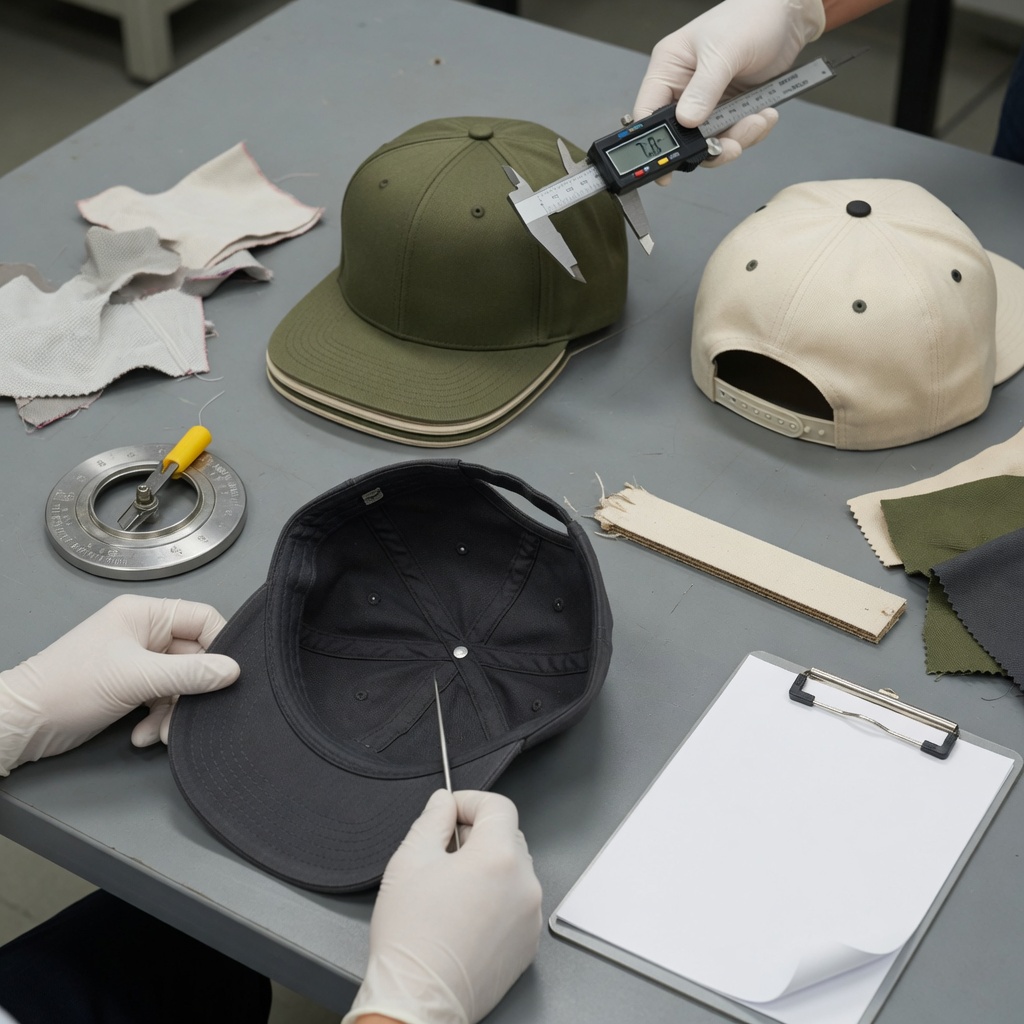
Social audits do not replace construction QC. Call out visor curvature after a 24-hour lay-flat check (RFQ test method and duration to specify; not a published laboratory result in the cited sources), snap engagement, stitch density in stitches per inch on the six panel seams, top-button attachment, sweatband seam cleanliness, and embroidery registration. A GOTS or GRS pack does not save a visor that twists or a snap that cracks.
United States labeling, import, and landed-cost controls
Keep the product and RFQ decision primary. Use United States rules as order controls, not as a country brochure.
Fiber and origin labels. Adult snapbacks sold in the United States need truthful fiber content and country of origin. If the crown is 100 percent cotton and the visor cover is polyester, the label must not read as if the entire hat were cotton. Recycled and organic words are extra claims on top of fiber identity. Align the commercial invoice, packing list, and sewn-in label so customs and retail compliance teams see the same bill of materials.
Environmental marketing. If hangtags say organic, recycled, waterless, or carbon-related numbers, keep copies of the supporting certificates in the shipment file. Drop any claim the factory cannot back with a current document. Do not let a factory social audit stand in as an environmental product claim on a United States website or carton.
Quality and safety tests to name in the RFQ. For bulk adult promotional or retail snapbacks, specify colorfastness to perspiration and rubbing, dimensional stability after a defined wash or wipe method, visor-insert deformation, and needle detection if required. If any size is intended for children, add the applicable children’s product path (tracking labels, third-party testing as required) instead of assuming an adult promotional spec covers it.
Landed-cost controls. Sustainability does not change Incoterms, but it does change cost lines. Ask for FOB unit price and the fabric surcharge, mill-minimum true-up, third-party inspection fees, certificate issuance fees, and carton specs. Request a USD-denominated breakdown in the supplier quote (currency and validity period to confirm in that quote, not a published average). Confirm HTS classification, duty, merchandise processing fee, and any additional origin-based duties with a licensed United States customs broker. Do not copy a duty percentage from a blog into a live PO; rates change by origin, material, and date.
Delivery. Split dates: fabric-ready date, cutting start, inspection window, and on-board date. Sustainable lots fail when the mill is late and the sewing factory substitutes conventional fabric to hit a ship window. Put a no-substitution clause on GRS/GOTS components. If climate reporting matters to the United States customer, require ocean freight as default and air as a documented exception.
MOQ, lead time, and landed-cost trade-offs on snapback wholesale supply
Ask the supplier to separate mill minimums from sewing minimums. Organic and recycled fabrics are often purchased from a different mill than conventional acrylic-wool or cotton twill, so a sewing MOQ of 500 pieces can still be blocked by a mill dye-lot minimum. Use this as an example planning set to verify in the quote, not as a published market average: 500-piece sales sample run; 1,500-piece first bulk color; 3,000-piece repeat color on existing GOTS or GRS fabric; 5,000-piece new colorway that requires a mill dye lot. If the mill minimum is stated in meters of twill, calculate whether leftover fabric is prepaid, owned by the buyer, or absorbed by the factory.
Lead time should be written as two clocks. Example assumption to verify in the supplier quote: mill lead time of 20–40 calendar days for a GRS or GOTS stock fabric versus 40–70 calendar days if yarn must be spun to order; plus sewing and finishing of 20–35 calendar days after fabric inward. Air freight can rescue a late sustainable lot, but it can erase the environmental intent of the fabric choice.
Price trade-offs belong on a one-page comparison: conventional fabric FOB, GOTS crown FOB, GRS visor/mesh FOB, combined GOTS+GRS FOB, plus inspection and certificate costs. A lower FOB with no transaction certificate is not cheaper if the United States retailer later rejects the hangtag.
Do not paste an undated directory threshold into the scorecard as if it were this factory’s audited KPI. Ask for a 12-month on-time shipment percentage for comparable structured caps, with the calculation method, and a 12-month repeat-order share. Use those dated files.
Buyer decision table for snapback wholesale supply
| Criterion | Specify in the RFQ | Evidence to compare | Approval test | United States order control |
|---|---|---|---|---|
| Crown fiber | Fiber %; organic vs conventional; panel count; fabric mass in gsm | Mill spec + fabric test | Bulk roll matches swatch and % | Sewn-in fiber label matches invoice |
| Recycled content | Component-level % (mesh, visor board, thread) | GRS scope + lot transaction certificate | Certificate names mill, article, shipped quantity | Hangtag may state only certified components |
| Organic claim | Which parts are organic; % organic | GOTS scope + transaction certificate | Certificate period covers production dates | Do not use “organic hat” if visor/sweatband are excluded |
| Closure and trims | Snap, eyelets, top button, thread claimed or excluded | Material spec; certificate only if hangtag names them | Uncertified hardware stays off the environmental claim | Label cannot imply a 100 percent organic or recycled hat |
| Restricted substances | Dye class; baby/adult standard | OEKO-TEX or equivalent lot report if required | Report covers bulk color, not only lab dip | Keep report in import file |
| Social compliance | Named sewing factory; no unauthorized subcontract | Current BSCI, SEDEX, WRAP, or Better Work report | Site name matches packing list factory | Reject logo-only PDFs with no date |
| Quality system | Measurement chart in mm, AQL, ISO 9001 if offered | ISO 9001 certificate + in-line QC plan | Certificate is current; QC plan matches snapback operations | Does not replace visor/snap inspection |
| Traceability | Lot codes on fabric, cartons, and hats | Trace map from mill to carton | Random carton lot code traces to TC | Needed for retailer ESG questionnaires |
| Packing claims | Polybag, tissue, carton if marketing mentions them | Packing BOM + any recycled-content document | Claim matches packing only | Do not move a fabric GRS claim onto the carton |
| Physical sample | Pre-pro in bulk fabric, not substitute cloth | Sealed sample + measurement report | Size, snap, visor, and stitch match spec | Sample label uses final US copy |
| On-time risk | Original CRD vs fabric-ready date | 12-month on-time % for comparable hats | Use this factory’s dated file, not an undated directory heuristic | Split liquidated damages on mill vs sewing delay |
| Repeat capability | Reorder of the same GOTS/GRS color | Reorder share or repeat PO list | Dated repeat-PO list; heuristic pages are prompts only | Lock shade band for 12-month replenishment |
| Incoterms and pack | Carton qty in pieces, gross weight in kg, FOB port | Carton spec + drop-test if required | Carton marks match US retailer routing | Broker confirms HTS and origin duties |
If a bidder cannot fill a cell, drop the marketing claim or drop the bidder for that claim.
Practical RFQ checklist for snapback wholesale supply
Paste this list into the RFQ.
- Quote a structured six-panel snapback with flat visor and plastic snap; attach a tech pack with crown height in mm, visor length/width in mm, circumference in cm, fabric mass in gsm, and snap type.
- Provide a component BOM with fiber content for crown, visor cover, visor board, mesh, sweatband, thread, snap, eyelets, top button, and labels.
- Mark claimed organic or recycled components; treat unmarked parts, hardware, and packing as conventional unless certified.
- Attach current GOTS and/or GRS scope certificates and state whether a transaction certificate will cover this PO’s lots.
- Attach the latest BSCI, SEDEX/SMETA, WRAP, or Better Work report for the exact sewing factory, with expiry date.
- State whether embroidery, visor forming, or washing will be subcontracted; name those sites.
- Offer OEKO-TEX Standard 100 or an equivalent restricted-substance test on the bulk dye lot if a chemical-safety claim is planned.
- Send a pre-production sample in the bulk sustainable fabric, plus a measurement sheet and interior-construction photos.
- Quote mill and sewing MOQ; show price breaks at 500, 1,500, 3,000, and 5,000 pieces as example quantities to confirm.
- Split lead time into mill date and sewing date; forbid silent substitution of conventional fabric.
- State FOB unit price, fabric surcharge, certificate fees, and inspection fee as separate lines, with currency and validity period.
- Provide a 12-month on-time shipment percentage for comparable cap POs and the calculation method.
- Submit proposed United States sewn-in label, hangtag, and carton-mark copy for approval before printing.
- Confirm country of origin, factory address on export documents, carton quantity in pieces, and gross weight in kilograms.
- Identify adult-only versus youth sizes and list extra testing if youth sizes are included.
- Name Incoterms, port, inspection window, AQL, stitches-per-inch on the six panel seams, and the sealed sample bulk must match.
- Provide a lot-code method so one carton traces to the GRS/GOTS transaction certificate.
- Include a corrective-action path for visor warp, illegal subcontracting, or a certificate that does not match the mill.
- State whether packing will carry any recycled or environmental claim, with documents or with the claim removed.
- Ship transaction certificates, the factory audit, and any restricted-substance report with the documents pack for the United States importer of record.
How these data points were compiled and what to verify before PO approval
Author note. Visible byline: Vincent Xi, Editorial Author, https://crownsforge.com/authors/vincent-xi/. This page is editorial synthesis of the cited public trade pages. It does not claim factory visits, laboratory tests, certifications, awards, client names, years of production experience, or customer outcomes for the author or for CrownsForge.
Source contexts. Three public trade pages: (1) a Bangladesh-focused supplier article on organic cotton and recycled polyester snapbacks, waterless dyeing, low-energy methods, and BSCI, SEDEX, and WRAP listings; (2) an Accio snapback supplier page recommending OEKO-TEX, ISO 9001, WRAP, physical samples, SGS or Bureau Veritas audits, on-time delivery rates over 90 percent, and reorder rates exceeding 30 percent from Chinese manufacturing clusters; (3) a 13 March 2026 announcement of a 2026 Sustainable Collection of wholesale snapbacks using GRS-certified recycled polyester and GOTS organic cotton, with BSCI, Better Work, and Sedex audits for factory-owned facilities. Bangladesh and China appear only as manufacturing-origin references, not as sales-market targets. Tex Garment Zone on sustainable snapback materials and audits Accio snapback supplier selection guidance Foremost Hat 2026 sustainable collection announcement
Concrete data points used on this page. (1) Accio snapback supplier page, undated as cited: on-time delivery rates over 90 percent, scope limited to that page’s directory selection heuristic for Chinese manufacturing clusters, not a United States import census. (2) Same Accio page, undated as cited: reorder rates exceeding 30 percent, same directory-heuristic scope. (3) Foremost Hat announcement dated 13 March 2026: a 2026 Sustainable Collection of wholesale snapbacks using GRS-certified recycled polyester and GOTS organic cotton, with factory-owned supply-chain and named social-audit programs as that company’s published claim. MOQ counts of 500 / 1,500 / 3,000 / 5,000 pieces and mill/sewing clocks of 20–40, 40–70, and 20–35 calendar days are example planning assumptions to verify in the supplier quote, not published market averages.
Methodology. Claims above are extracted from those published pages and restated as buyer-verification tasks. Named standards are described by the type of evidence they actually govern (fiber chain of custody versus factory social audit versus quality system versus restricted substances). Quantities, extra lead-time ranges, price-break counts, gsm/mm fields, stitches-per-inch targets, and the 24-hour visor lay-flat check that are not on the source pages are labeled as example calculations, RFQ fields, or planning assumptions to verify in the supplier quote. No factory visit, laboratory test, certification, customer result, or first-person production claim is made for CrownsForge or for the author.
Limitations / what to verify. Certificates expire and are scope-limited; a WRAP factory certificate does not prove GOTS cotton. Transaction certificates are lot-specific; an old mill certificate does not cover a substituted roll. The 90 percent on-time and 30 percent reorder figures are undated directory heuristics, not a sampled United States import benchmark. Duty, additional origin tariffs, and broker fees are date- and origin-specific and must be confirmed with a licensed United States customs broker outside this article. Waterless-dyeing and low-energy claims need mill-level evidence for the bulk colorway. United States label copy must be checked against the final BOM, including visor board, sweatband, snap, and packing. Approve the sealed sample, the certificate pack, and the label set together, then release bulk fabric. If any one of those three is missing, do not treat the order as meeting sustainability sourcing criteria for snapback wholesale supply.
Discuss Your Requirements
Review our manufacturing capabilities, then share your specifications for a supplier-fit review.