Snapback OEM Production Scalability Planning for Canada
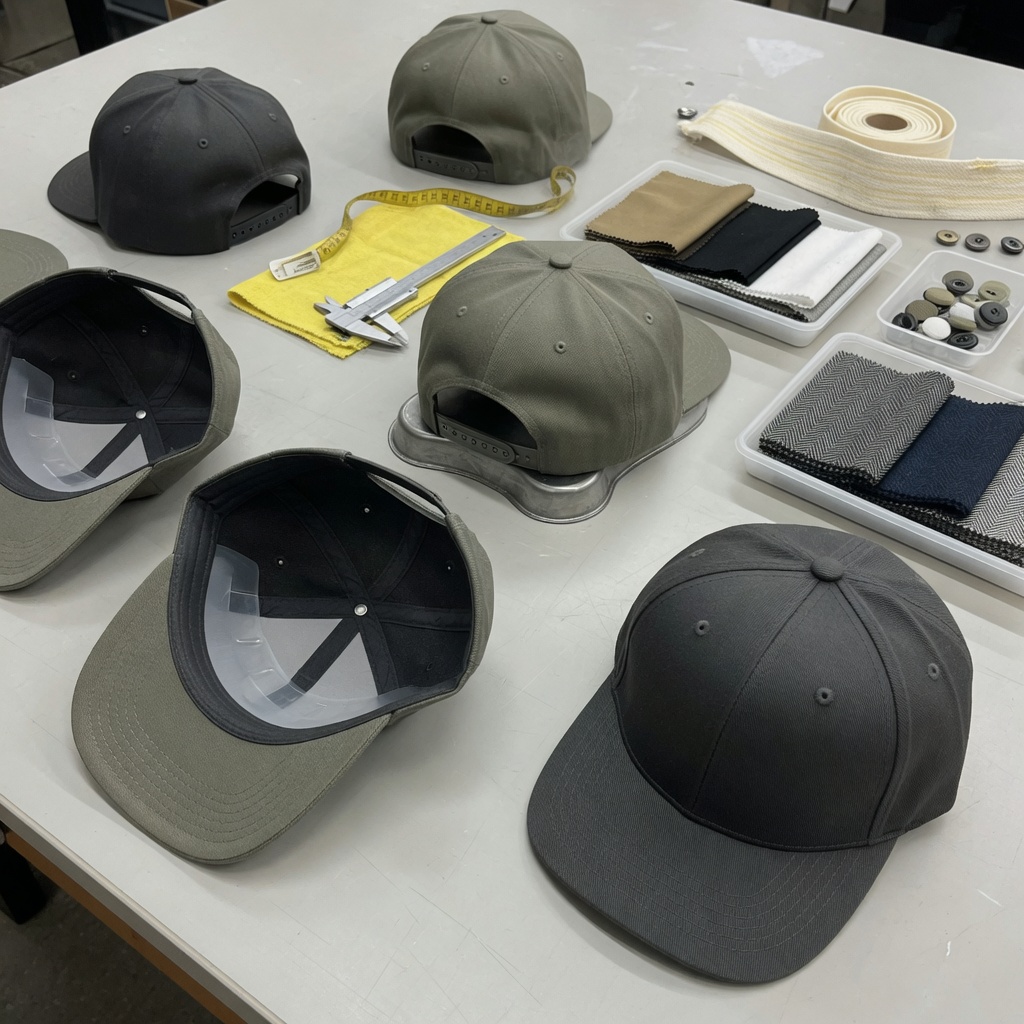
A buyer moving snapbacks into Canada should not raise quantity until one written quote names the quantity denominator, the sample clock, and the bulk window. Snapback OEM production scalability planning is that lock: the bill of materials, decoration route, and clock start have to survive the larger lot. The visor here is the head-worn brim, not a vehicle part. These figures are supplier statements, not a CrownsForge price and not a Canadian market benchmark.
Three pages captured on 23 September 2026 disagree, so do not average them. JoinTop, last updated 26 September 2025, is the source for one sample span and one bulk span JoinTop. Anthea states 200 pieces per design and publishes two bulk spans that must stay separate Anthea. Sumkcaps states 200 pieces per design and, in its FAQ, 200 per design per colour, with bulk time split below and over 5,000 pieces Sumkcaps.
Canadian duty, bilingual labeling, and any chemical or children's-product threshold were not supplied in these research excerpts. They remain unresolved against current official requirements. A CPSIA, Proposition 65, or REACH line is not clearance into Canada. Hold any deposit until the quote repeats one denominator and one calendar.
Editorial author: Vincent Xi, Editorial Author, https://crownsforge.com/authors/vincent-xi/. No factory visit, client outcome, or added credential is claimed.
How production scalability planning changes a snapback order
Freeze the approved snapback before pricing a larger lot. JoinTop describes an adjustable plastic snap, a structured high-profile crown, and a flat or slightly curved visor. Parts it names are five or six panels, front buckram, a visor insert usually of PE or HDPE, a sweatband, eyelets, a fabric-covered top button, labels, and seam tape. The snap strap is most often polypropylene, with different hole counts and colours. Crown fabrics it names are cotton twill, wool blends, polyester, and mesh. That is JoinTop's description, not a CrownsForge plant claim.
A bill change can move both the minimum and the clock. JoinTop ties a higher minimum to a custom dye lot that needs a mill length, a custom snap with injection-moulding setup cost, and more detailed or puff embroidery. No mill length and no fee were supplied in this research excerpt. Anthea says price depends on fabric and material, logo-technique complexity, quantity, and packaging. Sumkcaps lists many embroidery, patch, print, label, closure, sweatband, and visor options. Confirm any added process before reusing an older minimum or calendar.
JoinTop's path is a tech pack of measurements, trims, fabrics, and artwork, then sourcing, a pre-production sample, and only then bulk. Lock panel count, fabric, any buyer-set grams per square metre, buckram, visor shape, snap, and the labels that must remain. Optional puff, extra colours, and custom packing can wait. If branding or packing is simplified, required labeling and agreed traceability stay. Which marks Canadian law requires was not established in these excerpts, so name them on the purchase order.
Supplier MOQ and lead-time evidence, not a market benchmark
JoinTop's FAQ says many OEM and ODM suppliers start from 48-100 pieces per style on standard fabrics and snaps. Custom fabrics, unique snaps, or detailed embroidery usually need more. No factory count, year, or definition of style was supplied in this research excerpt. The range is not a census.
Anthea's minimum is 200 pieces per design. Colours within that design may be mixed to reach it. The page is not a single-piece or print-on-demand offer. Its start-at-200-and-scale-to-thousands line, and its hundreds-to-thousands line, give no weekly rate and no dates. Sumkcaps says 200 pieces per design in one place and 200 pieces per design per colour in the FAQ. The quote must pick one denominator.
JoinTop's sample is about 10-14 days, depending on complexity, and bulk is often 25-35 days, longer for custom fabrics, dyed snaps, or several embroidery techniques. Working-day status and an artwork-approval start were not supplied in the excerpt. Anthea's timeline splits sample development of 7-10 days, client review of 2-3 days, and 20-30 days covering mass production, quality control, and shipping preparation. Its FAQ instead says sample production of 7-10 days after design confirmation and bulk of typically 15-25 days, depending on quantity and customization. Do not fold the 2-3 day review into the FAQ span, and do not merge 15-25 days with 20-30 days.
Sumkcaps states a 7-10 working-day sample in both the advantage list and the FAQ. Below 5,000 pieces, the list says 20-25 working days and the FAQ says 25-35 working days. Over 5,000 pieces, the list says 30-35 working days and the FAQ says roughly 35-45 working days. Exactly 5,000 pieces is not assigned to either band in this excerpt. A numbered list says the order is done in about 5 weeks, then shipped. That line follows embroidery-proof approval, states no clock start, and says custom hip hop hats. Confirm it applies to the quoted snapback.
Sumkcaps also offers a free digital mockup within 24 hours of the logo and order details, and a quote within 12 hours. Those are message times, not sewing time. The same page states 5,500 square meters, 300 workshop workers, a daily output of 10k caps, and about 55 designs a day. The excerpt does not say whether 10k caps is all headwear or snapbacks only, or which dates were counted. Anthea displays 15+ years of experience and 500K+ caps produced, with no end date and no audit reference in the excerpt. Reserve capacity only from the sewing factory named on this order. JoinTop's partners in China, Bangladesh, and Vietnam are a manufacturing origin, not a sales market.
Canada checks that these excerpts do not settle
Name Canada as the destination and keep transit separate from landed cost. Sumkcaps' ordering steps say DHL, FedEx, or UPS takes 4-8 working days, and DDP takes 15-25 working days. The advantage list says 4-7 working days by DHL, FedEx, UPS, and TNT. No Canadian city, Canadian-dollar freight, duty, brokerage, or tax was supplied. Canada on Anthea's form is only a menu choice.
Named standards on these pages are supplier statements about other markets. JoinTop describes US CPSIA for children's products, including tracking labels and lead testing, California Proposition 65 as flagging chemicals such as phthalates in plastics or inks, and European REACH as restricting substances such as azo dyes. Anthea displays ISO 9001:2015, BSCI Certified, CPSIA Compliant, and REACH Approved, and states compliance with CPSIA, REACH, and other international safety standards in its EU and US block. Sumkcaps states ISO9000, ISO14000, WRAP, BSCI, and SEDEX, and says materials do not contain AOZ and have passed GOTS. None of this is a CrownsForge certification or a finding of Canadian conformity.
Official Canadian requirements for this headwear were not established in the excerpts. Do not adopt a supplier age example, a chemical example, or a badge as Canadian law. JoinTop's US CPSIA statement for children's snapbacks is not a Canadian age threshold. Sumkcaps' FAQ asks for 50 percent before later production steps and the balance before shipping. Currency and the failed-sample result were not supplied. That deposit is a commercial term on that page, not a Canadian rule.
Buyer decision table for snapback manufacturing scale-up
Dates are page context, not quote expiry. JoinTop shows 26 September 2025. Sumkcaps metadata lists publication on 11 January 2024 and modification on 2 September 2026. Capture of all three pages was 23 September 2026. Anthea's capture has no modified date; the footer copyright is 2024.
| Decision | What to lock | Attributed evidence | Approval check |
|---|---|---|---|
| MOQ basis | One denominator: style, design, colour, and mixing | JoinTop: many suppliers, 48-100 pieces per style on standard fabrics and snaps; higher if custom. Anthea: 200 pieces per design; colours in that design may mix. Sumkcaps: 200 per design, and FAQ 200 per design per colour | Accept only the denominator the quote repeats |
| Sample clock | Day count, day type, and start event | JoinTop: about 10-14 days; day type and start not in the excerpt. Anthea FAQ: 7-10 days after design confirmation. Timeline adds a separate 2-3 day review. Sumkcaps: 7-10 working days | Reject a quote with no clock start |
| Bulk window | One duration tied to one quantity band | JoinTop: often 25-35 days; longer for custom fabric, dyed snaps, or multiple embroidery methods. Anthea timeline: 20-30 days including shipping preparation. Anthea FAQ: typically 15-25 days. Sumkcaps bands below and over 5,000 pieces conflict by section; 5,000 exactly is unassigned; about 5 weeks is separate | Require one written calendar before deposit |
| Capacity | This snapback, at the sewing site on the order | Sumkcaps: 5,500 square meters, 300 workshop workers, 10k caps a day, about 55 designs a day. Anthea: hundreds to thousands, no rate or dates in the excerpt | Do not book time from another firm's 10k-cap line |
| Decoration | Logo method held while quantity rises | JoinTop: detailed or puff logos may raise the minimum; several embroidery methods can extend bulk time. Anthea: logo complexity affects price and bulk time | Re-quote minimum and clock if the method changes |
| Simpler branding | What stays if a patch or pack is dropped | Sumkcaps: satin, woven, and HD woven labels, hang tags, stickers. JoinTop: labels and seam tape | Drop the option only if required labeling and traceability remain |
| Acceptance | Defect classes, including snap function | JoinTop: most manufacturers use AQL, often Level II at 0/2.5/4.0, checking stitch per inch, symmetry, snap retention, brim curvature, and colourfastness | Buyer rule only, not Canadian law. Classes behind 0/2.5/4.0 were not defined |
| Exposure | Units at risk across the quoted bulk lead time | No Canadian weekly sales figure is in these excerpts. A weekly rate is a buyer assumption | Demand times lead time is exposure, not the order quantity. Subtract usable stock and incoming supply covering that demand once |
| Canada inbound | Place, Incoterm, and which costs are inside the price | Sumkcaps steps: courier 4-8 working days; DDP 15-25 working days. Advantage list: 4-7 working days by DHL, FedEx, UPS, and TNT. No Canadian-dollar duty or freight supplied | Do not read transit days as landed cost |
| Compliance file | Tests on the fabric, ink, and snap being bought | JoinTop: CPSIA, Proposition 65, REACH. Anthea badges: ISO 9001:2015, BSCI, CPSIA, REACH. Sumkcaps: ISO9000, ISO14000, WRAP, BSCI, SEDEX, no AOZ, GOTS | Canadian applicability is unresolved here. Check it outside the badge |
Manufacturing trade-offs when the snapback lot grows
Weight is a structure choice, not a promise of speed. On the JoinTop page updated 26 September 2025, the FAQ says most snapback crowns use cotton twill or wool blends between 180 and 250 gsm. It calls lighter cloth softer and less structured, and heavier cloth sturdier and more premium in look. That is a supplier description, not a mill test and not a price. State whether 180-250 gsm is the buyer's target or only this reference. Sumkcaps names 100 percent cotton, 100 percent polyester, 100 percent wool, corduroy, and mesh as foam or polyester, with no gsm in the excerpt. JoinTop says heavier twill or wool blends cost more, and custom fabric can stretch bulk time. No dollar difference was supplied.
Decoration is the change most likely to invalidate the old minimum. JoinTop calls flat embroidery suitable for most logos. Puff embroidery puts foam under the stitch and adds labour and material. Detailed or puff logos may raise the minimum, and several embroidery techniques can lengthen the bulk window. Anthea links bulk time to customization complexity. Put the method on the quantity band. A passed sample does not carry the old minimum forward after the route changes.
Approve scale-up on the pre-production sample. JoinTop checks crown height and shape, visor flat or curved as designed, fabric, snap and trim colour, and logo placement and quality. Anthea allows 2-3 days for review. Sumkcaps' FAQ takes 50 percent before material approval and that sample, a different order from its mockup and embroidery-proof steps. Define defect classes on the order. The figure 0/2.5/4.0 was not explained, so the AQL name is not the standard.
Example calculation to verify in the supplier quote. It is not a source fact and not an order quantity. Assume one approved design, buyer-entered demand of 400 snapbacks a week for Canada, and a buyer-assumed bulk window of 5 weeks. Exposure equals 400 times 5, or 2,000 snapbacks. If buyer-entered usable stock is 300 snapbacks and incoming supply already covering that same demand is 500, subtract 800 once. Uncovered exposure is 1,200 snapbacks. Do not add the 800 back onto 2,000, and do not order 1,200 or 2,000 until the written minimum, the confirmed lead time, and any separate buffer are set. Sumkcaps' about-5-week line and JoinTop's often-25-35-day span do not show that this 2,000-piece build finishes in that assumed window.
How these figures were derived, and what to verify
Figures were taken from JoinTop, Anthea, and Sumkcaps, all retrieved on 23 September 2026. JoinTop's on-page update is 26 September 2025. Its capture Last-Modified header of 23 September 2026 is not an article date or a quote expiry. Sumkcaps metadata shows 11 January 2024 published and 2 September 2026 modified. Anthea had no modified date in the capture, and the footer copyright is 2024. Denominators were not harmonized: per style, per design, and per design per colour stayed separate. Unstated day types were not converted. Exactly 5,000 pieces was left unassigned. Mockup and quote hours stayed message times. Demand times lead time stayed exposure, not an order quantity. Two figures from one page were not averaged.
These pages are supplier copy, not audited logs. The 48-100 piece remark is not a census. The 10k-cap day and the 500K+ caps have no counting period in the excerpts. Courier days are not Canadian landed cost. Bilingual labeling and any Canadian chemical or children's-product threshold were not supplied in this research excerpt and need a current official check. A simpler decoration or pack is acceptable on a scale-up only when required labeling and agreed traceability remain. These pages do not replace the quote or the official check.
RFQ Checklist
- Specify panel count, crown fabric, grams per square metre, buckram, visor insert, brim shape, snap polymer, hole count, and colour match before asking for a scale price.
- Ask the supplier to state pieces per design, per colour, and per style, and whether colours in one design may be combined.
- Require the supplier to give one sample calendar and one bulk calendar, with clock start, day type, quantity band, and exceptions for custom fabric, dyed snaps, and multiple embroidery methods.
- Require the sewing factory to state its own output for this snapback and to exclude any other firm's published daily output.
- Specify pre-production approval of crown height, visor curve, colours, logo placement, and snap function before bulk starts.
- Ask the supplier to apply the buyer's defect classes for stitch per inch, symmetry, snap retention, brim curvature, and colourfastness.
- Require reports on the purchased fabric, ink, and snap, kept separate from CPSIA, REACH, Proposition 65, or voluntary badges not established here as Canadian law.
- Specify the labels, seam tape, and traceability that remain if a patch, hang tag, or pack is simplified.
- Ask the supplier for the Canadian destination, the Incoterm, and whether freight, duty, brokerage, and tax are included.
- Compare the order quantity with exposure over the confirmed lead time, then subtract usable stock and incoming supply already covering that demand once.
Discuss Your Requirements
Review our manufacturing capabilities, then share your specifications for a supplier-fit review.