Hat OEM Digital Integration Readiness for Australian Manufacturing RFQs
By Vincent Xi, Editorial Author
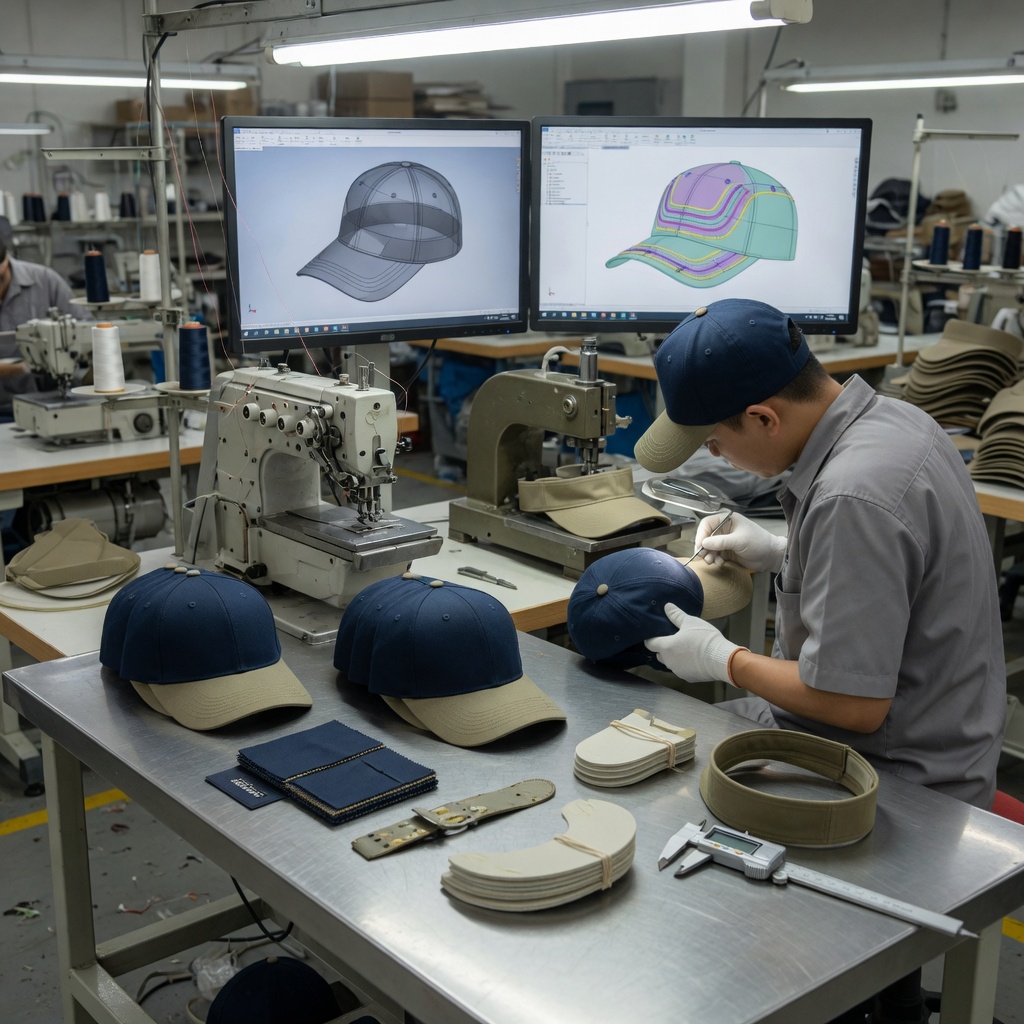
Australian B2B buyers should treat hat OEM digital integration readiness as a manufacturing interface, not a sales adjective. A factory can deliver a tidy sample and still be unready if crown panels, visor curve, stitch types, embroidery or 3D-puff parameters, colour references, and packing notes live in static PDFs that operators retype. Before any production purchase order, require three evidenced tests on the actual hat style: a versioned digital product definition the buyer can ingest into ERP or PLM; machine-level traces from sewing and visor-forming equipment rather than finished-hat counts only; and a golden sample built with production methods and measured against that same digital object. If the OEM pitches a digital twin or predictive brim model, add a predicted-versus-measured visor curve or stiffness check on a comparable material stack. That sequence is the control for hat manufacturing RFQs covering panel patterns, visor geometry, structured buckram or foam, closures, and decoration placements.
Skipping the interface test leaves visor width, stitch density, or logo-offset mismatches to physical sampling or first bulk, when calendar time is already consumed.
Pass/Fail Gate Before a Paid Pilot
Score the OEM on artefacts, not adjectives.
| Decision | What must already exist | Buyer action |
|---|---|---|
| Ready for a paid pilot | Parseable digital pack for the RFQ hat style; dummy ERP or PLM exchange; sensor map plus a redacted trace; golden-sample plan tied to a pack version ID | Approve a limited colourway and size-run pilot, then compare digital artefacts to physical hats before seasonal volume |
| Conditional | A pack or mock-up exists, but stitch logic, BOM, or forming notes still sit in a parallel spreadsheet; IoT on sewing only; a twin shown only as a generic demo | Price and schedule the gaps as project work; do not hide them in unit cost |
| Not demonstrated | PDF-only or screenshot packs; no version ID; no machine data; a sales sample made with different methods than bulk | Do not release seasonal volume on that manufacturing program |
What Digital Integration Readiness Covers in Hat OEM Manufacturing
A hat digital tech pack, when it is more than a drawing dump, binds geometry to process rules. RFQ examples to verify in the supplier quote include lockstitch versus chainstitch on the sweatband join, needle type and SPI for twill versus performance mesh, embroidery density limits so the crown does not pucker, and measured placements from a seam or centre-front rather than approximate front-panel notes. One OEM process article describes instant digital mock-ups and packs that lock Pantone, logo coordinates, and decoration method (flat embroidery, 3D puff, print) as the front end of a sequence, after which a golden sample is made with the same methods and bulk QC is checked against that digital blueprint.
How to Manufacture Custom Hats: MasterCap's 4-Step OEM Process
Write those capabilities as RFQ clauses, not tour talking points. Four buyer-visible layers matter: (1) file and data model (whether the OEM can return a pack the buyer's PLM or shared folder can parse); (2) execution systems (cutting, sewing program, brim mould); (3) in-process sensors that record stitch speed, consistency, and yarn tension rather than relying only on end-of-line visual QC; (4) a model or twin that predicts forming behaviour for a new visor material so trial hats are not the only learning loop.
Minimum hat fields to require inside the digital object so vendors are comparable: style ID and pack version ID; crown height and panel count; visor width, length, and curve; visor stack notes (foam, plastic, buckram); stitch type and SPI at named joins; decoration method with coordinates measured from centre-front or a named seam; colour references; size run; BOM objects needed for an ERP dummy order; buyer-furnished packing and labelling text. That list is an interface specification for this RFQ, not a full hat-construction manual.
Evidence Contexts from Digital Tech Packs and Smart-Factory Write-ups
Two public industry write-ups supply the numerical claims used below. They are blog-style manufacturing accounts, not audited multi-factory studies, and they do not state calendar dates, factory names in full statistical detail, or sample sizes in the excerpts used here. They are used only as attributable illustrations of what those authors have associated with digital packs, ERP connection, IoT protocols, and digital twins in hat production.
| Attributed claim | Unit | Scope in the source narrative | As-of context | Source |
|---|---|---|---|---|
| Rework cut 35-40 | percent rework reduction | digital hat/cap tech packs and factories as described in that article | undated blog publication | New Generation HK |
| Rejection from 22 to under 4 | percent rejected | one brand case as narrated | undated | New Generation HK |
| Pre-production from 24 to 8 | calendar days | that narrated pre-prod cycle | undated | New Generation HK |
| Waste cut 37 yearly | percent waste | yearly, mid-sized producers as described | undated | New Generation HK |
| 220 ROI in 14 months | percent return on investment over 14 months | mid-sized producers as described | undated | New Generation HK |
| Waste cut 23 | percent waste reduction | the sewing and brim-moulding integration described | undated | Ace Accessory |
| Speed boost 17 | percent speed increase | the integration described in that article | undated | Ace Accessory |
| Trial waste reduced 92 | percent trial-waste reduction | new-material brim trials as narrated | undated | Ace Accessory |
The New Generation HK account of digital hat tech packs states that they cut rework by 35-40 percent (unit: percent rework reduction; scope: described for digital hat/cap tech packs and factories in that article; as-of context: undated blog publication; source: New Generation HK). The same account describes rule-driven packs with stitch logic reducing a brand's rejection from 22 percent to under 4 percent (unit: percent rejected; scope: one brand case as narrated; as-of: undated; source: New Generation HK) and pre-production time from 24 days to 8 days (unit: calendar days; scope: that narrated pre-prod cycle; as-of: undated; source: New Generation HK). It further states that ERP sync cut waste 37 percent yearly (unit: percent waste; scope: yearly, mid-sized producers as described; as-of: undated; source: New Generation HK) and cites 220 percent ROI in 14 months (unit: percent return on investment over 14 months; scope: mid-sized producers as described; as-of: undated; source: New Generation HK).
How Digital Hat Tech Packs Turn Factories into Innovation Engines
The Ace Accessory account of smart-factory implementation for hat manufacturers describes IoT sensors on sewing speed, stitch consistency, and yarn tension, and the use of OPC UA and MTConnect protocols to integrate brim moulding with sewing, with a claimed waste cut of 23 percent and speed boost of 17 percent (units: percent waste reduction and percent speed increase; scope: the integration described in that article; as-of: undated; source: Ace Accessory). It also describes digital twins that predict brim moulding and reduce trial waste 92 percent for new materials (unit: percent trial-waste reduction; scope: new-material brim trials as narrated; as-of: undated; source: Ace Accessory).
How Can Hat Manufacturers Implement the Smart Factory Concept?
These figures are not industry averages, not CrownsForge test results, and not forecasts for any specific Australian order. They are source-bound examples. Re-verify every number against current OEM data rooms, dated case notes, and a pilot style of your own.
IoT Protocols, Sensors, and Visor Forming Models
Hat sewing is sensitive to tension and speed because crown panels are curved, visors are often laminated or moulded, and embroidery sits on a semi-rigid or buckram-backed surface. Sensor coverage that only counts finished hats is weaker than coverage that timestamps stitch consistency and yarn tension on the actual sewing head. OPC UA and MTConnect, as named in the smart-factory account, are industrial information models and protocols; naming them in an RFQ is a request for machine connectivity, not a claim that a given OEM is certified to any particular scheme. The protocol specification defines how data can be exposed; the OEM decides which machines are instrumented and what a buyer is allowed to see.
Digital twins in the same account are tied to brim moulding prediction. For structured baseball-style hats and similar visor products, moulding heat, dwell, and cooling interact with foam, plastic, or fabric stacks. A twin that reduces physical trials is useful only if the OEM can show predicted versus measured visor curve or stiffness on a material the buyer actually uses. Request that comparison on the RFQ style, not a generic video.
RFQ Trade-offs for Australian Hat Manufacturing Programs
Moving from analog or PDF packs to rule-driven digital packs can reduce transcription error and shorten the loop from comment to revised marker, but it imposes file-discipline costs on both sides. The buyer must keep a single current source of truth for colour, placement, and stitch logic. The OEM must staff or automate intake so a visor-width change updates cutting and forming without a parallel unofficial spreadsheet. Published accounts associate large rework and waste percentage movements with that shift; those movements will not appear if the digital file is only a prettier PDF or if the sewing floor still works from a printed photocopy.
Instrumenting sewing and moulding can support faster diagnosis of puckering or skipped stitches on embroidered crowns and laminated visors. It also creates data-security, latency, and interpretation work: raw tension traces are not a QC certificate. Buyers who want live dashboards must specify who hosts the data, retention, and whether the OEM will expose only aggregated KPIs. Factories that have not instrumented older brim presses may quote a longer readiness timeline; that is a schedule and cost variable, not a ranking of intent.
Digital twins and digital mock-ups can reduce some physical sampling between concept freeze and shipment booking. The offsetting cost is model validation: if the twin is not calibrated to the actual mould and fabric lot, trial waste can move from the factory floor to a later claim. Golden-sample discipline remains necessary. The physical hat still has to match the digital blueprint for panel alignment, visor peak, and decoration, then bulk lots have to be checked against that same object.
ERP or PLM sync can fail silently. A pack that looks complete in a viewer but does not generate a correct BOM, size run, or packing list will still create waste at cut or carton. The 37 percent yearly waste figure (unit: percent waste; scope: yearly, mid-sized producers as described; as-of: undated; source: New Generation HK) and the 220 percent ROI over 14 months (unit: percent return on investment over 14 months; scope: mid-sized producers as described; as-of: undated; source: New Generation HK) are hypotheses to test with a dummy SKU, not guaranteed program economics.
Compatibility with the buyer's own stack is the hidden constraint. If the Australian company's PLM expects a particular CAD, 3D, or JSON schema and the OEM only exports flattened PDFs, readiness is low regardless of how advanced the sewing line looks in photographs. Specify the exchange format and run a round-trip test on a non-confidential hat style before approving the vendor for a seasonal program.
RFQ Language, Evidence, and Verification
| Assessment criterion | Language to put in the RFQ | Evidence the OEM must return | How the buyer verifies | Why it matters for the order |
|---|---|---|---|---|
| Digital tech pack object | "Supply a versioned digital pack for Style X including visor geometry, panel pattern, SPI/stitch type, embroidery or puff parameters, colour refs, and measured logo placement." | Native or agreed-format file plus change-history log | Open the file in the buyer's PLM or viewer; edit one dimension and confirm the OEM can re-import | Supports comparison of transcription risk versus PDF-only vendors |
| Hat field completeness | "Pack must include crown height, panel count, visor width/length/curve, visor stack, size run, and buyer-furnished packing text." | Field-level pack extract mapped to Style X | Check every named field is populated, not listed as TBD | Makes two OEM returns comparable on the same hat definition |
| Rule-driven stitch and construction logic | "Pack must encode construction rules (for example visor join, sweatband, structured crown) so a change updates related operations." | Written rule list or demonstrated pack behaviour | Change visor width or fabric in a sandbox and inspect downstream instructions | Relates to narrated rejection and pre-prod time reductions in digital-pack accounts |
| ERP or PLM connectivity | "State method (API, secure file drop, middleware), objects exchanged (BOM, size run, routing), and test a dummy PO." | Interface note plus dummy-order screenshot or log | Run a non-production SKU through both systems | Tests whether waste and scheduling claims can even apply |
| IoT on sewing and forming | "List machines instrumented for stitch speed, stitch consistency, and yarn tension; name protocols in use (for example OPC UA, MTConnect if applicable)." | Sensor map and a redacted sample log from a similar hat | Confirm timestamps align with operations on a video or line walk | Lets buyers compare diagnostic depth, not just end-of-line visual QC |
| Brim / visor digital twin or predictive model | "For new visor material Y, show predicted versus measured curve/stiffness and trial-hat count." | Model description and one paired prediction-vs-actual dataset | Repeat on buyer fabric if NDA allows, or witness a trial | Grounds the 92 percent trial-waste illustration in an actual material |
| Golden sample locked to digital blueprint | "Golden sample must be built with production methods; bulk QC checkpoints must cite the same digital object." | Sample report mapping measurements to pack fields | Measure visor, crown height, and decoration against the file | Prevents a mock-up from diverging from bulk hats |
| Data handling and access | "State hosting, retention, and buyer access to production traces or pack versions." | Written policy and access demo | Quality and IT jointly sign off | Required before approving live integration on an Australian program |
Award points only when the file, log, or sample exists.
Practical RFQ Checklist
- Attach one anonymised but complete hat style (structured visor hat or equivalent) and require the OEM to return it as their digital pack in a named format the buyer can open, including style/version IDs, visor dimensions and curve, panel count, crown height, stitch types and SPI, decoration coordinates, colour references, size run, and packing text.
- Require a one-page interface statement: ERP/PLM objects supported, protocol or file method, and a date by which a dummy order can be synced.
- Ask which sewing and brim-forming assets expose stitch speed, stitch consistency, and yarn-tension data, and whether OPC UA, MTConnect, or another named protocol is actually implemented on those assets (protocol name is not proof of coverage).
- Request a redacted IoT extract from a prior comparable hat (tension and speed traces with operation IDs), plus the QC decision that used or ignored those traces.
- For any new visor or performance fabric, require a digital-twin or predictive-forming statement with predicted versus physical measurements and the number of trial hats consumed.
- Specify golden-sample rules: production methods only, measurement points that match the digital pack, and a sign-off form that both parties store against the pack version ID.
- Require bulk QC to reference the same pack version (not a local printout) for visor width, crown height, colour, and decoration; state the measurement method and sampling plan the buyer will accept.
- Include a round-trip change test: buyer issues a digital change (for example visor peak or logo offset); OEM returns updated pack, marker or forming note, and impact on lead time within an agreed number of working days.
- State data-security and IP terms for 3D models, stitch files, and sensor logs, including who may subcontract decoration files.
- Require the OEM to ingest buyer-provided packing and labelling text into the same digital pack so carton marks and care information stay versioned with the product definition; confirm this on the dummy order (do not assume any destination rule is already in the OEM template).
- Ask for a dated readiness gap list: which machines are not yet on the protocol, which pack fields are still manual, and the calendar impact on the first production window.
- Make approval conditional on a short paid pilot (one colourway, limited size run) whose digital artefacts and physical hats are compared before seasonal volume is released. Do not treat undated published percentages as the commercial terms of the Australian manufacturing program.
Every item above is a specify, compare, verify, approve, or order action. Items the OEM cannot evidence should be priced and scheduled as project work, not hidden in a unit cost.
Methodology, Source Contexts, Limitations, and What to Verify
Source contexts. Claims about digital tech packs, rework, rejection, pre-production days, ERP-related waste, and ROI are taken from the New Generation HK article on digital hat tech packs. Claims about IoT sensors, OPC UA and MTConnect, waste and speed percentages, and digital-twin trial waste are taken from the Ace Accessory article on smart-factory implementation for hat manufacturers. Process sequence claims about digital mock-ups, Pantone and decoration lock-in, golden samples, and QC against a digital blueprint are taken from the MasterCap OEM process article. No other numerical manufacturing outcomes are used.
How the data were derived for this article. The cited articles were read as published narratives. Percentages, day counts, and ROI figures were copied with their units and the scope stated in those narratives. No CrownsForge factory tests, customer names, or certifications are inferred.
Limitations and what Australian buyers should verify. The source articles do not provide independent audit, full experimental design, or a stated as-of date in the excerpts used here. Results will vary by hat construction (unstructured vs structured, embroidery load, visor stack), factory scale, and whether the buyer's systems actually connect. OPC UA and MTConnect are standards for industrial data; they are not substitutes for an OEM's own maintenance, calibration, or quality system, and this article does not imply any certification. Australian regulatory, labelling, biosecurity, or freight rules for imported hats are not described in the source excerpts and are not specified here; include them as buyer-furnished digital pack content and confirm with the OEM and the buyer's own compliance function. Interoperability, data residency, and pilot measurements remain the buyer's gate. If an OEM cannot produce the files and traces in the checklist, treat digital integration readiness as not demonstrated for that manufacturing program.
Vincent Xi is named as Editorial Author for this page (https://crownsforge.com/authors/vincent-xi/). No first-person factory, laboratory, or client-delivery experience is claimed.
Discuss Your Requirements
Review our manufacturing capabilities, then share your specifications for a supplier-fit review.