Dad Hat Sourcing Product Development Capability in Australia
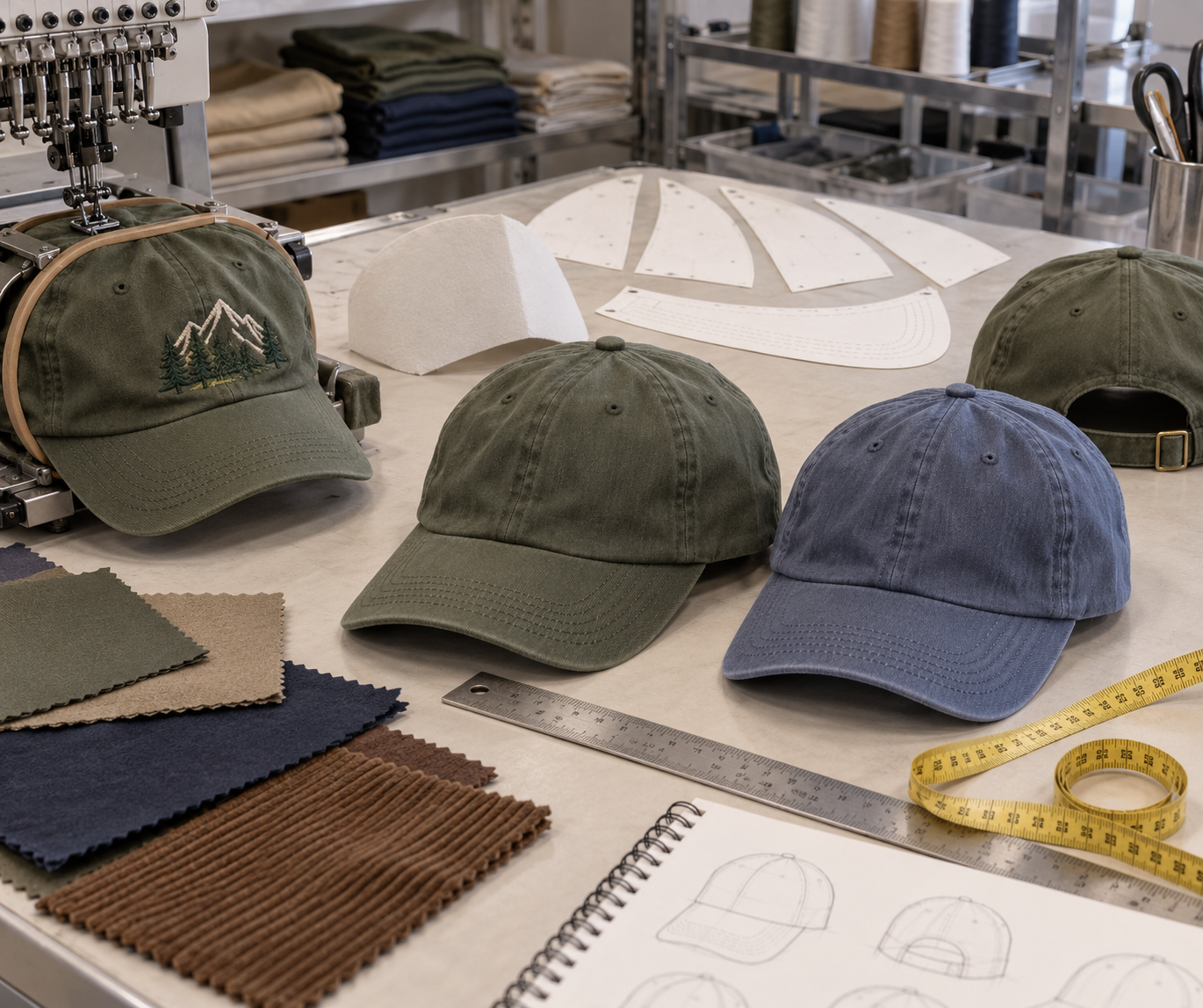
For Australian B2B buyers, dad hat sourcing product development capability should be a procurement gate, not a synonym for low MOQ. The question is whether a supplier can take a wearable, unstructured dad-hat brief through material and construction choices, sample approval, and a controlled bulk specification. That keeps the decision focused on product development for the dad-hat family rather than on a generic hat-manufacturing guide.
Australia is the sales market in this brief. The supplied evidence does not establish Australian freight timings, current labelling rules, or product-specific legal thresholds, so those items appear as RFQ verification points rather than claimed facts. The research pages are supplier-authored headwear material. Their statements are attributed offers or explanations, not independent verification, Australian benchmarks, or CrownsForge production results.
By Vincent Xi — Editorial Author. Author profile. The profile identifies the author and role; this article makes no first-person factory, testing, customer-outcome, award, or certification claim.
What product development capability means in Australian dad hat procurement
For this buying decision, product development capability means the ability to turn a brief or tech pack into an approved physical dad-hat sample and a written bulk reference. That reference should identify the crown construction, brim profile, material, closure, decoration, labels, packaging, measurements, tolerances, and approval status. A supplier may provide design support, but the buyer still needs to approve the final specification.
The Hat Manufacturing guide dated 1 July 2026 says a buyer brief should identify the hat style, vector artwork, colour specifications, and label or packaging requirements. It describes sampling checks for embroidery quality, fabric feel, fit, structure, and colour accuracy before production setup. Those are useful procurement checkpoints, but the guide presents them as general small-batch guidance rather than as an Australian quotation (Hat Manufacturing small-batch guide).
JoinTop’s custom dad hat page has publication metadata dated 10 December 2025 and modification metadata dated 14 December 2025. The page says its in-house development team supports early-stage sampling and prototyping. It lists an unstructured six-panel soft crown, optional front-panel reinforcement, deep or shallow crown options, cotton twill, pigment-dyed cotton, corduroy, nylon performance blends, recycled polyester, organic cotton, several closure types, and decoration options including embroidery, patches, appliqué, interior labels, and taping. These are JoinTop’s stated options. The supplied excerpt does not establish availability for every style, colourway, decoration combination, or quantity tier, so the quoted scope needs confirmation (JoinTop custom dad hat page).
The AceAccessory article dated 10 April 2026 distinguishes a designer’s upstream product-development role from a pattern maker’s production role. It says an in-house designer can interpret a concept, propose silhouette or seam alternatives, and convert the concept into a technical specification. It also explains that embroidery placement may need adjustment when moving from a structured reference cap to an unstructured dad hat because the fabric curves differently. This is a supplier-authored explanation, not an independent test result (AceAccessory design-team article).
How to compare sampling evidence and the approval clock
A useful sampling comparison starts with named events rather than a headline such as fast sampling. Ask when the clock begins: design approval, artwork approval, sample payment, material confirmation, or another event. Also ask what ends the clock: a photo approval, a physical sample delivered to Australia, or a written pre-production approval. Without those definitions, two lead-time claims may measure different work.
The Hat Manufacturing guide dated 1 July 2026 says small-batch custom hat production typically takes 2–5 weeks including sampling. The scope is small-batch custom hats described in that guide. The supplied excerpt does not provide an Australian transit time, a phase-by-phase split, or a clock-start event, so the range should not be relabelled as an Australian door-to-door schedule (Hat Manufacturing small-batch guide).
The AceAccessory article dated 10 April 2026 claims that an in-house design team can accelerate product development by 2–3 weeks. It also gives the article author’s estimate of saving 1–2 sampling rounds per project, using an estimate of $100–$200 per sample round including shipping, plus two weeks of calendar time per round. The excerpt does not identify the currency, destination, client population, or clock-start event. These figures are therefore supplier-authored claims and an estimate, not an Australian price, transit promise, or market benchmark (AceAccessory design-team article).
JoinTop says it supports early-stage sampling, photo approvals, and video approvals, but a dad-hat sample duration is not supplied in the research excerpt. A comparable Australian RFQ should request the number of sample rounds included, the sample fee and currency, courier responsibility, revision rules, approval event, and expected delivery point. A communication response-time promise should not be treated as a manufacturing lead-time promise.
How MOQ changes with dad hat customization
MOQ is only comparable when the denominator is clear. A supplier may mean total hats, quantity per style, quantity per colourway, quantity per decoration method, or a combined order. The RFQ should also separate setup, digitising, sample, label, packaging, and reorder charges from the unit quantity.
JoinTop’s page, with publication metadata dated 10 December 2025 and modification metadata dated 14 December 2025, states as low as 100 pcs for basic embroidered hats, 100–300 pcs for low-MOQ custom embroidery, 500–1000 pcs for full customization, and 500+ pcs for full-spec production. The page presents these as JoinTop offer tiers, not as an industry floor. The supplied excerpt does not define the quantity basis for every style, colourway, or combination, so the quote must state whether each figure applies per style, per colourway, per design, or to a combined order (JoinTop custom dad hat page).
The Hat Manufacturing guide dated 1 July 2026 defines small-batch custom hat manufacturing as typically 30–300 units per style or colourway, depending on complexity and factory capability. It says embroidered caps often start around 100 units and lists basic embroidery caps at 100–300 units. It also identifies dad hats as a recommended small-batch style. These are general guide ranges, not an Australian dad-hat quotation (Hat Manufacturing small-batch guide).
JoinTop distinguishes stock programs from full customization, stating that no-minimum language usually applies to stock programs while full customization still requires setup costs and a base quantity. That distinction should remain visible in the RFQ. A blank dad hat with later local decoration is a different procurement route from a supplier-made hat with custom fabric, closure, interior label, and packaging.
The Hat Manufacturing guide dated 1 July 2026 says that selling 100–200 units is often enough to understand whether a design has real demand. That is the guide’s market-validation suggestion, not an order quantity or Australian demand benchmark. Demand multiplied by lead time measures demand exposure; it does not automatically become extra buffer stock or a purchase quantity. Before ordering additional stock, reconcile usable inventory, available incoming supply, committed demand counted once, and a separately stated uncertainty allowance.
How to control materials, substitutions, and traceability
Material and construction flexibility can support product development, but only when the approved result remains measurable. JoinTop lists cotton twill, pigment-dyed cotton, corduroy, nylon performance blends, recycled polyester, organic cotton, metal buckles, Velcro, snaps, and strapback closures. The AceAccessory article describes possible construction alternatives involving panel and seam layout, sweatbands, eyelets, and hardware. These are supplier-authored options and examples; they do not prove that every supplier can reproduce the same result, price, or performance (JoinTop custom dad hat page; AceAccessory design-team article).
If the buyer accepts simpler optional branding, closure, or packaging, require the change in writing. The substitution must retain all buyer-agreed labelling and traceability requirements. A plain package or reduced decoration scope cannot silently remove agreed material identification, origin information, care information, lot identification, or order traceability. Those are buyer-controlled requirements here, not a statement of Australian legal applicability.
JoinTop says it sources from OEKO-TEX® certified fabric mills and describes lab-tested materials. The supplied excerpt does not include a current certificate number, issue date, expiry date, scope, test method, laboratory identity, or lot coverage. Request the relevant document for the material in the quoted dad-hat order. Do not convert a supplier certification statement into independent proof or an Australian legal conclusion.
The AceAccessory article uses a brim curve intended to hold shape better in high humidity as an example of design-team input. It does not supply a humidity level, test method, sample population, or acceptance result. If an Australian buyer needs a climate-related performance requirement, the RFQ should specify the condition, method, sample basis, and acceptance threshold rather than treating the example as proof of performance.
Buyer decision table for Australian dad hat procurement
| Decision | Buyer-controlled RFQ requirement | Supplied source context | Release rule |
|---|---|---|---|
| Brief to pattern | Specify crown, brim, panel construction, material, closure, decoration, labels, packaging, and the gap between the brief and the proposed pattern | The Hat Manufacturing guide dated 1 July 2026 lists style, vector artwork, colour, and label or packaging inputs. JoinTop’s page with publication metadata dated 10 December 2025 and modification metadata dated 14 December 2025 lists an unstructured six-panel soft crown | Do not treat a design-team offer or product menu as a completed bulk specification |
| Sample clock | Require the start event, included revisions, sample fee, currency, shipping scope, approval event, and Australian delivery point | The Hat Manufacturing guide dated 1 July 2026 says small-batch custom hats typically take 2–5 weeks including sampling. The AceAccessory article dated 10 April 2026 claims 2–3 weeks of development acceleration and estimates 1–2 saved sampling rounds at $100–$200 per round including shipping, plus two weeks per round; currency and destination were not supplied | Compare only like-for-like clocks and do not treat a supplier estimate as a guaranteed schedule |
| Customization tier | Request separate quote lines for basic embroidery, custom embroidery, full customization, and full-spec production, with quantity basis | JoinTop’s page, published 10 December 2025 and modified 14 December 2025, states 100 pcs for basic embroidery, 100–300 pcs for low-MOQ custom embroidery, 500–1000 pcs for full customization, and 500+ pcs for full-spec production | Require the exact style, colourway, decoration, label, and packaging scope behind each tier |
| Small-batch basis | State units per style and colourway, setup charges, digitising, labels, packaging, and reorder terms | The Hat Manufacturing guide dated 1 July 2026 says 30–300 units per style or colourway and 100–300 units for basic embroidery | Treat the guide range as general evidence, not as the supplier’s Australian quotation |
| Soft-crown branding | Require a physical sew-out and logo-placement approval on the actual unstructured dad-hat crown | The AceAccessory article dated 10 April 2026 says structured-cap embroidery may look different on an unstructured dad hat. JoinTop lists an unstructured six-panel soft crown | Do not release bulk production from artwork-file approval alone |
| Materials and certification | Request the exact material, finish, colour reference, applicable test documents, certificate scope, issue or expiry details, and lot coverage | JoinTop says it uses lab-tested materials and sources from OEKO-TEX® certified mills; those document details were not supplied in the excerpt | Treat the statement as an attributed supplier claim until current documents are reviewed |
| Substitution control | Require written approval for every fabric, construction, closure, branding, or packaging change and preserve agreed labelling and traceability | JoinTop lists material and branding options. AceAccessory describes design-team alternatives. Retaining buyer-agreed labelling and traceability is a buyer-defined control | Reject an unapproved substitution even if the simplified option appears commercially acceptable |
| Bulk acceptance | Approve a pre-production sample, measurement sheet, colour reference, tolerances, and acceptance or rejection process | The AceAccessory article dated 10 April 2026 describes a final approved PP or Gold Seal sample and a specification sheet as a consistency reference | Write the buyer’s own limits; the source’s illustrative examples are not recommended dad-hat tolerances |
| Australian delivery and applicability | Require freight scope, delivery point, quote-validity date, and a separate check of current Australian product and labelling applicability | The supplied excerpts do not establish Australian freight prices, transit times, legal thresholds, or current official labelling requirements | Keep unresolved legal and logistics items open until verified from current appropriate sources |
Methodology, limitations, and what to verify
The method was a direct comparison of each quantitative or operational claim with the supplied page excerpts and their capture metadata. A number was retained only when its unit, product scope, quantity basis, time context, supplier, or source estimate could be preserved. Buyer-defined checks and calculations were kept separate from attributed supplier claims. A missing detail in the supplied excerpt is treated as unresolved; it is not treated as proof that the original page omits the detail.
The supplied capture receipt records retrieval of the source pages on 10 October 2026. JoinTop’s 10 December 2025 publication date and 14 December 2025 modification date are page metadata, not quote-validity dates. AceAccessory’s figures come from its article dated 10 April 2026. Hat Manufacturing’s ranges and 2–5 week statement come from its guide dated 1 July 2026. None of those dates establishes a current price, freight offer, production slot, or certificate validity period.
The evidence does not include current official Australian compliance text, a current certificate document, a lot-specific laboratory report, an independent factory audit, an Australian freight quotation, a quote-validity period, or first-party production and customer-outcome evidence. This review therefore assigns no legal threshold, price, transit promise, market benchmark, or demand metric. Before issuing a purchase order, verify the applicable Australian requirements, legal manufacturing entity, material documents, sample approval record, quote validity, freight scope, and acceptance standard.
RFQ Checklist
- Specify the approved dad-hat construction, including crown and brim profile, panel configuration, fabric, closure, decoration, labels, and packaging.
- Ask the supplier to return a written gap list showing what is missing from the brief, artwork, or tech pack before sampling begins.
- Require the manufacturer to state the sampling clock start, number of revisions, sample fee, currency, shipping responsibility, and approval event.
- Define separate quote lines for basic embroidery, custom embroidery, full customization, and full-spec production, with MOQ per style and colourway.
- Require a physical embroidery sew-out and logo-placement approval on the actual unstructured dad-hat crown.
- Ask the supplier to document every fabric, construction, closure, branding, or packaging substitution and to preserve buyer-agreed labelling and traceability.
- Specify the material name, weight or finish where relevant, colour reference, and required test method; request any certificate scope and lot coverage in writing.
- Require a pre-production sample, measurement sheet, colour reference, tolerances, and acceptance or rejection process before bulk cutting.
- Verify current Australian labelling and product-applicability requirements with an appropriate official source before approving the final label set.
- Ask the supplier to identify the legal entity and physical site that will cut, sew, inspect, and pack the order, and place that information on the proforma.
- Require the freight quote to state the transport mode, delivery point in Australia, included services, exclusions, and quote-validity date.
An Australian dad-hat offer is ready for like-for-like comparison when product-development scope, sample control, quantity basis, substitution rules, traceability, delivery scope, and acceptance criteria are visible in writing. Low MOQ can be useful, but it cannot replace those controls.
Discuss Your Requirements
Review our manufacturing capabilities, then share your specifications for a supplier-fit review.
Sources
- Top Custom Dad Hat Supplier for U.S. Brands | Low MOQ & OEM
- Why Should I Choose a Factory with an In-House Design Team for Hats? - AceAccessory
- Small Batch Custom Hat Manufacturing Guide (2026 Edition) - Hat ManufacturingExpandExpandExpandTikTokFacebookInstagramShopping CartToggle MenuPreviousContinueContinueContinueContinueContinueContinueContinueScroll to topScroll to topExpandExpandExpand