Dad Hat OEM Digital Integration Readiness for Malaysia Manufacturing Orders
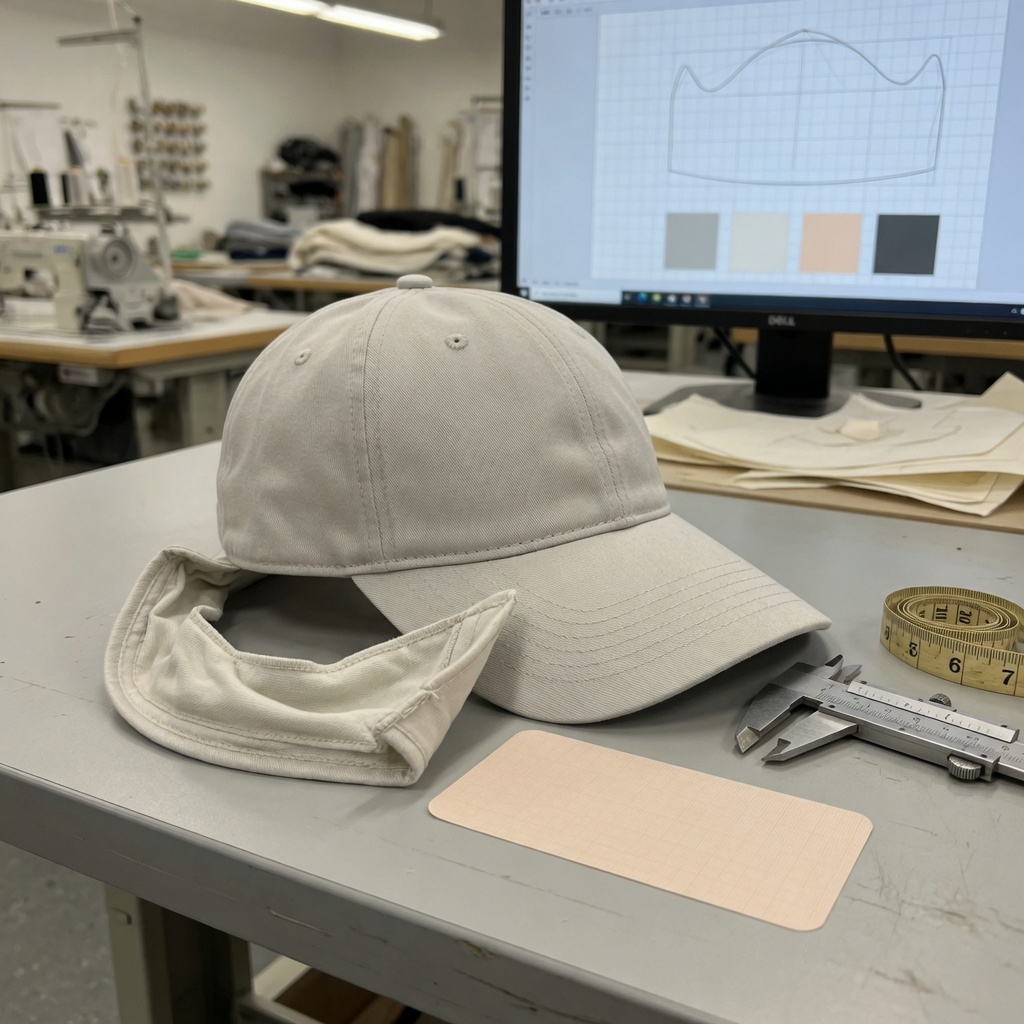
Malaysian buyers should release a dad hat OEM order into manufacturing only when one version-controlled tech pack is the file that sampling, cutting, stitching, and bulk will follow. Digital integration readiness, for that Malaysia order, means the factory can show which data it will execute, who may change it after design approval, and which measurement releases the bulk. It does not mean sewing machines are networked, and it is not a price or lead-time benchmark.
On the New Generation Headwear article, which gives a Shenzhen address, the site navigation includes the label UNSTRUCTURED - DAD CAP. That article describes a smart hat tech pack as a dynamic system with measurement matrices, material curves, and thread specs, and it gives Tex 60 for structured crowns or Tex 40 for soft-finish dad hats as examples (How Digital Hat Tech Packs Turn Factories into Innovation Engines). For this Malaysia order, write the crown construction and the head-worn brim. Brim here means the peak on the hat, not a vehicle part. The navigation label and the phrase soft-finish dad hats appear separately. A statement that those two labels are interchangeable was not supplied in this research excerpt, so the order should name the construction rather than assume it.
CrownsForge publishes this manufacturing note under the byline of Vincent Xi, Editorial Author (author profile). The note does not report a factory visit, a wear test, a client program, or a CrownsForge production result. Each figure stays with the publisher and the case that stated it.
Treat the file as ready for this order only if it states crown construction, Tex, stitches per inch, and a brim tolerance with its unit; the bulk work order cites that same revision; and any structured-crown rule or NFC inlay is excluded or written on its own line. Hold the quotation if those points are still implied. This pass test is a purchasing control for the order, not a cited certification.
What Malaysia buyers should lock before dad hat manufacturing starts
Lock the dad hat specification before comparing quotations. A lower price that still carries a structured-cap default is not a ready manufacturing file.
- Construction: the crown the buyer wants, panel count, closure, and head-worn brim.
- Thread and stitch: Tex size and SPI. In the New Generation article, SPI is stitch density, and the worked example is stitches per inch.
- Geometry: brim curve, a tolerance in millimetres, and the measuring method.
- Revision rule: the ERP or work-order field that must match the tech-pack version.
- Optional NFC or RFID: in scope only if a tap or identity function is required, and specified apart from the textile build.
New Generation gives a structured-fit example in which the file enforces interlining thickness of at least 1.8 mm and SPI of at least 10 when structured fit is true. A separate line calls SPI below 9 on a structured crown a hard stop. Those are that article's examples for structured builds. They are not identified as a requirement for a soft-finish dad hat. One rule that classifies SPI 9 was not supplied in this research excerpt, so do not invent a single threshold. Leaving the word structured undefined on a Malaysia order can add interlining that the soft-finish dad hat file did not approve.
The cost illustration in that article is a snapback, worded as a U.S. streetwear label sending a design to Vietnam. It is not a dad hat result and not a Malaysia price. It says stitch density dropping from 10 to 8 per inch, or brim curvature outside a +/-1.5 mm tolerance, can trigger a three-week rework cycle costing up to $18K per style. The next sentence treats a Tex 40 versus Tex 60 substitution as a further risk, noticed when the first batch pills, and it does not assign that risk the same $18K figure. A later sentence says a missed SPI tolerance or Tex mismatch can cost $18K and 14 days per style. This research excerpt presents those as separate statements. A shared style or clock-start was not supplied in this research excerpt, so they should not be merged into a lead-time or price benchmark. A publication date for that article was not supplied in this research excerpt. Use the illustration only to ask how the bidding factory prices a failed tolerance on this dad hat.
Tech-pack records that separate a soft dad hat from other cap cases
Use the dad-hat cue as a starting contrast, not as a standard: the article's examples are Tex 40 for soft-finish dad hats and Tex 60 for structured crowns. Do not paste the case percentages below into the purchase order. They become acceptance terms only if the factory restates the unit, the quantity basis, and the limit on this dad hat file.
Verge Berlin, described as a European cycling-lifestyle brand, launched a five-panel cap in 2023. New Generation says the first run, made from static PDFs, lost 2,400 units to brim delamination after manufacturers in that supply chain interpreted the brim curve in three different ways. After a rule-driven digital tech pack with embedded stitch logic and +/-1.5 mm cutting tolerances, the article says pre-production cleared in eight days instead of twenty-four, and the rejection rate fell from 22% to under 4%. The 2,400-unit loss is not stated as the denominator of the 22% rate. That +/-1.5 mm figure is a cutting tolerance on the five-panel pack, not the brim-curvature scenario in the snapback illustration. A clock-start for the eight-day and twenty-four-day counts, and a separate date for the rejection-rate result, were not supplied in this research excerpt. The style is a five-panel cap, not a soft-finish dad hat, and the result is not an industry average.
The Green Stitch, described as a Scandinavian sustainable-headwear startup, placed a 2024 pre-order for 8,000 organic cotton snapbacks across two Asian cap manufacturers. New Generation says one factory used Tex 40 on perforated panels designed for Tex 60, seam puckering increased, and 17% of units failed final QC. Whether 17% applies to the full 8,000-unit pre-order or only to the factory that changed the thread was not supplied in this research excerpt. After a move to a digital tech pack synced with that brand's factory audit protocols, the article reports a next-batch rejection rate of 3.8% and a customer return rate cut by half. No baseline return percentage is stated, and a date for that next batch, separate from the 2024 pre-order, was not supplied in this research excerpt. A dad-hat failure of this type was not supplied either. The buyer check is an inference from the contrast, not a reported dad-hat defect: do not apply the article's Tex 60 example, or its structured SPI example, to a soft-finish dad hat that the same article associates with Tex 40, unless the approved strike-off for this order says so.
Two broader citations are apparel-operations claims as relayed by New Generation, not headwear censuses, and they were not remeasured for this note. New Generation attributes to Lectra's 2024 Fashion PLM Survey the statement that rule-driven tech packs clear approvals 52% faster than PDFs. It attributes to McKinsey's 2025 Apparel Operations Benchmark the statement that digitized workflows save 11.3 labor hours per style and cut first-batch rejection rates from 29% to 11%. Neither attributed result is limited, in this excerpt, to dad hats, Malaysia, or one named factory. They support a question about hours and first-batch rejection on this style. They are not a contract target.
ERP version control is the manufacturing handoff
Do not start bulk while design, the sample room, and the sewing line can each hold a different PDF. New Generation describes a Canadian urbanwear brand editing a crown curve in CAD, with the linked tech pack recalculating seam allowances and fabric yields across connected factories in real time. The same article describes version-integrity logs as an audit trail. That example states no percentage, and it does not set a waste rate for a Malaysia-bound dad hat.
The waste figure attached to an ERP sync is a different claim. New Generation says one Mexico-based cap factory reduced pre-production waste by 37% annually after syncing cloud-based tech packs with its ERP. The factory is unnamed, the product is not identified as a dad hat, the waste unit and formula are not shown, and the year covered by that annual result was not supplied in this research excerpt. Treat 37% as that article's single unnamed-plant claim, not a Malaysia benchmark.
A second source is AceAccessory's smart-factory article, which carries a 13 November 2025 publication timestamp (How Can Hat Manufacturers Implement the Smart Factory Concept?). That supplier names OPC UA and MTConnect as examples of unified communication protocols, and it says its own implementation connected legacy brim-molding machines with new automated sewing systems and material-handling equipment. A certificate number was not supplied in this research excerpt and needs verification on the quotation if a bidder claims one. A dad-hat job using those protocols was not supplied in this research excerpt either. In that account, OPC UA and MTConnect are communication protocols, not a certification held by CrownsForge or by an unnamed bidder.
After design approval, write the tech-pack revision ID that bulk must match, the system of record, and the roles allowed to edit Tex, SPI, brim curve, and the bill of materials. Also name the lead-time clock-start. Examples the buyer can write into the order are sample approval, artwork approval, or fabric in-house. Those are order terms to set, not durations published in the sources. A claim that planning systems are connected does not replace that date.
Where sensor QC and digital twins do, and do not, apply
Do not require networked sensors to manufacture a conventional dad hat. If a factory offers tension alarms, cameras, or a digital twin, turn the offer into a release gate: which defect stops the order, whether the check is 100% or sampled, and what the unit is. The percentages in this section are AceAccessory's account of its own work in the article published on 13 November 2025, not a third-party audit and not a dad hat trial.
On its baseball-cap line, the article says sensors monitor sewing-machine speed, stitch consistency, and needle temperature. For knit beanies, it says sensors track yarn tension, knitting speed, and pattern consistency. In that same account it says the system identified a 12% variation in embroidery thread tension that was causing inconsistent logo application on caps, that the issue had previously gone undetected until quality inspection, and that hundreds of defective units had been produced by then. Hundreds is the article's wording, not an exact unit count. That the 12% reading came from the sewing-speed, stitch-consistency, or needle-temperature sensors was not supplied in this research excerpt. A measurement date was not supplied in this research excerpt. The only timing word supplied is recently. The 13 November 2025 timestamp is the article publication time, not the production period and not a quote-validity date.
The visual-inspection claim is separate. The article says those systems perform 100% quality checking of hats at multiple stages, including cap-brim curvature and, for beanies, knitting consistency, and that this inspection reduced customer returns by 64% and improved its first-pass quality rate from 87% to 98.5%. The number of hats inspected, a baseline return rate, and a measurement date were not supplied in this research excerpt. Do not copy 12%, 64%, 87%, or 98.5% into the dad hat specification.
The digital-twin claim is also separate. The article says a brim-molding digital twin reduced material trial waste by 92% when new recycled materials were introduced on its eco-friendly cap line. An unstructured or soft-finish dad hat trial was not supplied in this research excerpt. Do not copy 92% into this order.
NFC as a separate digital component, not a textile assumption
Leave NFC out of the dad hat textile price unless a tap or identity function is in the brief. Global-Caps, on a page that carries a Shanghai Fumao Clothing copyright, says NFC cap sourcing needs a tag supplier and a factory that can embed the inlay so it remains functional after washing and wear (How to Source NFC-Enabled Smart Caps for Brand Engagement?). It tells buyers to insist on flexible, ultra-thin textile tags rather than rigid tags, to request wash-cycle test reports, with 50 or more cycles given as the example, plus the encapsulation method, and to check NFC Forum certification and wireless rules for the destination market. The market examples it names are FCC and CE. It also gives NTAG 216 as an example of memory size to discuss, not as a chip this order must use. A Malaysia type approval, label rule, or spectrum condition was not supplied in this research excerpt and needs verification on the order. Require the bidder to name the conformity file it will provide for a Malaysia delivery, or to state that Malaysia conformity is not included.
The article lists placements inside the sweatband, under the brim, or in a label pouch, and it warns that fabric that is too thick, or metal at the tap point, can interfere with the read. It says the usual encoding method is a URL. The vetting questions it recommends include prior apparel NFC or RFID examples, the attachment method, whether read range and comfort are maintained, a 100% tap test, and wash-test sampling. Those are questions in the article, not published test scores for a named dad hat.
On money, the article says to expect a 20-50% increase over a standard cap, depending on tag specifications, encoding labor, and order volume. That range has no validity date, no currency, and no soft-finish dad hat or Malaysia freight scope. On quantity, it says tag suppliers often have high minimums, with 10,000 or more units given as an example, which may differ from the sewing factory's minimum. Do not treat 10,000 units, or the 20-50% range, as the commercial term for this order unless the quotation states that basis.
Decision table for dad hat OEM digital integration readiness
| Buyer decision | What to write into the dad hat order | Attributed evidence to compare | Limit of that evidence |
|---|---|---|---|
| File type | One digital tech pack with the stated crown, Tex, SPI, head-worn brim curve, and revision ID | New Generation contrasts rule-driven packs with static PDFs and attributes to Lectra's 2024 Fashion PLM Survey a claim of approvals 52% faster than PDFs | Apparel PLM speed, as relayed here, is not a dad hat seam result |
| Thread | Record Tex 40 only as that article's example for a soft-finish dad hat, unless this order's strike-off states another Tex | New Generation pairs Tex 40 with soft-finish dad hats and Tex 60 with structured crowns | The Green Stitch 17% final-QC figure was on snapback panels specified for Tex 60, and the 17% denominator was not supplied |
| Structured logic | State soft-finish or unstructured and do not import interlining of at least 1.8 mm or SPI of at least 10 unless you approve that structured rule | Those values are New Generation's example only when structured fit is true; SPI below 9 is a separate structured-crown stop | One classification for SPI 9 was not supplied in this research excerpt, and neither line is identified as a dad hat requirement |
| Tolerance | State brim or cutting tolerance in millimetres and how it is measured | +/-1.5 mm appears as brim curvature in the snapback illustration and as cutting tolerance on the Verge Berlin five-panel pack | No dad-hat sample at +/-1.5 mm, and no shared instrument, was supplied in the excerpt |
| ERP handoff | Bulk work order cites the same revision; edits to Tex, SPI, and curve are logged | A Canadian urbanwear example of a live crown-curve yield update, plus one unnamed Mexico cap factory's stated 37% annual pre-production waste reduction after an ERP sync | The live-update example has no percentage; the 37% claim has no plant name, waste unit, or year in the excerpt, and it is not a Malaysia benchmark |
| Machine data | Optional gate only: metric, unit, and 100% versus sample | AceAccessory article published 13 November 2025: 12% embroidery-tension variation on caps; visual checks described as 100%, with returns reduced 64% and first-pass quality from 87% to 98.5%; brim-molding twin stated as 92% less trial waste on a recycled-material cap line | Supplier self-report. Counts, baselines, and measurement dates were not supplied. Publication date is not a validity date. Not this dad hat |
| NFC | Out of scope, or a separate line for placement, encoding, wash-cycle report, and tap test | Global-Caps: flexible tags, a 50-or-more cycle report as the example to request, NTAG 216 as an example memory chip, and a 20-50% expected increase versus a standard cap | The cost range is not a quotation and is not dad-hat or Malaysia specific; 10,000 units is that article's example of a tag-supplier minimum |
How the figures were selected, and what buyers still verify
Do not average these figures into a Malaysia price, a defect rate, or any other benchmark. Figures in this note were taken from the three manufacturer articles linked above: New Generation Headwear, AceAccessory, and the Global-Caps page carrying a Shanghai Fumao Clothing copyright. The excerpts used here were retrieved on 22 September 2026. That retrieval date is not a quote-validity date and is not the measurement period for any percentage. AceAccessory's publication timestamp in the excerpt is 13 November 2025. A publication date for the New Generation page and for the Global-Caps page was not supplied in this research excerpt.
Measured case figures were kept only when the excerpt gave a unit or count, a product or style, and the publisher. Survey figures were kept only with the survey name New Generation used, and they are marked above as not dad-hat results. A missing date, denominator, waste unit, or clock-start is stated beside the figure rather than filled. Buyer-written controls in this note, including the pass test and any choice to start from Tex 40, are assumptions to verify in the supplier quotation. They are not attributed factory results.
The cases stay with the style named where each figure is introduced. Verge Berlin is a 2023 five-panel cap, not a soft-finish dad hat. The Green Stitch account is a 2024 organic-cotton snapback pre-order. The 37% waste claim is one unnamed Mexico cap factory. AceAccessory's tension, return, first-pass, and trial-waste figures are that supplier's own description in an article published on 13 November 2025, not a dated dad-hat trial. Global-Caps' cost range, wash-cycle example, NTAG 216 example, and tag-minimum example are planning statements for smart caps, not a priced dad hat. Nothing here was converted to ringgit. A quote-validity date was not supplied in these excerpts.
Before award, verify the items this evidence set does not settle. A dad-hat-only defect study, a Malaysia wireless ruling, a humidity or tropical-wear method for a Malaysia-bound dad hat, a freight plan, and a current price were not supplied in this research excerpt. That is a limit of the evidence used here, not proof that a factory lacks the documents. Supplier articles speak for the supplier: the unit-loss and yield figures were not remeasured independently for CrownsForge. The Lectra and McKinsey figures, as cited by New Generation, do not certify a plant. NFC Forum, FCC, and CE are marks the Global-Caps article tells buyers to check for markets those marks cover. They are not evidence that a tag discussed here, or any CrownsForge product, currently holds them, and they do not replace a Malaysia conformity file. Contract language should name the dad hat construction, the unit, the quantity basis, and the acceptance limit the supplier will sign.
RFQ Checklist
- Ask the supplier for one version-controlled digital tech pack for this unstructured dad hat, including panel count, soft crown, head-worn brim geometry, Tex, stitches per inch, closure, and each tolerance with its unit.
- Require the manufacturer to show the ERP or work-order field that carries that revision into bulk, and who may edit Tex, stitch density, curve, or materials after design approval.
- Specify that structured-cap defaults stay out of scope unless you approve them in writing, including interlining of at least 1.8 mm and SPI of at least 10.
- Compare pre-production samples built from that same file, and require recorded head-worn brim measurements against the stated millimetre tolerance.
- Ask the supplier which sensor, camera, or digital-twin check will actually run on this dad hat, which defect it stops, and whether the check is 100% or sampled.
- Require the manufacturer to price any NFC or RFID inlay on its own line, with flexible tag type, placement, encoding, tap-test plan, wash-cycle count and method, and the quantity those costs assume.
- Verify which conformity documents cover a Malaysia delivery, and accept an NFC Forum, FCC, or CE reference only together with the current file the supplier will provide.
- Ask the supplier to state the lead-time clock-start, the bulk acceptance sample, and the rework term if Tex, stitch density, or brim curve misses the approved revision.
Discuss Your Requirements
Review our manufacturing capabilities, then share your specifications for a supplier-fit review.