Dad Hat OEM Communication Workflow Review for United States Buyers
Vincent Xi, Editorial Author - https://crownsforge.com/authors/vincent-xi/
United States buyers should not place a dad hat OEM order on a fast greeting or a unit price alone. This dad hat OEM communication workflow review treats manufacturing as a written process: the supplier stays on the shortlist only when the record names a reply clock, an art and sample approval gate, and the evidence due at each stage. A soft dad hat still has to match the approved fabric, stitch, crown, and quantity.
The figures below come from three supplier pages. They are not CrownsForge results, not an independent audit, and not a United States legal deadline. Anthea's 6 March 2026 article says a custom hat manufacturer should answer an initial inquiry within 24 hours on business days and ongoing messages within 12 hours (Anthea Hats). Pechoter's 4 June 2025 article describes milestone notices from design approval through shipping handoff (Pechoter). The Hat Manufacturing guide published 1 July 2026 says small hat batches typically take 2-5 weeks including sampling (Hat Manufacturing).
Communication Workflow Review Method
Keep each number with its supplier, unit, product scope, and page date. If the text reviewed here does not give a sample size, order count, or measurement window, leave the gap open. Do not borrow a missing qualifier from another factory.
This is an editorial review of wearable dad hats, a head-worn cap with a soft crown and brim. It is not a factory visit or a wear test. Vincent Xi is the Editorial Author, and this page adds no production record. Dates on the source articles are publication context, not quote-validity dates.
A supplier line can show a target or a self-measured result. It does not prove the same result on the next dad hat order. United States fiber-identification, country-of-origin, and care-label rules were not supplied in these texts. This review states no legal threshold and does not treat a packing habit as compliance. Confirm those rules, and the quote validity date, from current official sources and the written offer.
United States Reply Clocks and Written Records
Anthea's 6 March 2026 article says the supplier should reply within 24 hours on business days for an initial custom-hat inquiry and within 12 hours for ongoing project messages. Its rubric is under 12 hours, keep the supplier on the shortlist; 24 hours, acceptable if the buyer proceeds with caution; and 48 hours or longer, move on. That rubric is Anthea's, not a statute, and it was not re-tested here on a dad hat order (Anthea Hats).
Anthea illustrates the gap with an email from New York at 2 p.m., which it calls the middle of the night in China, and says its own team sees that email on arrival at 9 a.m. It says a supplier who blames the time zone for a 3-day delay is making excuses. The 9 a.m. start describes Anthea's team only. Its hope that the buyer wakes up to a reply is an expectation, not a measured rate.
Anthea uses WhatsApp for quick questions and email for official records such as quotes and invoices. It warns against an instant yes to complex 3D embroidery on a mesh seam or to a 2-day sample, and it calls a promise of 500 hats in 3 days a lie aimed at the deposit. A careful reply might take 2 hours rather than 2 minutes while a master technician measures the hat panel and calculates stitch count. No stitch-count formula or embroidery price was supplied in the text reviewed here. A reply that gives a price and skips fabric weight is another warning. Do not treat a generic yes as a check of the dad hat crown, brim, or front panel.
Anthea's inquiry checklist asks for mold fees, shipping, and unit cost within 24 hours. Those are separate lines, not a United States landed price. No unit prices were supplied in that text, so this page states no dad hat price. Ask for the unit, decoration or mold, labels, packaging, and freight as separate lines, each tied to a stated quantity.
Milestone Notices, Inspection Claims, and Delays
Pechoter's 4 June 2025 article says notifications should include milestone alerts, a visible status, a timeline adjusted for order complexity, and a channel for questions. In the system it describes, design approval goes within 24 hours of the order and includes a digital mockup and a timeline estimate. Later notices follow events, not that same 24-hour clock: materials secured, the first hat on the line, 25 percent, 50 percent, 75 percent, quality-control start, packaging start, and shipping handoff. The 50 percent notice includes mid-production samples and any adjustments. Stage files include material photos, a short video, progress statistics and quality metrics, a projected completion date, inspection and packaging photos, and tracking with an estimated arrival. Channels in that table include email, a portal, photos, short video, SMS, and a dashboard update (Pechoter).
Pechoter reports that this system reduced order-status inquiries by 78 percent and raised satisfaction scores from 7.1 to 9.4 out of 10. Client count, order count, and baseline dates were not supplied in the text reviewed here. Treat both figures as Pechoter's self-reported headwear result, not a rate for every dad hat order.
The same article describes inspection of the first 10 pieces on a 27-point checklist, with production paused if issues are found, then inspection of 5 percent of the first 100 units, mid-run sampling at AQL 2.5, and a final random check before packaging. The checklist points were not supplied in the text reviewed here. Pechoter states a defect rate under 0.4 percent across all of its production, and says warranty claims and returns decreased by 94 percent since the system was implemented five years earlier, as that 4 June 2025 article puts it. The defect rate is not identified as dad-hat-only. Naming AQL 2.5 is not a certification, and these texts do not make that sampling plan a United States legal requirement.
Pechoter reports on-time delivery from 82 percent to 97.8 percent while average quoted lead times fell by 15 percent. Separately, it says lead times were reduced by up to 40 percent for its most consistent clients. The 40 percent figure is not the 15 percent average and not a dad hat guarantee. Order count and the comparison window were not supplied in the text reviewed here. The article also says small buffers sit in each stage, visible internally but not on the client-facing timeline. Ask whether the purchase-order date already includes that pad. These pages do not report usable stock or committed demand, so the pad is not an order quantity.
From the 18-plus years of custom headwear production described in that article, Pechoter assigns historical issues to materials at 31 percent, capacity at 27 percent, external disruption at 24 percent, and quality at 18 percent. Those shares are a past mix, not the odds of the next dad hat order. After a delay, the article calls for the earliest specific notice, a revised timeline, and options such as expedited shipping or a price adjustment. Its risk review is described for orders above 1,000 units. That threshold does not by itself put a delay clause on a smaller dad hat run.
Do not fold Anthea's checklist into those percentages. Anthea calls for weekly updates, with examples that fabric has been cut, embroidery is underway, and packing has started, plus tracking within 24 hours of dispatch. It asks for raw-material photos, then high-resolution sample photos from four angles, and it does not ship the sample until those photos are approved. Anthea's 24 hours after dispatch and Pechoter's notice when the order leaves the facility are different triggers.
Dad Hat Quantity, Sampling, and Calendar Messages
The 1 July 2026 Hat Manufacturing guide describes small-batch hat production as typically 30 to 300 units per style or colorway, depending on complexity and factory capability. It says embroidered caps often start around 100 units. Its stated ranges are 100-300 pieces for basic embroidery caps, 50-100 pieces for heat-transfer designs, and 300 pieces or more for complex structured hats. It lists dad hats for small batches because the structure is soft and embroidery is easy. That is the guide's recommendation, not a measured result for every soft cap (Hat Manufacturing).
The same guide says even small batches typically take 2-5 weeks including sampling. Sampling is where embroidery quality, fabric feel, fit, structure, and color accuracy are confirmed. Changes after approval can raise cost and delay production. No dollar amount for that increase was supplied. Setup effort is described as almost the same for a small run as for a large run, and setup cost as almost fixed in the guide's examples of 50 units and 500 units, which is why it says the per-unit price is higher on a small run. Those quantities are not a dad hat price.
On the Anthea page that carries the 6 March 2026 article, an advantages line states a low MOQ of 200 pieces per design and fast sampling of 7-10 days. A separate validity date for that line was not supplied in the text reviewed here. Do not add the 7-10 day sampling line to the 2-5 week range, and do not treat 200 pieces per design as the same denominator as 30 to 300 units per style or colorway. The quote has to name the basis and the event that starts the clock, such as design approval, sample-photo approval, or deposit.
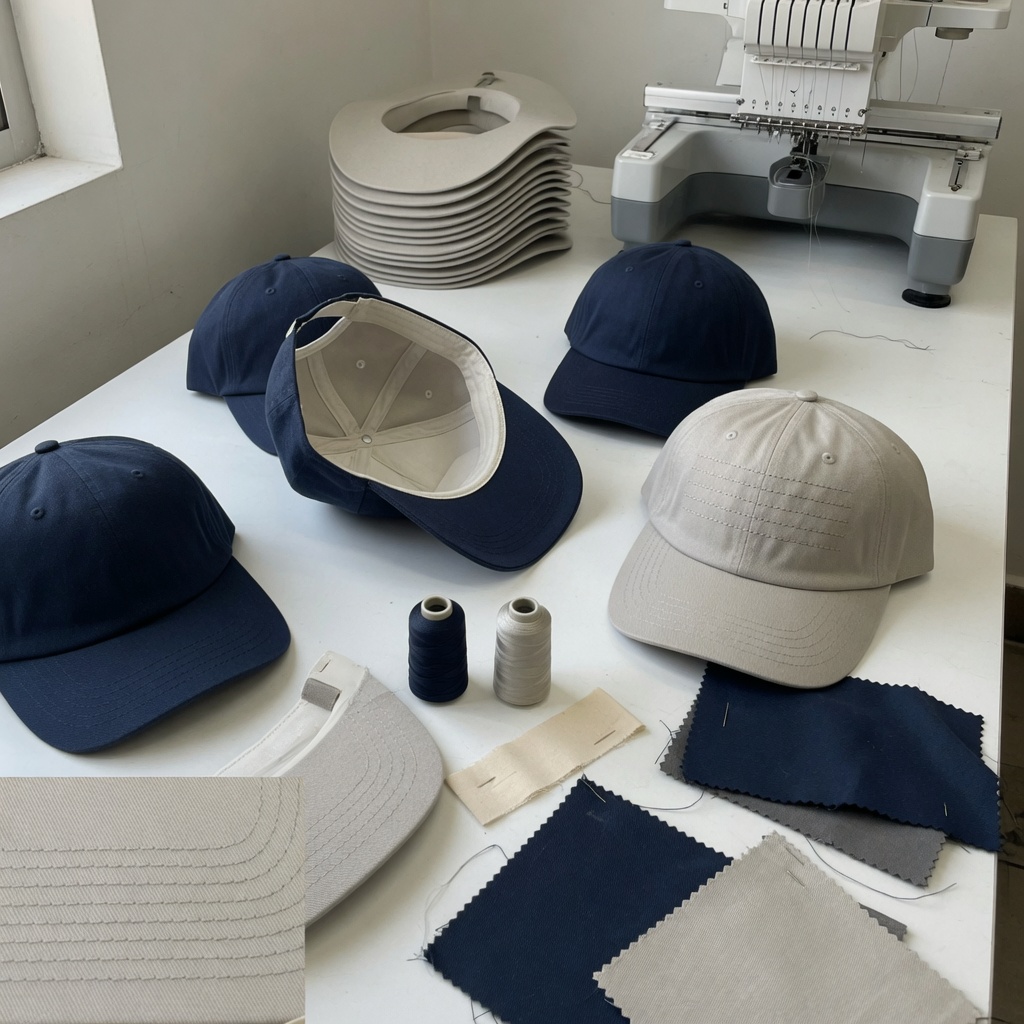
A tech-pack message, as that guide describes the buyer's inputs, names the hat style, prefers vector logo artwork, asks for a color specification with Pantone where possible, and includes the label or packaging requirement. Later steps are sampling, digitizing and cutting setup, bulk production, and inspection of stitch accuracy, shape consistency, and logo alignment. For this review, those steps are approval messages the buyer can see in writing, not a factory manual.
Landed-Cost Lines and Label Substitution
Do not build a United States landed cost from these pages. No dad hat unit price, freight rate, duty rate, or United States transit time was supplied in the three supplier texts reviewed here. Anthea names shipping as a quote line rather than a finished landed cost. The 1 July 2026 guide lists air versus sea freight among cost factors, with fabric, embroidery complexity, the number of colors in the logo, custom labels, packaging, and sampling fees. Those points support a line-item request only. If the buyer adds the lines into a working total, label that total as buyer arithmetic until the supplier confirms every input and the quote validity date.
Labels, hangtags, and packaging appear as specifications, not as quoted United States legal thresholds. Whether a particular dad hat must carry fiber content, origin, or care information is unresolved in this evidence. A factory's usual pack is not proof of compliance. If optional branding or an optional pack format is simplified, keep the agreed style code, the quantity basis, and the approval revision on the tech pack, the purchase order, and the packing list, together with any mark a separate compliance check still requires. That document match is a buyer-defined traceability control. It is not a certification, and none is claimed here.
Pechoter describes pre-approved material substitutes for use when a primary material is unavailable. A different fabric or thread can change the feel and color that sampling is meant to confirm, while the style name stays the same. Require written approval of any substitute before cutting. Silence in chat is not an approval, and a factory backup is not automatically the material named on the purchase order.
Buyer Decision Table
| Buyer decision | Attributed reference | Scope to keep | Approval action |
|---|---|---|---|
| Initial reply | 24 hours on business days for a first inquiry | Anthea article, 6 March 2026; not a United States legal deadline | Name the time zone and which days count |
| Live-order reply | 12 hours for ongoing project messages | Same Anthea article; not re-audited here | List which decisions must meet that clock |
| Record channel | WhatsApp for quick questions; email for quotes and invoices | Anthea's stated channel split | Confirm chat approvals by email before they bind the order |
| Quote split | Mold fees, shipping, and unit cost within 24 hours | Anthea checklist; no prices supplied in that text | Separate unit, decoration, labels, pack, and freight |
| Art gate | Mockup before physical work; timeline estimate on the design notice | Anthea's pre-work proof and Pechoter's notice within 24 hours of the order are separate statements | Approve crown and brim placement before sampling |
| Sample gate | Raw-material photos, then four-angle photos before the sample ships | Anthea's stated photo hold | Keep photo approval separate from physical-sample approval |
| Quantity basis | Typically 30 to 300 units per style or colorway; embroidery often near 100; Anthea line states 200 pieces per design | Guide dated 1 July 2026 versus Anthea's per-design line; denominators differ | Show every denominator on the quote |
| Calendar | 2-5 weeks including sampling, versus a 7-10 day sampling line | Guide end-to-end range versus Anthea advantages line; do not add them | State the clock-start event and any excluded wait |
| Milestones | Materials, first output, 25, 50, and 75 percent, inspection, packing, dispatch | Pechoter list in the 4 June 2025 article | Choose each notice and the file it must carry |
| Inspection plan | First 10 pieces on a 27-point list, pause if issues are found; 5 percent of the first 100 units; AQL 2.5 | Pechoter's plan; checklist points were not supplied; not a certification or a legal rule | Ask whether a failed first-article check stops this order |
| Delay history | Materials 31 percent, capacity 27 percent, external 24 percent, quality 18 percent of that historical mix | Pechoter's 4 June 2025 account of 18-plus years; not the odds of this order | Require the cause, a revised date, and written substitute approval |
| Dispatch file | Anthea: tracking within 24 hours of dispatch. Pechoter: tracking when the order leaves the facility | Two triggers; no United States transit time was supplied | Match tracking, ship date, pieces, and cartons to the order |
| Simpler branding | Labels and packaging are specifications in these sources | United States legal thresholds were not supplied; style-code match is a buyer-defined check | Keep the style code, quantity basis, and any required marks if optional branding is removed |
RFQ Checklist
- Specify the dad hat fabric, crown construction, brim, closure, size range, and decoration method as separate lines.
- Ask the supplier to define the initial-inquiry reply clock and the ongoing-order reply clock, including business days, time zone, and the event that starts each clock.
- Require an email record of any approval first given in chat, including artwork, thread color, and sample photos.
- Specify the quantity basis for each design, style, colorway, and size, and ask the supplier to show the resulting total piece count.
- Ask the supplier to itemize digitizing or mold fees, unit cost, labels, packaging, and freight, and to state whether freight is air or sea.
- Require a dated digital mockup before any physical work, then raw-material photos and four-angle finished-sample photos before a physical sample is shipped.
- Specify which notices are mandatory from material reservation through cutting, decoration, packing, and dispatch, and what photo or count each notice must include.
- Require a delay notice that states the cause, the revised ship date, and any fabric or thread substitute before that substitute is cut or sewn.
- Specify that simpler optional branding or packaging must still carry the agreed style code, carton quantities, and the labeling the buyer confirms against current United States requirements.
- Ask the supplier to name the shipping term, the costs excluded from the quote, the quote validity date, and the piece and carton counts that will be used at acceptance.
- Verify that the purchase order, approved mockup, sample sign-off, and packing list share one style code and one quantity basis before production or any balance payment is authorized.
Limits Before an Order
Keep each figure with its supplier, unit, and page date. Anthea's reply clocks and commercial lines, Pechoter's self-reported rates, and the 1 July 2026 small-batch ranges are not interchangeable. They are not a customs ruling or a test report for the reader's dad hats. Do not fill a missing order count or comparison window from a different factory's claim.
Before using a self-reported rate, ask how many orders were counted, which constructions were included, and whether a soft dad hat is in that set. Until the quote answers, hold the approval gates and keep one quantity basis on every document.
Discuss Your Requirements
Review our manufacturing capabilities, then share your specifications for a supplier-fit review.
Sources
- How Long Should It Take a Reliable Custom Hat Manufacturer to Respond to Your Inquiries? - Custom Hat Manufacturer in China | OEM/ODM | Low MOQ 200
- 📊 Production Tracking for Custom Hat Orders: How to Monitor Your Headwear from Design to Delivery? - Pechoter Factory
- Small Batch Custom Hat Manufacturing Guide (2026 Edition) - Hat ManufacturingExpandExpandExpandTikTokFacebookInstagramShopping CartToggle MenuPreviousContinueContinueContinueContinueContinueContinueContinueScroll to topScroll to topExpandExpandExpand