Bucket hat sourcing product development capability for procurement in Australia
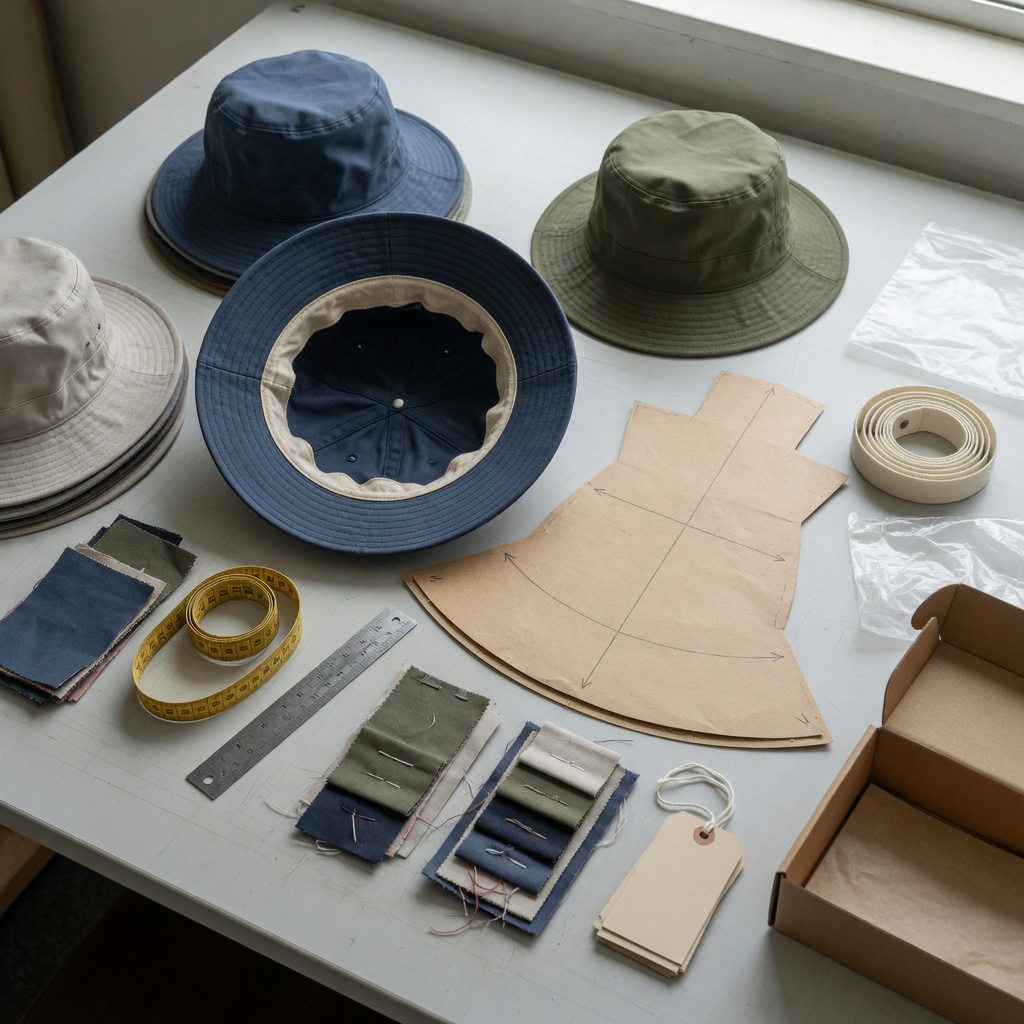
Vincent Xi, Editorial Author, https://crownsforge.com/authors/vincent-xi/. No factory visit, wear trial, client project, or personal test is claimed.
For procurement in Australia, treat bucket hat sourcing product development capability as a gate on the quotation, not as a phrase on a factory webpage. Let sampling start only when the offer names pattern ownership, the measurements that stay frozen, the physical rounds included, the change that starts a new paid round, the label and pack items on the approval sample, and the physical wearable bucket hat that bulk must follow. A blank line means the prices are not comparable. CrownsForge supplies wearable textile headwear, including bucket hats. This brief tells Australian buyers what to specify and verify. It states no CrownsForge sample speed, minimum, test result, or certificate, because those facts are not on the cited pages.
The cited pages are supplier-published statements about manufacturing and procurement. They are reference material for Australian importers. Their publication or update dates are identified below; those dates do not establish current prices, delivery commitments, or independently verified factory performance.
Seetime Luxury says buyers should weigh fabric options, sampling capability, minimum order quantity, lead time, private-label services, and experience with bucket hat production. It describes development from sample to bulk with tech-pack assistance, material sourcing, and prototype revisions. This brief selects five comparison factors from that broader list; it does not claim the source lists only five. The source compares 10 manufacturers, which is its own selection rather than an audited census or this brief's ranking. Its visible dates are first published 7 April 2026 and last updated 5 June 2026. Source: Seetime Luxury manufacturer comparison.
Hongyuecap describes brief review, specification, physical sampling, bulk control using approved references, and final release. This brief focuses on the first four stages when assessing product development; final release remains a separate step in the source workflow. The page also names fabric, brim construction, logo execution, sampling, quality control, and packing. Its structured metadata records publication on 16 May 2026 and modification on 11 August 2026; these are page dates, not factory performance measurements. Source: Hongyuecap bucket hat manufacturer page.
The customizationcaps.com guide displays 5 January 2026. In its Wanjia Hats section it states a typical sample lead time of 7-10 days and lists pattern development, logo printing, custom labels, and packaging design. Its K-Brand Caps section instead states approximately 7-12 days. These are supplier-specific publisher claims, not an industry-wide range, independently measured averages, or CrownsForge delivery commitments. They concern sampling, not bulk production or arrival in Australia. Source: customizationcaps.com sourcing guide. Obtain the current sample calendar and the definition of days in a quotation for the exact hat.
Use one sequence. Classify the sale as tech-pack adaptation or new pattern work. Freeze construction and material as separate lines in the units you will inspect. Set the included sample rounds and the revision rule. Put labels and packing on the same approval sample. Only then compare quotations. Name that sample on the purchase order before any bulk cutting.
How product development capability is judged for procurement in Australia
Product development capability, for this procurement decision, is the supplier's ability to turn a commercial request into a repeatable wearable bucket hat and to show the records that identify it. Bulk sewing capacity does not show who owns the pattern, which measurements are frozen, or which physical sample is the acceptance reference.
An Australian importer, retailer, or promotional buyer should require a construction spec, a material spec, a workmanship note, a trim and packing note, and a named approval sample. Construction covers crown, panel count, brim build, and brim stitching. Material covers fiber, cloth construction, color approval, and whether a lining is in scope. Workmanship names the seams and topstitch an inspector can see. Trim and packing name the woven label, any hang tag, the size mark, and the bag or carton. The approval sample is the physical hat that bulk must follow. These are buyer-set fields. The cited pages do not publish crown height, brim width, head size, fabric weight, or tolerances, so this brief states none.
Turn the selected comparison factors from Seetime Luxury into questions, and replace each answer with a current quotation. Likewise, the development stages described by Hongyuecap are not purchasing evidence for an Australian order until the quotation includes a written specification, a physical sample, and a written definition of approval. Keep the source's final-release step in the shipment plan.
Separate pattern work from logo decoration
The customizationcaps.com guide groups logo printing, custom labels, packaging design, and pattern development as OEM/ODM capability (customizationcaps.com sourcing guide). Seetime Luxury separately names tech pack assistance, material sourcing, and prototype revisions (Seetime Luxury manufacturer comparison). As a procurement distinction drawn from that split, not as a measured test, pattern development can change the hat, while logo application on a frozen pattern usually does not. These sources do not publish fees.
Require the quotation to classify the sale: adaptation of the buyer's tech pack; pattern making from a sketch or sample; material sourcing with a substitution rule; a capped count of prototype revisions; and label or packing approval on the same reference sample. A webpage list does not prove that the sample price includes every item.
The cited pages do not state Australian care, fiber-content, or origin-label rules, so this brief states none. Confirm current obligations with a qualified adviser. Procurement can still require labels and packing to be specified, shown on the approval sample, and repeated in bulk. That is a commercial control, not a legal conclusion.
Sample days, revision rounds, and labeled planning arithmetic
Set dates from the quotation for this hat. The customizationcaps.com guide, dated 5 January 2026, gives supplier-specific sampling claims: 7-10 days for Wanjia Hats and approximately 7-12 days for K-Brand Caps (customizationcaps.com sourcing guide). These are different supplier descriptions, so 7-10 days is neither the only figure in the source nor a common guarantee. Neither range is a CrownsForge lead time, a bulk-production duration, or transit time to Australia. Confirm whether the quoted days are calendar days or working days.
Example calculation to verify in the supplier quote, not a factory promise or an observed average: assume 10 working days for each physical round and three sequential rounds with no overlap. The rounds are an initial silhouette sample, one revision, and one approval sample. Three times 10 working days equals 30 working days of assumed sample-making time. The choice of 10 working days is a buyer worksheet input; the cited supplier ranges do not establish this calendar or a duration for every round. This example excludes buyer comments, lab dips, cloth purchase, weekends, freight to Australia, and customs.
Under the same worksheet assumptions, moving from one 10-working-day round to three such rounds adds 20 working days of sample-making time. That difference is arithmetic, not a published average. If fiber or brim construction changes, a round may restart; the quotation should say who pays and how the dates change. Each additional sequential round adds 10 working days only under this chosen assumption. Verify every input with the supplier and use the smallest number of rounds that freezes the required decisions.
These sources give no transit time to Australia, so none is stated. If the approval sample must arrive before the bulk deposit, require quoted transit in calendar days for the real lane and mode. Add that quoted number only to the supplier's stated sample days, not automatically to the 30-day example.
State the included revision count, what counts as new development, and whether approval means a photo or a measured physical sample. Hongyuecap links bulk control to approved references for silhouette and workmanship (Hongyuecap bucket hat manufacturer page). Name that sample and those measurements in the purchase order. Do not release bulk cutting against an unnamed photo.
Trade-offs that change cloth, labels, and acceptance
The cited pages treat fabric and brim construction as development variables (Hongyuecap bucket hat manufacturer page; Seetime Luxury manufacturer comparison). As a general production control, not a test result from those pages, a heavier cloth or an added lining can change needle choice, seam bulk, and carton fit. Fabric weight, brim width, and head size are absent from the sources, so this brief states none. Set each value in a named unit, including any tolerance in that same unit, and require the supplier to repeat it. Do not fill a blank from this article.
Woven labels, hang tags, logo execution, and packaging are described as private-label work (Seetime Luxury manufacturer comparison; Hongyuecap bucket hat manufacturer page; customizationcaps.com sourcing guide). Developing them with the hat can protect a delivery date. Waiting until construction is approved can avoid label scrap. Require the quotation to state label minimums and artwork timing. No numeric minimum is taken from the sources, because none is shown.
The customizationcaps.com guide says factories provide OEKO-TEX and CPSIA certified quality control (customizationcaps.com sourcing guide). That sentence is a publisher claim. It is not a certificate for an order and not a statement about CrownsForge practice. A usable file for any certificate offered on the order should show holder, scope, and expiry. Those details are not on the cited page. As general context, not a finding from the hat pages, CPSIA is a United States consumer product safety statute and does not establish Australian compliance. Children's product rules may not apply if the bucket hat is not a children's product. No Australian standard is named here, because these sources do not establish one. If a chemical or fiber-content document is needed, specify the document and match it to the lot to be imported. A webpage mention is not approval to ship.
Freeze one specification before comparing quotations
Send the same specification to each supplier, or the prices describe different hats. State the end use. The sources refer to fashion, streetwear, wholesale, private-label, promotional, and outdoor hats (Seetime Luxury manufacturer comparison; Hongyuecap bucket hat manufacturer page). State crown height, brim width, and head opening in one unit system. Those measurements are the buyer's, not figures from these pages. State how many physical samples will be made, who pays sample freight to Australia, and that comments must come back as one reply. State that development can stop if brim or color still misses the agreed standard, without an automatic bulk order. Keep a written record of answers. Do not turn blanks into a weighted score, because this page has no basis for weights.
Decision table: compare development scope before the purchase order
Fill every quote cell from the written offer before placing the order. An empty cell is not zero, a pass, or comparable with another quotation. Use the supplier's project-specific sample calendar for the sample-calendar row. The 7-10-day Wanjia and 7-12-day K-Brand descriptions in the guide dated 5 January 2026 are publisher-reported examples, not acceptance limits or transit commitments (customizationcaps.com sourcing guide).
| Decision point | What the buyer specifies | What to compare in the quote | Order or acceptance consequence |
|---|---|---|---|
| Development depth | Tech-pack adaptation or new pattern work | Included tasks versus chargeable design time | An unset pattern is not ready for bulk |
| Silhouette | Crown, panels, brim width, brim slope, brim stitching | Measurement sheet in stated units plus the physical sample | Bulk follows the approval sample, not a new sketch |
| Material | Fiber, construction, color method, lining in or out | Mill or stock options, lab-dip timing, substitution rule | An undeclared cloth change is grounds to reject |
| Sample calendar | Rounds included and days per round | Project-specific sample days, calendar definition, and approval milestones | Deposit dates follow the quote, not this article |
| Revision rule | Included count and what starts a new development | Fee and extra days for another round or a construction change | Stops an open-ended sample loop |
| Private label | Label type, artwork owner, hang tag, size mark | Label minimum, lead time, and presence on the approval sample | A missing label is an incomplete delivery |
| Packing | Bag, inner pack, carton, and retail box if required | Pack quantity and whether a packing sample is approved | Packing drives cube and freight planning to Australia |
| QC reference | Inspection points and acceptance-sample identity | Who inspects, at which stage, against which measurements | Release shipment only against that reference |
| Documents | Only files the buyer requires | Holder, scope, expiry, and match to the product | A webpage mention is not a document |
| Commercial close | Price basis, Incoterms, and any sample-fee credit | What stays fixed after sample approval | Do not cut bulk until the approval sample is named on the order |
RFQ Checklist
- Ask the supplier to state in writing whether the quotation is tech-pack adaptation or new pattern development, and to list every deliverable due before bulk.
- Specify crown construction, brim construction, fiber, color-approval method, and lining as separate lines, each with the unit you will inspect.
- Require the manufacturer to quote sample lead time in days for each round, the number of included revisions, and the fee and added days if a revision changes fabric or brim construction.
- Ask the supplier to identify the approval sample by number and date, and to confirm that bulk silhouette and workmanship will be controlled against that sample.
- Specify the woven label, hang tag, size marking, and transit or retail packing, and state whether each item must appear on the approval sample.
- Require the manufacturer to supply any certificate it offers as a current file showing holder, scope, and expiry, and to confirm that the file covers the fabric and bucket hat on this order.
- Ask the supplier to separate sample-making days from freight time to Australia, and to name the Incoterm that assigns carriage and risk.
- Require the manufacturer to define the inspection stage, the measurement list, and the acceptance rule for shipment, including how a failed inspection is corrected.
- Specify a purchase-order clause that blocks bulk cutting until the named sample is approved in writing.
- Ask the supplier to state which sample fees are credited against bulk and which costs remain payable if development stops before an order.
Method, author, and limits
Editorial author: Vincent Xi, Editorial Author, profile https://crownsforge.com/authors/vincent-xi/. The experience basis for this page is that profile only. No factory visit, wear trial, client project, or personal test is claimed.
How the figures were derived: the three linked supplier pages support the procurement topics, while the arithmetic examples are buyer worksheet assumptions to verify in a quotation. Seetime Luxury lists six introductory comparison considerations; this brief uses five selected factors. Its list of 10 manufacturers is a publisher selection. It visibly records first publication on 7 April 2026 and update on 5 June 2026 (Seetime Luxury manufacturer comparison). Hongyuecap names five workflow stages; this brief focuses on brief review, specification, sampling, and bulk control, while retaining final release in the shipment plan. Its structured metadata records publication on 16 May 2026 and modification on 11 August 2026 (Hongyuecap bucket hat manufacturer page). The customizationcaps.com guide displays 5 January 2026 and reports 7-10 sample days in the Wanjia Hats section and approximately 7-12 days in the K-Brand Caps section; those are separate supplier claims, not industry averages or CrownsForge promises (customizationcaps.com sourcing guide). The 30-working-day illustration is three assumed sequential rounds of 10 working days. The 20-working-day difference is three such rounds minus one, and a further 10-working-day round uses the same chosen input. None is a measured lead-time statistic; all exclude freight to Australia.
Limits: these supplier-published pages do not establish an independently measured industry average or a current quotation for this order. Seetime Luxury's FAQ does publish a claimed MOQ range of 50-300 pieces per design; this brief does not adopt it as a CrownsForge minimum or an order-specific offer. Confirm price, quantity, fabric specification, dimensions, tolerances, and transit with the selected supplier. A webpage statement about certificates is not a current certificate and says nothing about CrownsForge practice. CPSIA is a United States statute and does not establish Australian compliance. Before paying a deposit, verify sample days, revision rules, packing, document scope, Australian requirements, and the approval-sample clause for the exact bucket hat.
Discuss Your Requirements
Review our manufacturing capabilities, then share your specifications for a supplier-fit review.