Bucket Hat OEM Sample Approval for United States Buyers
By Vincent Xi, Editorial Author
Author basis: The linked CrownsForge profile identifies Vincent Xi as an Editorial Author. It does not support claims of factory visits, product testing, sourcing results, client outcomes, or other first-person experience.
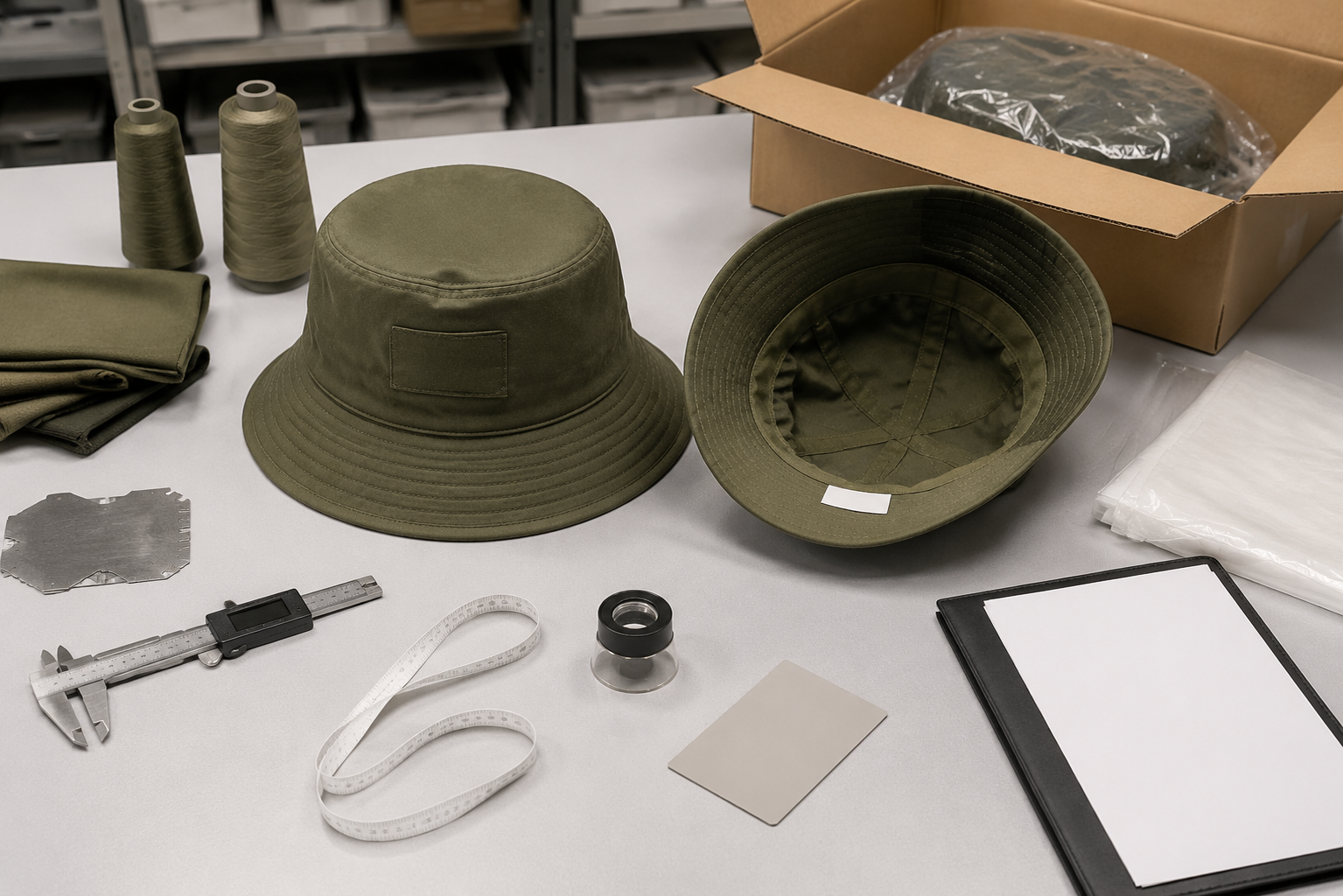
For a United States B2B order, bucket hat OEM sample approval should be a controlled production-release decision. The approval record should connect the physical sample to the current RFQ, bill of materials, measurement report, production artwork, label layout, packaging instruction, supplier deviations, signed quote, and delivery schedule.
Use one unambiguous disposition: approved for production, revise and resubmit, or rejected. Artwork acceptance, an answered inquiry, or agreement on price does not approve physical construction. Likewise, an acceptable sample should not release production while label evidence, landed-cost inputs, quote exceptions, or delivery dates remain unresolved.
A flat rendering can support artwork review, but it should not be the sole evidence for decoration on a flexible, curved bucket hat. The cited custom-order page discusses the limits of flat mockups for this product form (Dirt Cheap Headwear). Request a physical decorated sample when placement, distortion, puckering, seam interaction, or finished appearance affects acceptance.
United States Bucket Hat OEM Sample Approval Gate
Keep product acceptance and commercial release as separate decisions. Production should begin only after both are recorded against the same style and revision identifiers.
| Gate | Evidence required | Hold or resample when |
|---|---|---|
| Controlled identity | Style code, sample identifier, RFQ revision, artwork revision, label revision, packaging revision, and approval date | The sample or supplier response refers to an obsolete, conflicting, or unidentified revision |
| Materials | Identified shell, lining, sweatband, interfacing, thread, trims, decoration inputs, labels, and packaging | A material is generic, unavailable, substituted, or missing an identifying reference |
| Measurements and shape | Dimensioned views, defined datums, buyer-set tolerances, sample condition, instrument identification, and actual results | Shape is accepted by appearance alone or the report omits measurement locations or observed results |
| Construction | Seam layout, stitching, reinforcement, brim structure, edge finishing, symmetry, and inside finishing | Open seams, skipped stitching, twisting, poor finishing, or an unapproved construction change remains unresolved |
| Decoration | Approved production artwork, method, finished size, placement datum, color reference, backing, edge quality, and seam relationship | Decoration differs in size or position, puckers the crown, loses required detail, or crosses an unapproved seam |
| Labels | Buyer-approved copy, supplier declarations, substrate, placement, orientation, attachment, and physical evidence | Copy is unresolved, declarations are missing, or the sewn label differs from approved artwork |
| Packaging | Folding method, shape protection, inner packing, assortment, carton specification, and traceability fields | Packing changes the approved shape, mixes variants, or conflicts with distribution requirements |
| Production equivalence | Supplier statement identifying intended bulk materials, process, production location, sub-suppliers, and every sample exception | The sample uses substitute inputs or a nonrepresentative process without an approved equivalence plan |
| Commercial release | Reconciled quote and purchase order covering approved construction, quantity basis, charges, payment terms, trade term, named place, and exclusions | Price assumptions, development charges, import responsibilities, or correction costs remain open |
| Delivery release | Calendar milestones for supplier actions, buyer review, production, inspection readiness, dispatch, and the required United States warehouse date | Timing is stated only as an unanchored duration or assumes approval before buyer review is complete |
| Change control | Written authorization requirement for changes to controlled inputs | The supplier can change materials, process, location, trims, packaging, or sub-suppliers without buyer approval |
Do not use conditional approval for an open point that could change fit, appearance, construction, labeling, packaging, price, or delivery. Record the missing evidence, issue a controlled revision, and require resubmission.
Specifications to Freeze at Sample Approval
The released specification should tell the supplier what to manufacture and give the buyer an objective basis for reviewing bulk goods.
- Bill of materials: Identify the shell, lining, sweatband, interfacing, sewing thread, decoration inputs, labels, trims, inner packing, and cartons. Include supplier article codes or controlled references where available.
- Pattern and fit: Define the crown profile, crown height, head opening, brim width, brim angle, panel geometry, measurement datums, sample condition, and buyer-set tolerances.
- Construction: Show seam types and locations, visible stitching, reinforcement, ventilation details, brim structure, seam finishing, and edge treatment.
- Decoration: Attach the production artwork revision and define the method, finished dimensions, placement datum, color references, backing, edge treatment, and permitted seam interaction.
- Color: Identify the buyer-approved physical reference, assessment conditions, lot-change notification, and required action when a later lot differs.
- Workmanship: Name rejectable conditions, disposition authority, required correction evidence, and resampling triggers.
- Labels: Control the approved copy, supporting supplier declarations, substrate, placement, orientation, attachment, and legibility.
- Packaging: Define folding, shape protection, inner packing, assortment, carton construction, carton data, and pre-shipment evidence.
Require the supplier to list every departure from the RFQ in a deviation matrix. A blank response should not be interpreted as acceptance.
Hypothetical Measurement Schedule
The following values are buyer-authored assumptions for a hypothetical January 2026 RFQ. They are not market norms, CrownsForge specifications, supplier capabilities, or test results. Every value must be confirmed or replaced in the supplier's dated quote and sample-approval record.
| Control | Hypothetical January 2026 assumption to verify | Review method |
|---|---|---|
| Brim width | 60 mm target with a +/- 2 mm tolerance for the hypothetical style | Measure from the crown-to-brim seam to the finished edge at the defined front, back, left, and right locations while the sample is relaxed |
| Crown height | 85 mm target with a +/- 3 mm tolerance for the hypothetical style | Measure the relaxed side crown from the brim attachment seam to the defined crown-top datum |
| Head opening | 590 mm circumference with a +/- 5 mm tolerance for the hypothetical style | Measure along the inside sweatband while the sample is relaxed and unstretched |
| Decoration size | 70 mm wide by 35 mm high for the hypothetical style | Measure between the artwork-defined outer points of the finished decoration |
| Decoration placement | 25 mm from the lower decoration edge to the brim seam, with a +/- 2 mm tolerance for the hypothetical style | Measure from the defined center-front datum with the hat in the stated relaxed condition |
The report should identify the sample, controlled revisions, instrument, sample condition, measurement location, observed result, tolerance, reviewer, review date, and disposition. Record each observed result rather than approving only an average.
Review decoration from the outside and reverse side against buyer-defined conditions for puckering, backing exposure, incomplete coverage, loose thread, edge quality, distortion, and seam interference. If folding or packing simulation is part of the RFQ, define the procedure before sampling and apply it to the identified approval sample.
If the RFQ names a test standard, state the standard, edition, conditioning, report issuer, sample scope, and contractual pass threshold. A buyer-defined requirement is not evidence that the supplier or product is certified. Do not rely on certification language without a current document whose issuer, status, product coverage, production location, and scope match the proposed order.
United States Label Evidence Before Production Release
The supplied commercial sources do not establish legally sufficient label wording for a United States order. Treat labeling as a controlled buyer-review step, not as a conclusion drawn from the sample or supplier template.
Assign a qualified buyer or importer role to determine current requirements for the intended wearer, materials, sales channel, manufacturing origin, and import arrangement. Candidate review fields may include material or fiber wording, country of manufacture, responsible-party identification, care information, size information, and channel-specific content. Applicability and final wording should be decided through the buyer's current United States compliance process.
| Label control | Supplier evidence requested | Hold condition |
|---|---|---|
| Copy basis | Material declarations, manufacturing-country declaration, proposed production location, and exceptions to buyer-provided copy | Declarations are missing, inconsistent, or not linked to the sampled style |
| Artwork control | Buyer-approved label revision and supplier confirmation of the production file | The physical sample uses obsolete, altered, or unapproved copy |
| Substrate and legibility | Label material, print or weave method, color, attachment method, and close-up sample evidence | Approved content is incomplete, obscured, or illegible on the sample |
| Placement and orientation | Dimensioned placement instruction and inside-view evidence | Placement, orientation, attachment, comfort, or fit differs from the released instruction |
| Origin evidence | Supplier declaration identifying manufacturing country and proposed production location | The declaration is absent, conflicts with another document, or changes after artwork approval |
| Change control | Written notice before changes to copy, substrate, attachment, location, or label supplier | A controlled input changes without compliance review and a documented resampling decision |
Physical approval confirms execution against the controlled artwork; it does not by itself establish United States legal compliance. Keep the supplier declarations, buyer review, approved artwork, physical sample, and production-release record under matching identifiers.
Landed Cost Reconciliation Before Sample Approval
Reconcile the signed quote to the approved sample before releasing production. The quote should identify the approved materials, construction, decoration, labels, packaging, order quantity, payment stages, trade term, named place, validity period, included charges, exclusions, and assumptions.
Request separate lines for sample work, artwork or digitizing, tooling, revisions, courier service, inspection, freight, insurance, export charges, brokerage, duty or tariff treatment, inland delivery, and destination charges. This prevents an apparently lower unit price from masking costs outside the supplier's quoted scope.
Hypothetical United States Landed-Cost Calculation
Every amount below is a buyer-authored assumption for a hypothetical January 2026 United States order. The figures are not quotations, market averages, tariff statements, or company operating data. Verify each input with the supplier, freight provider, customs broker, inspection provider, and purchase order.
| Hypothetical January 2026 input | Assumed amount and scope to verify |
|---|---|
| Order quantity | 1,000 ordered pieces for the hypothetical order |
| Product | US$4.20 per ordered piece across 1,000 ordered pieces, totaling US$4,200 for the hypothetical order |
| Sample, artwork, and development | US$350 per hypothetical style |
| International freight and insurance | US$900 per hypothetical shipment |
| Brokerage, entry, and inland delivery | US$650 per hypothetical shipment |
| Duty and tariff reserve | US$1,050 per hypothetical shipment as an example placeholder, not a stated rate |
| Independent inspection allowance | US$300 per hypothetical shipment |
| Illustrative landed total | US$7,450 per hypothetical order, equal to US$7.45 per ordered piece across 1,000 ordered pieces |
The hypothetical January 2026 calculation is US$4,200 + US$350 + US$900 + US$650 + US$1,050 + US$300 = US$7,450. Dividing US$7,450 by 1,000 ordered pieces produces US$7.45 per ordered piece. These results demonstrate the calculation structure only and must be verified in the buyer's current quote and landed-cost review.
Replace the reserve with current product-specific input from the buyer's customs broker. Add any applicable financing, storage, relabeling, rework, returns, unusable-unit allowance, or destination costs before comparing offers. Use the same quantity denominator for each comparison.
After a sample correction, require the supplier to state whether the change affects unit price, MOQ, development cost, tooling, packaging, shipment dimensions, freight assumptions, payment terms, or schedule. Reconcile those effects before production release.
Delivery Controls Tied to Sample Approval
Work backward from the required United States warehouse date. Use calendar dates, named responsibilities, and approval dependencies rather than relying only on duration estimates.
| Milestone | Evidence to request | Release risk |
|---|---|---|
| Material commitment | Availability, reservation basis, substitute restrictions, and commitment expiry date | The approved material may not be available for bulk production |
| Sample preparation and dispatch | Sample type, production-equivalence statement, completion date, dispatch date, carrier basis, and tracking evidence | A mockup or nonrepresentative sample may be mistaken for a production sample |
| Buyer receipt and review | Expected receipt date, assigned reviewer, consolidated-feedback date, and disposition authority | The schedule may assume approval before physical review is complete |
| Revision and resampling | Corrective-action owner, revised completion date, dispatch date, and effect on bulk milestones | A failed sample may be corrected only after bulk production begins |
| Written production release | Controlled document register, signed deviations, quote reconciliation, open-issue status, and release date | Production may begin while product, label, cost, or timing issues remain open |
| Bulk readiness and inspection | Completion date, inspection-readiness notice, correction timing, and shipment-release authority | Sample approval may be misapplied as a waiver of bulk inspection |
| Shipment and delivery | Cargo-booking basis, expected departure and arrival, customs responsibilities, inland delivery, and warehouse appointment | A shipping estimate may be mistaken for a United States warehouse commitment |
State how late buyer inputs, rejected samples, material changes, label revisions, or compliance review affect the calendar. A delayed approval should not authorize material substitution, omitted inspection, or a changed delivery basis.
Practical RFQ Checklist for Bucket Hat Sample Approval
Complete this checklist before issuing written production approval:
- [ ] Attach the current RFQ, bill of materials, drawings, artwork, label layout, packaging instruction, and revision register.
- [ ] State the style, variants, order quantity, United States destination, required warehouse date, and responsible buyer reviewer.
- [ ] Require the supplier's legal entity, manufacturing country, proposed production location, responsible contact, and disclosed sub-suppliers.
- [ ] Identify the physical sample, sample type, revision, preparation date, intended bulk materials, intended bulk process, and every known exception.
- [ ] Record actual results for every controlled measurement and compare them with the buyer-issued targets, tolerances, datums, and sample condition.
- [ ] Review construction, workmanship, color, decoration size, decoration placement, seam interaction, and inside finishing on the physical sample.
- [ ] Match label declarations, approved copy, substrate, placement, orientation, and attachment to the sampled style and controlled artwork revision.
- [ ] Confirm the folding method, shape protection, inner packing, assortment, carton specification, carton data, and pre-shipment evidence.
- [ ] Reconcile the quote to the approved construction, quantity basis, sample charges, tooling, revisions, payment terms, trade term, named place, freight scope, import responsibilities, and exclusions.
- [ ] Obtain calendar dates for sample corrections, buyer review, production release, bulk readiness, inspection, dispatch, arrival, customs handling, inland delivery, and the United States warehouse requirement.
- [ ] Resolve every supplier deviation in writing and require buyer authorization before any change to materials, process, location, decoration, labels, packaging, or sub-suppliers.
- [ ] Keep sample approval, bulk inspection, shipment release, and purchase-order acceptance as separate recorded decisions.
The RFQ should make the supplier return evidence, not merely acknowledge instructions.
| RFQ section | Buyer-issued control | Supplier response required before approval |
|---|---|---|
| Order scope | Buyer entity, United States destination, intended wearer, sales channel, style, variants, quantity, and required warehouse date | Accepted scope, exceptions, manufacturing country, proposed production location, and responsible contact |
| Document control | RFQ, drawing, artwork, label, packaging, and revision identifiers with order of precedence | Completed document register, conflicts, omissions, and proposed deviations |
| Sample plan | Purpose of the sample, evidence required, approval authority, and resampling triggers | Sample type, production-equivalence statement, charges, courier basis, and calendar dates |
| Materials | Bill of materials, controlled references, substitution restrictions, and declaration requirements | Article codes, composition, finish, color basis, availability, lot controls, and proposed substitutes |
| Measurements | Targets, tolerances, datums, sample condition, instruments, and report format | Actual results and disposition for every controlled measurement |
| Construction and decoration | Pattern views, seams, stitching, reinforcement, production artwork, placement, backing, and appearance criteria | Feasibility response, exceptions, executed measurements, and outside and reverse-side evidence |
| Labels and packaging | Compliance-reviewed artwork, declarations, placement, folding, shape protection, assortment, and carton requirements | Physical label evidence, copy exceptions, pack-out proposal, carton data, and shipment dimensions and weights |
| Commercial terms | Currency, quantity basis, payment stages, trade term, named place, validity, and required cost lines | Unit price, MOQ, development and revision charges, tooling, exclusions, and payment terms |
| Delivery and bulk quality | Required warehouse date, buyer dependencies, inspection requirement, shipment authority, and change controls | Calendar milestones, capacity assumptions, bulk control plan, inspection readiness, remediation commitment, and schedule risks |
| Supporting documents | Requested declarations, reports, or certification evidence with required scope | Current documents showing issuer, status, product coverage, production scope, and limitations |
A production-release statement can read:
> Production is approved only against the identified physical sample, RFQ revision, bill of materials, measurement report, artwork, label layout, packaging instruction, signed deviations, quote, and schedule listed in this approval record. Any change requires written buyer authorization before use. Sample approval does not waive compliance review, bulk inspection, shipment release, or purchase-order requirements.
Source Evidence and Claim Boundaries
The following statements are attributed only to the cited commercial pages. They are not industry benchmarks, factory-audit findings, current binding quotations, or proof that the same terms or capabilities apply to a proposed order.
| Source context | Attributed statement | Decision boundary |
|---|---|---|
| CDHB Hats, undated cited page | The page states a starting MOQ of 50 pieces for that supplier's custom-headwear program and says feasibility depends on style, material, color, decoration, and packaging. Because the page is undated, the value is not treated as current. | It does not establish a general bucket hat MOQ, another supplier's MOQ, or a binding quantity for the buyer's style. Obtain a dated quote by style, color, size, decoration, and packaging. |
| Dirt Cheap Headwear, undated cited page | The page discusses why a flat mockup may not fully represent decoration on a curved, flexible bucket-hat surface. | It does not prove that a proposed supplier can reproduce the buyer's artwork or bulk result. Require a physical decorated sample and a production-equivalence statement. |
| KBETHOS, page published March 26, 2025 | The page displays a US$50 minimum order value per order for that distributor's wholesale program and states that the program ships from the USA. | The amount is not an OEM manufacturing MOQ, development charge, unit price, landed cost, or manufacturing-origin statement for a custom order. Verify manufacturing origin, customization scope, quantity rules, and delivery basis independently. |
| Grand Canal Headwear, page dated January 19, 2026 | The page states one business day per inquiry review for that supplier's United States inquiry process. | The statement does not establish sample lead time, production lead time, transit time, customs timing, or a delivery guarantee. Require order-specific calendar dates. |
Supplier response speed, a distributor's order-value threshold, and another program's starting quantity are not sample-approval criteria. They indicate questions that the current RFQ, supplier response, and signed quote must resolve.
Methodology and Limitations
Methodology: Source statements were kept in their original commercial context and separated from buyer-authored controls. The CDHB page is used only for its own conditional starting-quantity statement. The Dirt Cheap Headwear page supports physical review of decoration on a curved, flexible bucket hat. The KBETHOS page illustrates why a distributor's order-value threshold should not be treated as an OEM manufacturing MOQ. The Grand Canal Headwear page is used only for its stated inquiry-review timing.
No supplier values were averaged, extrapolated, or converted into an industry benchmark. The measurement schedule is a hypothetical buyer-authored specification. The landed-cost result was derived by adding the listed hypothetical inputs and dividing the total by the stated ordered-piece quantity.
Limitations and verification: The cited pages are commercial sources, not factory audits, product tests, customs determinations, legal opinions, or binding quotes for the proposed bucket hat. Their terms, availability, service statements, and content may change. No publication date is available for the cited undated pages.
Before production release, verify the supplier's legal entity, manufacturing location, dated quote, MOQ, sample representativeness, material identity, availability, measurements, tolerances, construction, decoration, workmanship, label declarations, approved label copy, manufacturing origin, customs classification, applicable charges, packaging, inspection plan, calendar dates, and any claimed test or certification document. Keep bulk inspection and shipment release separate because sample approval addresses the identified sample and controlled documents, not conformity of every production unit.
Discuss Your Requirements
Review our manufacturing capabilities, then share your specifications for a supplier-fit review.