Malaysia Bucket Hat OEM Quality Control Inspection for Manufacturing RFQs
By Vincent Xi, Editorial Author
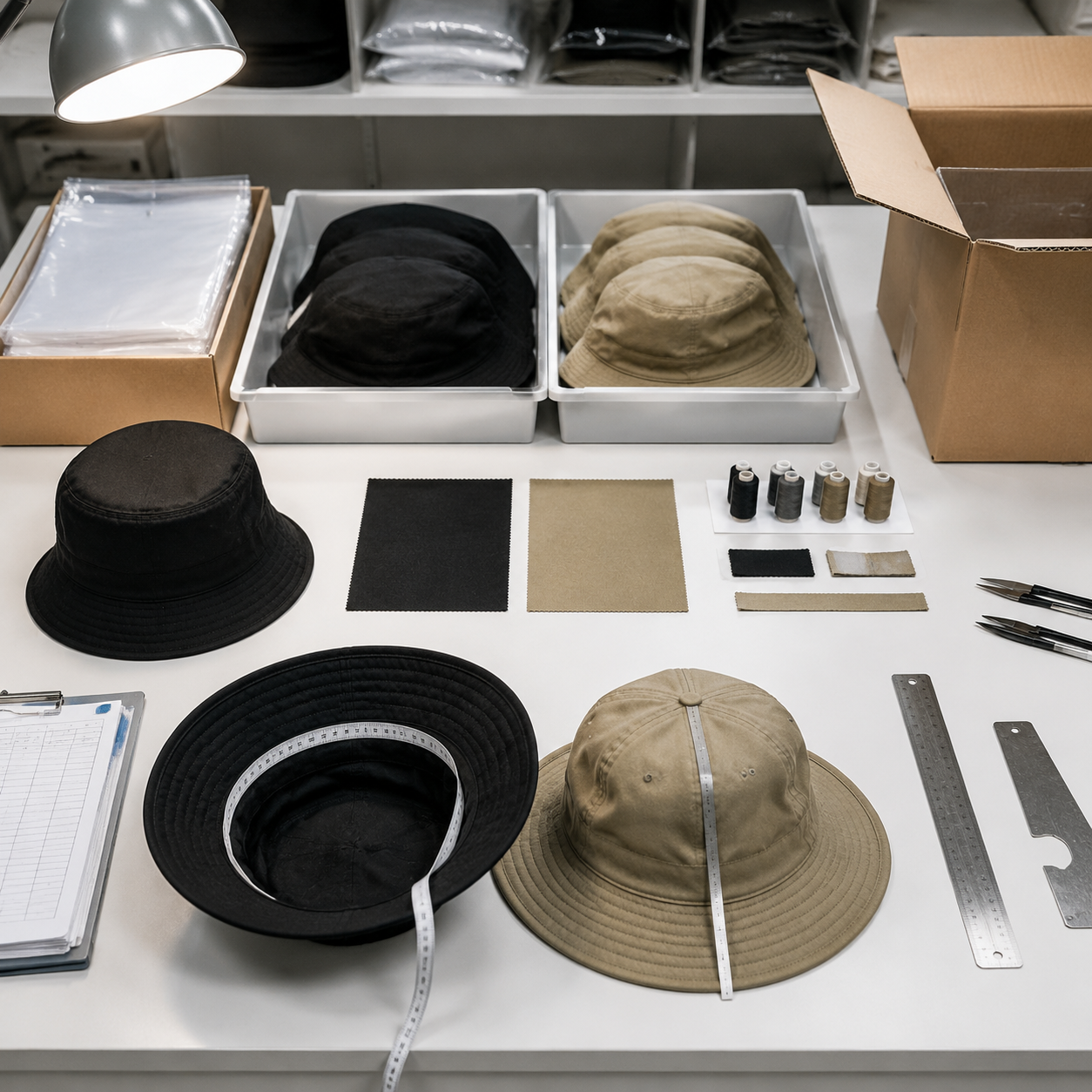
For a Malaysia-bound order, the bucket hat OEM quality control inspection plan should be part of the manufacturing RFQ, not an undefined service added after production. Each bidder should quote against the same SKU revision, approved sample, material specification, measurement method, tolerances, defect rules, inspection gates, evidence requirements, and release authority. A response such as quality control included does not provide enough detail to compare quotes or authorize shipment.
The supplied Tangren page identifies stitching, head circumference, metal-hazard control, material quality, and packaging safety as custom-hat inspection checkpoints (Tangren Cap). The supplied AQI page identifies pre-production, first-article, during-production, pre-shipment, defect-sorting, and loading activities (AQI Service). These commercial pages provide useful checkpoint and stage vocabulary. They do not establish universal bucket hat tolerances, acceptance limits, supplier performance, certification, or Malaysian legal requirements.
Recommended release rule: Hold manufacturing when a required material, sample, specification, or approval is missing. Hold shipment when the agreed inspection report, corrective evidence, or buyer release decision is incomplete. Any exception should require written disposition from the buyer representative named in the purchase order.
Source Boundaries
| Supplied source and context | Supported use here | What the source does not establish |
|---|---|---|
| Tangren Cap, a commercial custom-hat quality-control page | Published checkpoint categories covering stitching, head circumference, metal-hazard control, material quality, and packaging safety | Universal methods, tolerances, independent test results, order conformity, certification, or Malaysian requirements |
| AQI Service, a commercial inspection-services page | Published stage vocabulary covering pre-production, first article, during production, pre-shipment, defect sorting, and loading | A requirement to use every stage, a universal sampling plan, acceptance thresholds, or proof that a particular supplier or lot passed inspection |
| Grand Canal Headwear, a commercial sourcing article | Material-sourcing topics that can be converted into supplier verification questions | Independent laboratory evidence, guaranteed material performance, production capability, or Malaysia-specific compliance |
| Vincent Xi author profile, a first-party author page | Vincent Xi's name and Editorial Author role | Factory visits, inspections, testing, certification, supplier performance, or customer outcomes |
Malaysia Bucket Hat Quality Control Inspection Gates
Select inspection gates according to the SKU, production arrangement, and purchase-order risk. Require each bidder to identify included work, exclusions, added charges, reporting responsibility, hold authority, and the person permitted to release an exception.
| Decision gate | RFQ instruction | Evidence required before release |
|---|---|---|
| Quote review | Require the bidder to confirm the specification revision, approved sample, material basis, inspection scope, packing scope, and failure obligations | Signed compliance response and line-by-line deviation schedule |
| Bulk-input approval | Require production fabric, thread, sweatband, labels, trims, decoration inputs, and packing materials to match identified references | Lot-linked swatches, trim references, buyer-requested documents, and approval status |
| First-article approval | Require initial output made with the intended production materials and construction method to be checked against the control file | Identified first article, measurements, construction images, exceptions, and signed disposition |
| During-production review | Define when observed variation triggers correction, segregation, sorting, or another inspection | Presented quantity, lot identity, sample-selection record, measurements, defect log, and corrective-action record |
| Pre-shipment release | Apply the agreed sampling, measurement, defect, packing, and acceptance instructions to finished goods | Complete inspection report, exception log, packing findings, corrective evidence, and buyer release decision |
| Sorting and re-inspection | Define how failed or affected goods will be segregated, repaired, replaced, or accepted by concession | Corrected-lot identity, affected and corrected quantities, new findings, and final buyer disposition |
| Loading observation | State whether released-carton identity, condition, quantity, or loading sequence must be observed | Loading record linked to the released lot and shipment handover |
AQI presents its listed stages as inspection-service options. Its page does not establish that every bucket hat purchase order requires every stage. Loading evidence also should not be treated as a substitute for product inspection evidence.
Build the SKU Control File Before Manufacturing
Prepare a controlled file for every quoted bucket hat SKU and revision. Require the supplier to return an affirmative response or a specific deviation for each field.
| Control field | Buyer definition | Supplier response required |
|---|---|---|
| SKU identity | Style code, color, size, revision, ordered quantity, and production-lot definition | Confirmed identity plus disclosure of split or subcontracted production relevant to inspection |
| Materials | Fabric composition or construction, finish, shade reference, hand-feel reference, sweatband, reinforcement, thread, labels, trims, and permitted alternatives | Accepted material basis, proposed substitutions, and requested supporting records |
| Construction | Crown pattern, seam type, reinforcement, brim construction, stitch appearance, edge finish, and intentional washed or irregular effects | Capability response and every proposed construction deviation |
| Dimensions | Measurement points, targets, tolerances, units, conditioning state, product position, tool, and applied tension where relevant | Accepted methods and tolerances or measurable quoted deviations |
| Decoration | Artwork revision, dimensions, color reference, orientation, placement datum, backing, edge finish, and prohibited defects | Signed artwork or sample reference plus disclosed process limitations |
| Labels and trims | Approved content, material, location, orientation, attachment, and component reference | Confirmed references and requested traceability records |
| Packing | Folding method, protective materials, pack and carton quantities, SKU separation, carton basis, buyer-supplied marks, and acceptable post-packing condition | Confirmed packing basis, exclusions, and proposed alternatives |
| Inspection | Selected gates, lot definition, sample selection, measurement subset, defect classes, acceptance rules, report format, and evidence | Included scope, price, timing, inspector responsibility, and report template |
| Disposition | Sorting, repair, replacement, re-inspection, concession, cost responsibility, and release authority | Accepted responsibility or clearly priced deviation |
Add a precedence clause stating which signed document or approved physical sample controls if the purchase order, specification, artwork, and sample conflict. Resolve conflicts before production rather than asking a supplier or inspector to choose the controlling reference later.
Example RFQ Data to Verify in the Supplier Quote
The following values are buyer-created editorial examples. They are not CrownsForge specifications, source findings, supplier performance data, market norms, or Malaysian requirements. Every value applies only to the hypothetical unbranded black-and-khaki cotton-twill bucket hat SKU described below, as of the issue date recorded on the hypothetical buyer RFQ. Each value is an assumption or calculation to verify in the supplier quote and signed control file.
| RFQ field | Example value | Scope, as-of context, and source | Supplier decision required |
|---|---|---|---|
| Presented production lot | 2,000 pieces per hypothetical production lot | Hypothetical unbranded black-and-khaki cotton-twill bucket hat SKU; as of its buyer RFQ issue date; source: editorial example assumption to verify in the supplier quote | Confirm the lot definition, color quantities, production location, and any split production |
| Visual inspection sample | 80 finished hats per hypothetical production lot | Same hypothetical SKU; as of its buyer RFQ issue date; source: editorial example assumption to verify in the supplier quote | Confirm carton selection, unit selection, and representation of each color |
| Visual sample coverage | 4.0 percent of the hypothetical production lot, calculated as 80 sampled hats divided by 2,000 presented pieces | Same hypothetical SKU; as of its buyer RFQ issue date; source: editorial example calculation to verify in the supplier quote | Treat coverage separately from defect thresholds, dimensional checks, and the failure response |
| Finished head circumference | 58.0 cm target with a +/- 0.5 cm tolerance per sampled finished hat | Same hypothetical SKU; as of its buyer RFQ issue date; source: editorial example assumption to verify in the supplier quote | Confirm the measurement path, product position, conditioning state, applied tension, and tool |
| Finished brim width | 6.0 cm target with a +/- 0.3 cm tolerance from the agreed crown-seam datum to the finished edge at each agreed position | Same hypothetical SKU; as of its buyer RFQ issue date; source: editorial example assumption to verify in the supplier quote | Confirm the datum, measurement positions, product position, and tool |
The calculated sample coverage is not an acceptance plan. The buyer must still approve the production-lot definition, selection method, treatment of colors or sizes, dimensional subset, defect thresholds, and response to failure.
Product-Specific Inspection Matrix
Tangren's published checkpoint categories can be converted into measurable RFQ fields, but the buyer still has to define the method, evidence, and release consequence. The Grand Canal Headwear article can help frame material-sourcing questions; it is not independent evidence that an ordered material or finished lot conforms.
| Control area | Measurable RFQ definition | Inspection evidence | Release instruction |
|---|---|---|---|
| Material identity | Nominated composition or construction, finish, shade reference, approved swatch, component references, and permitted alternatives | Lot-linked material declarations or buyer-requested documents plus comparison with identified references | Hold an unlisted substitution for written buyer disposition |
| Head circumference and fit | Measurement path, target, tolerance, product position, conditioning state, tool, and applied tension | Individual sampled results with units, method, tool identity, and pass/fail status | Apply the signed defect and disposition rules |
| Brim geometry | Measurement datum, positions, width, intended shape, symmetry boundary, stitch appearance, edge finish, and permitted waviness | Recorded measurements and consistent inspection-view photographs compared with the approved sample | Require a quoted deviation before award when the requested construction or tolerance is not accepted |
| Crown and seams | Panel alignment, seam construction, reinforcement, stitch appearance, and definitions for open, broken, skipped, loose, or puckered stitching | Defined viewing positions, close photographs, defect counts, and sampled-unit identifiers | Apply the buyer-defined defect class and failure response |
| Decoration | Artwork revision, dimensions, placement datum, orientation, colors, backing, and appearance limits | Comparison with signed artwork, strike-off, or approved sample; scale shown when size or placement is measured | Hold wrong revisions, positions, orientations, or unapproved variations under the agreed rules |
| Labels and trims | Approved content, material, location, orientation, attachment method, and component reference | Findings by SKU plus representative and failed-unit photographs | Segregate mixed, missing, or substituted components pending disposition |
| Metal-hazard control | Applicability based on the buyer's documented material, component, process, and intended-use risk review | Agreed procedure and lot-linked record | Do not claim implementation or certification when the required record is absent |
| Packaging | Folding method, protective materials, pack and carton quantities, SKU separation, carton condition, and buyer-defined shape-recovery boundary | Reproduced packing method, count records, carton findings, and post-packing product observations | Compare packing cost or density only when bidders use the same condition and evidence requirements |
Define Sampling, Defects, and Failed-Lot Action
Do not accept a bare reference to AQL as a complete sampling instruction. The incorporated inspection specification should state the presented production lot, lot identity, sample size, carton-selection method, unit-selection method, treatment of separate colors or sizes, dimensional subset, defect thresholds, and action after failure. The report should record how units were selected from the presented lot. Supplier-selected display samples should not replace the agreed selection method.
Defect classes also need SKU-specific definitions. The following are drafting categories, not universal classifications:
- Critical drafting example: A sharp foreign object, expressly prohibited material, or another condition that the buyer's documented risk assessment identifies as a safety or legal release blocker.
- Major drafting example: Wrong SKU, wrong decoration revision, open seam, or a measurement outside a signed major-defect boundary.
- Minor drafting example: A bounded cosmetic variation that the signed specification classifies as not impairing the intended use.
If a party proposes a standard, require its exact title, edition or revision, applicable clauses, inspection inputs, and acceptance values. Record any supplier or inspection company's internal procedure separately. A standard's requirements and a company's own practice are not interchangeable. Do not describe a facility, product, or order as certified without a current document whose holder, site, scope, issuer, and validity match the RFQ condition.
The failed-lot clause should keep affected goods identifiable while the supplier proposes sorting, repair, replacement, or another corrective action. Re-inspection evidence should identify the corrected lot, selection method, findings, and remaining exceptions. Only the buyer representative named in the purchase order should release an unresolved exception by written concession.
Compare Manufacturing Quotes on the Same Basis
Normalize each quote against the same quality control inspection fields before comparing price.
| Quote line | Required supplier disclosure |
|---|---|
| Specification basis | Accepted revision, controlling sample, document conflicts, and exceptions |
| Material basis | Accepted fabric and trims, proposed substitutions, and supporting records |
| Dimensional basis | Accepted targets, tolerances, methods, and quoted deviations |
| Inspection gates | Included and excluded stages, price, timing, report owner, and hold authority |
| Sampling and defects | Lot definition, selection method, measurement subset, defect thresholds, and failure action |
| Evidence | Report template, measurement records, photograph scope, material documents, and exception log |
| Testing or certification | Buyer-requested scope, responsible party, current supporting documents, price, and timing effect |
| Failed-lot responsibility | Sorting, repair, replacement, re-inspection, disposal, and associated charges |
| Packing and handover | Packing method, carton basis, Malaysia destination, named handover point, and excluded tasks |
Require the final quote to identify every substituted material, widened tolerance, reduced sample, omitted inspection task, and document exclusion. Treat an unanswered field as unresolved rather than as supplier acceptance.
Malaysia-Bound Release Evidence
State Malaysia as the destination and identify the buyer's receiving or handover point. These are buyer-defined commercial facts for the RFQ, not claims about Malaysian law.
The release pack should contain:
- Purchase order, specification, artwork, and approved-sample revisions used during inspection.
- Production-lot identity and quantities presented, sampled, accepted, rejected, corrected, and unavailable.
- Inspection stage, date, location, responsible organization, and sample-selection record.
- Individual measurement results with units, tolerances, method, tool identity, and pass/fail status.
- Defect log linked to sampled units and buyer-defined defect classes.
- Whole-product and close-view photographs, with a scale when dimensions or placement are evaluated.
- Material, shade, construction, decoration, label, packing, and carton findings tied to the SKU and lot.
- Deviations, corrective action, re-inspection outcome, unresolved exceptions, and final buyer disposition.
- Packing counts, carton identity, carton condition, and connection to the released lot before handover.
- Buyer-approved document index for the Malaysia-bound shipment.
The supplied evidence does not establish a Malaysia-specific bucket hat tolerance, tropical-climate conditioning protocol, climate test, labeling rule, import procedure, or mandatory shipment-document set. The buyer should have a qualified Malaysian importer, broker, legal adviser, or other appropriate specialist verify current destination requirements for the actual material, intended use, labeling, packing, and shipment before dispatch.
Practical RFQ Checklist for Malaysia Bucket Hat Quality Control Inspection
Complete this checklist before sending the RFQ and require the supplier to return each item as accepted, excluded, or amended. Attach every referenced document to the purchase order after award.
- [ ] State the bucket hat SKU, color, size, revision, order quantity, production-lot definition, and Malaysia destination.
- [ ] Identify the controlling specification, artwork, approved sample, and document-precedence rule.
- [ ] Define fabric, sweatband, thread, reinforcement, labels, trims, finish, shade reference, and permitted substitutions.
- [ ] List every measurement point with its target, tolerance, unit, datum, product position, conditioning state, tool, and applied tension.
- [ ] Define crown, seam, brim, edge, decoration, label, and packing workmanship requirements.
- [ ] Select the required pre-production, first-article, during-production, pre-shipment, sorting, re-inspection, and loading gates.
- [ ] State the presented-lot rule, carton-selection method, unit-selection method, sample size, and dimensional subset.
- [ ] Define critical, major, and minor defects for the actual SKU and state the corresponding acceptance rules.
- [ ] Require a line-by-line deviation schedule covering substitutions, widened tolerances, reduced samples, omitted tasks, and document exclusions.
- [ ] Request the inspection report template, measurement-record format, photograph scope, material records, and corrective-action format.
- [ ] Assign responsibility and charges for sorting, repair, replacement, re-inspection, disposal, delay, and unresolved goods.
- [ ] Name the buyer representative authorized to hold manufacturing, hold shipment, approve corrective evidence, or grant a written concession.
- [ ] Define the packing method, pack and carton quantities, SKU segregation, carton basis, post-packing condition, and shipment handover evidence.
- [ ] Require the supplier to identify any proposed standard by exact title, edition or revision, clauses, inputs, and acceptance values.
- [ ] Verify any certification claim against a current document showing the relevant holder, site, scope, issuer, and validity.
- [ ] Obtain qualified Malaysia-specific advice for applicable destination, labeling, import, packing, and shipment-document requirements.
- [ ] Withhold award until the completed supplier response, priced inspection scope, deviation schedule, and report format are acceptable.
Methodology, Limitations, and Author Basis
Methodology: The Tangren page was used only for its published custom-hat checkpoint categories. The AQI page was used only for its published inspection-stage vocabulary. The Grand Canal Headwear article was used only to frame material-sourcing questions for supplier verification. Those observations were converted into buyer decisions, control fields, evidence requirements, release gates, and the practical RFQ checklist. The numerical data were derived separately as clearly labeled editorial assumptions and a stated arithmetic calculation; they were not attributed to the commercial source pages.
Limitations and verification: No purchase order, technical pack, signed sample, supplier quote, production-lot record, inspection report, laboratory result, certification document, shipping term, or current Malaysian regulatory opinion was supplied. The cited commercial pages are not treated as independent proof of production capability, conformity, certification, universal acceptance limits, or Malaysian legal requirements. Before award and release, the buyer must verify the actual SKU's materials, dimensions, tolerances, construction, decoration, sampling, defect limits, testing, packing, documents, and decision authority.
Author basis: The cited Vincent Xi author profile identifies Vincent Xi as an Editorial Author. It does not document first-hand factory, inspection, testing, certification, or customer-outcome experience, so no such claim is made.
Discuss Your Requirements
Review our manufacturing capabilities, then share your specifications for a supplier-fit review.