Baseball Cap Sourcing Product Development Capability for Procurement in Canada
By Vincent Xi, Editorial Author · Author profile
For a buyer in Canada, product development capability in baseball cap sourcing is a pass/fail procurement filter, not a catalogue option. The supplier must convert a brand brief into a locked construction—panel count and geometry, crown height, visor shape and insert, fabric mass, fit, decoration, and private-label trims—then prove that construction with a tech pack, sequential samples, and production inspection. Decorating a stock blank is a narrower service and is not the same purchase.
Decision sequence. Specify the silhouette in millimetres. Compare factories on tech-pack ownership, sample ladder, MOQ by SKU, cut-and-sew origin, and inspection. Treat ISO or BSCI claims as current-document requests, not as proof. Seal a bulk reference. Release the order against written measurement points, not catalogue photos.
This article is for B2B buyers in Canada who must specify, compare, verify, approve, and order custom baseball caps. It does not invent factory certifications, client lists, test reports, or factory visits. Construction, sampling, origin, and factory-selection facts are limited to three published manufacturer and sourcing pages.
How the data was derived. Construction options, sampling windows, MOQ ranges, and origin notes were taken from those public pages on custom baseball cap OEM, private-label development, and factory selection. Each number below is quoted with unit, scope, and source. The figures are typical ranges from undated excerpts, not a landed-cost quote into Canada.
What to verify. Lead times and MOQs are typical values from live pages without publication dates in the research excerpts; they are not current capacity commitments. ISO/BSCI mentions are items to request as current documents, not evidence that a named factory is certified today. The cited pages do not publish duties, freight, or bilingual-label rules for Canada. Put HS treatment, CBSA documentation, and the labelling brief on the RFQ.
What product development capability means in baseball cap sourcing
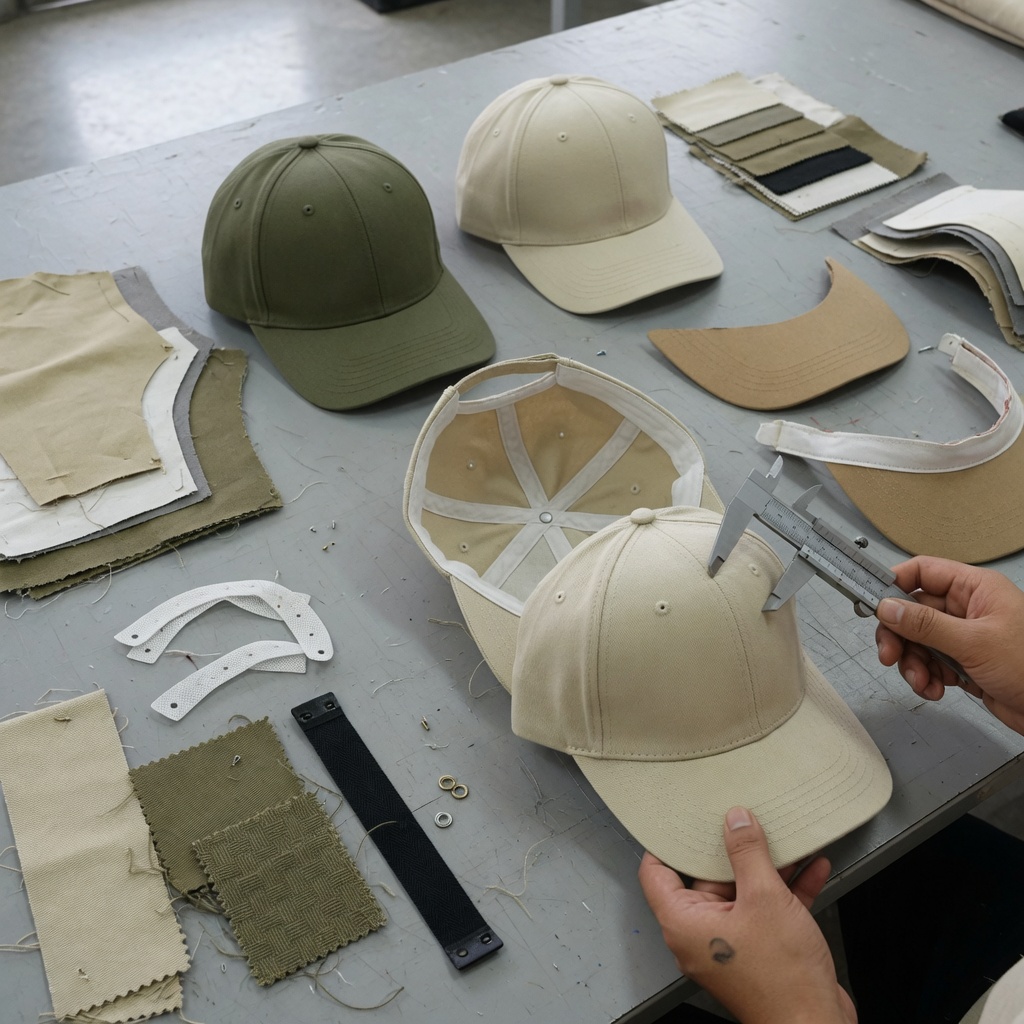
For this procurement task, product development capability is the end-to-end process that turns a brand brief into a repeatable cap. Head & Cap describes developing custom baseball caps from the ground up in Poland, coordinating shape, fabric, fit, branding, tech-pack development, sampling and production as one process, including 5- and 6-panel baseball caps with custom crown height, panel geometry, visor shape, fabric weight and fit. Head & Cap
JoinTop’s manufacturing guide for custom baseball hats describes fully custom OEM construction, a path from brief and specification to physical sample approval and production inspection, plus fabrics, decoration methods and private-label details, with manufacturing described across China, Vietnam and Bangladesh. JoinTop custom baseball hats guide
Pechoter’s factory-finding guidance tells buyers to research manufacturers in China, Vietnam or Bangladesh, verify credentials through inspections, request samples, and assess quality, communication and certifications such as ISO and BSCI. It describes China as offering comprehensive capabilities from pattern making to assembly, specialized clusters, and over 70% of global supply. Pechoter factory guide
Operational test: can the supplier produce a tech pack that another sewing line could follow, then match that pack on a physical sample and on a bulk inspection? If the answer depends on a salesperson’s memory of last season’s blank, the capability is not in place.
Claim-to-source map (source-backed facts only).
| Claim preserved | Unit and scope | As-of / source context |
|---|---|---|
| Typical MOQ of 100 pieces per design | Finished caps; custom baseball hats OEM as described by JoinTop | Undated public guide as cited; confirm on the live page and in a dated quote. JoinTop |
| Development samples in 18–25 days | Calendar days as published, unless the quote restates working days; custom baseball hats development samples | Undated public guide as cited. JoinTop |
| Bulk production in 45–50 days | Calendar days as published, after sample approval in the same JoinTop guide | Undated public guide as cited. JoinTop |
| Manufacturing described across China, Vietnam and Bangladesh | Cut-and-sew / OEM origin language in JoinTop’s guide | Undated public guide as cited. JoinTop |
| 5- and 6-panel baseball caps with custom crown height, panel geometry, visor shape, fabric weight and fit; tech-pack, sampling and production coordinated in Poland | Construction and development model as described by Head & Cap | Undated public page as cited. Head & Cap |
| Research manufacturers in China, Vietnam or Bangladesh; request samples; assess inspections, communication, and credentials such as ISO and BSCI | Factory-selection actions in Pechoter’s article | Undated public article as cited. Pechoter |
| China described as producing over 70% of global supply, with specialized clusters and pattern-making-to-assembly capability | Share of global supply as stated by Pechoter; not independently audited here | Undated public article as cited. Pechoter |
| MOQ flexibility of 100–300 pieces for startups | Finished caps; startup band as described by Pechoter | Undated public article as cited. Pechoter |
Anything not in that map—bilingual-label law, duty rates, AQL percentages, a “correct” GSM, or a landed-cost number into Canada—is a buyer-owned RFQ control, not a published fact from the three pages.
Construction, visor and fabric choices that lock the silhouette
Panel architecture is the first specification lock. A 5-panel cap and a 6-panel cap are different pattern systems. Custom crown height and panel geometry change how the cap sits on the head and how a front logo lands. Head & Cap states that they manufacture 5- and 6-panel baseball caps with custom crown height, panel geometry, visor shape, fabric weight and fit for control over silhouette and private-label identity. Head & Cap
Write those locks as measurement points, not style adjectives. Example specification formats to verify in the supplier quote (the cited pages do not publish a single correct value):
- Crown height at centre front and front-panel width at the logo zone, both in millimetres, so embroidery or a patch has a known landing area.
- Visor width, visor length, and a curve template or radius the factory must match on proto, TOP, and packed goods; plus circumference, sweatband length, and back-opening width in millimetres.
Visor shape is a packing and QC variable, not only a style choice. Specify visor curve, visor width, insert material, and whether the visor is sewn closed or left as a sandwich so merchandising and inspection can measure the same points on the proto, the sealed bulk reference, and inbound cartons.
Fabric mass and hand-feel should be written as measurable targets—for example fabric mass in grams per square metre (GSM), weave, and composition—rather than as a marketing fabric name. That GSM figure is an example specification format to verify in the supplier quote; the cited pages do not publish a single “correct” GSM. JoinTop’s guide covers fabrics and decoration methods as part of fully custom OEM construction. JoinTop custom baseball hats guide
Fit is a development output. Dimension crown height, back opening, closure type, and sweatband height on the tech pack. If the programme includes hang tags, size strips, or bilingual care labels, sample those items with the cap body. The cited pages do not state that bilingual labels are legally required; treat language as a buyer-owned brief until counsel or the labelling programme confirms it.
Decoration and private-label details should be specified as process, placement, and durability checks: embroidery stitch count and backing, woven or leather patch attachment, print method, eyelet type, and interior branding. JoinTop lists private-label details in the same development path as construction. JoinTop custom baseball hats guide
Risk control on construction. More custom geometry and mixed decoration usually adds sample loops. Budget time and sample cost against the identity the programme actually needs. Reject “equivalent fabric TBD,” unnamed visor inserts, and logo placement described only as “front centre” without coordinates.
Sampling sequences, MOQ and production timelines
JoinTop’s manufacturing guide for custom baseball hats states a typical MOQ of 100 pieces per design, development samples in 18–25 days, and bulk production in 45–50 days, with a process from brief and specification to physical sample approval and production inspection. JoinTop custom baseball hats guide
Pechoter states MOQ flexibility of 100–300 pieces for startups, alongside advice to request samples and assess quality. Pechoter factory guide
Unit, scope, and as-of context for those figures sit in the claim-to-source map above: finished caps for both MOQ bands; calendar days as published for the sample and bulk windows, unless the quote restates working days; undated public pages in both cases. Confirm the live pages and a dated quotation before treating any number as capacity.
These windows do not include inland transit, brokerage, or a buyer’s internal approval cycle. Add time for sample shipping, fit review, a possible second proto, and document checks. If colourways, sizes, or mixed decorations multiply, treat each combination as its own development risk even when the factory quotes a single “per design” MOQ.
Name sample types in the RFQ as buyer-owned gates (the cited pages do not require these exact internal names): construction proto; decorated salesman or pre-production sample; size set if fitted sizing is in the assortment; and a sealed bulk reference / TOP for inspection.
Head & Cap frames tech-pack development, sampling and production as one coordinated process rather than disconnected vendor steps. That is the capability being purchased: one owner of geometry through inspection. Head & Cap
Risk control on sampling and MOQ. A 100-piece MOQ can look attractive for a test order, but it may limit mill access, dyeing, or visor tooling. Neither published range is a promise of duty-paid pricing. Cap extra revision rounds in writing. Do not release bulk from informal phone photos. Ask whether the 18–25 day sample clock includes visor tooling, embroidery, and inbound sample freight, or only sewing.
Origin, credentials, and packing checks for Canada
Pechoter advises researching manufacturers in China (described as producing over 70% of global supply with specialized clusters), Vietnam or Bangladesh; verifying credentials through inspections; requesting samples; and assessing production capacity, communication and certifications such as ISO and BSCI. It also states that China offers comprehensive capabilities from pattern making to assembly. Pechoter factory guide
JoinTop describes manufacturing across China, Vietnam and Bangladesh. Head & Cap describes development and manufacture in Poland for custom 5- and 6-panel baseball caps. Origin is therefore a product-development variable: pattern-making depth, visor supply, embroidery capacity, and sample speed differ by cluster. A supplier-origin reference is not a sales-market target and does not change this page’s focus on buyers in Canada.
What the standards language does and does not mean:
- ISO and BSCI appear in Pechoter’s list of credentials buyers should assess. That is a factory-selection recommendation, not proof that a given mill holds a current certificate. Distinguish the standard’s requirement from any company’s own practice. Never treat a webpage mention as certification. Ask for the current document, scope, site address, and expiry, and match that address to the actual cut-and-sew site—not only a trading office.
- Inspections in the cited guides mean buyer-requested factory checks, sample assessment, and production inspection. They are not a substitute for a buyer-written AQL plan on the purchase order. This article does not assign an AQL number.
Canadian-specific items the cited pages do not quantify belong on the buyer’s RFQ, not as claimed supplier facts: packing list, commercial invoice, and origin documentation for import into Canada; whether care labels, fibre content, and origin marks must be bilingual (if required, put both languages on the tech pack and sample); carton marks and visor-curve packing; and a landed-cost model built from FOB or EXW components plus freight, insurance, brokerage, and duty. The cited guides do not publish Canadian duty rates.
Do not assume private-label development in Poland automatically simplifies compliance in Canada, or that a China, Vietnam, or Bangladesh cluster automatically fails it. Verify documents and sample labels against the programme.
Risk control on origin and packing. Name subcontractors for visors, embroidery, washing, and labels. Require change notice if mill, visor insert, thread lot, or sewing line changes after TOP approval. Measure visor curve on a packed sample, not only on a hand-held proto, before approving a Canada-bound pack method.
Buyer decision table: comparing baseball cap product development capability
Use this table to compare suppliers on the actual development work, not on catalogue photos. Every row is a specify / compare / verify / approve / order action for procurement in Canada.
| Capability to compare | What the buyer should specify | Measurable trade-off | How to verify before PO |
|---|---|---|---|
| Panel architecture | 5-panel vs 6-panel; crown height in millimetres; panel seam map; front-panel width for logo | Custom geometry improves identity but adds pattern time and sample loops | Pattern or measurement sheet and a proto in the intended panel count (Head & Cap) |
| Visor | Width, length, curve, insert type, sandwich vs solid, stitch lines | Aggressive curve can crush in cartons and add packing cube | Measure visor on proto and on a packed sample after a buyer-defined transit simulation |
| Fabric and structure | Composition, mass (example: GSM, to verify in the quote), weave, buckram/stiffener, unstructured vs structured | Structure holds decoration; lighter fabrics pack smaller | Swatch with the same mill reference as bulk; reject “equivalent TBD” |
| Fit and closure | Size run or adjustable range; sweatband; back opening; fitted vs snap/buckle | Fitted size sets raise inventory risk on a test order | Size-set sample or graded measurements on the tech pack |
| Decoration and private label | Method, placement coordinates, backing, patch spec, interior brand, hang tag | Mixed methods raise defect modes and sample cost | Decorated pre-production sample sealed as bulk reference (JoinTop custom baseball hats guide) |
| Tech pack ownership | Who draws panels, visor, stitch types, BOM, and label copy (including bilingual copy if required) | If only the buyer owns the pack, factory “development” is sewing only | Review a redlined tech pack from the supplier, not a mood board |
| Sampling path | Proto, decorated sample, size set, sealed bulk reference; who pays; revision rounds | 18–25 day development-sample window is typical in one cited guide | Written sample calendar with revision cap; confirm calendar vs working days (JoinTop custom baseball hats guide) |
| MOQ and colourways | Pieces per design, per colour, per size; whether 100 or 100–300 applies | Lower MOQ can constrain mill dye lots and visor tooling | Quote that restates MOQ per SKU, not only “per design” (JoinTop; Pechoter) |
| Bulk window and inspection | Production days after approval; in-line vs final inspection; defect definitions | 45–50 day bulk window in one cited guide excludes transit and brokerage | Inspection protocol named on PO; photos of in-line work and final packed cartons |
| Origin and credentials | Country of cut-and-sew; pattern-making location; current ISO/BSCI documents if claimed | Cluster choice affects sample speed; certificates expire | Current PDF certificates with scope, site address, and date (Pechoter) |
| Import pack for Canada | Label language, fibre content, origin mark, carton marks, packing to protect visor curve | Extra labels and packing add unit cost but prevent relabel labour | Sample with production-intent labels, not a blank interior |
RFQ checklist for baseball cap product development capability
Every item below should appear in the RFQ or the resulting tech pack so a buyer in Canada can specify, compare, verify, approve, or order.
- Brand brief in measurable terms — target silhouette (5-panel or 6-panel), use case, and which dimensions are locked versus open for factory proposal.
- Panel and crown drawing — panel shapes, seam types, and crown height in millimetres. Head & Cap
- Visor specification — width, length, curve template or radius, insert material, sandwich or solid construction, and visor-edge stitch count.
- Fabric package — composition, GSM or equivalent mass (example format to verify in the quote), colour standard, structure, and approved substitutes if any.
- Fit and sizing — adjustable range or fitted size run, sweatband, closure hardware, and how many size-set samples are required.
- Decoration file package — vector art, placement coordinates, method, backing, and any stitch or process limit.
- Private-label BOM — inner label, size label, care copy, hang tag, and whether bilingual care/fibre copy is required on the production sample.
- Tech pack owner and revision rule — who updates the pack after each sample, and that bulk cannot start on an unreleased revision.
- Sample ladder and calendar — proto, decorated sample, optional size set, sealed bulk reference; request a written response against the 18–25 day development-sample range published in JoinTop’s guide, stating inclusions and calendar versus working days. JoinTop custom baseball hats guide
- MOQ by SKU — pieces per design, per colour, and per size; confirm whether the quote is the 100-piece-per-design typical figure, the 100–300 startup band, or a different number for the nominated fabric. JoinTop; Pechoter
- Bulk production window — days after written sample approval; request a response against the 45–50 day bulk range in JoinTop’s guide and whether embroidery, washing, or packing is included. JoinTop custom baseball hats guide
- Inspection plan — in-line and final checks; measurement points (crown, visor, circumference); decoration defects; packed visor shape. Write the AQL or defect plan on the PO.
- Origin and site list — cut-and-sew country, pattern-making location, and subcontractors for visors, embroidery, or washing; China / Vietnam / Bangladesh / Poland as published options. Pechoter; JoinTop; Head & Cap
- Credential documents, not logos — if ISO or BSCI is claimed, require the current certificate PDF, scope, site address, and expiry. Treat webpage mentions as leads only. Pechoter
- Commercial terms — Incoterm, currency, payment against sample approval and inspection, and a cost breakdown that lets the buyer model landed cost. Do not accept a single delivered-to-Canada number without independently verified freight and duty components.
- Packing for visor and labels — inner poly, visor protection, and carton marks that match the warehouse scan process.
- Approval gates — named people who can approve proto, colour, and TOP sample; informal phone photos do not release bulk.
- Change control — what happens if fabric mill, visor insert, thread lot, or sewing site changes after TOP approval.
- Failure samples — photo and physical records of rejected goods from the first bulk for later comparison.
- Re-order lock — BOM, measurement sheet, and sealed sample ID that must be used on season-two orders without silent substitution.
Limitations and source context
Source context 1. Head & Cap publishes a private-label / custom baseball cap development model in Poland covering shape, fabric, fit, branding, tech packs, sampling and production, including 5- and 6-panel constructions with custom crown height, panel geometry, visor shape and fabric weight. Head & Cap
Source context 2. JoinTop’s custom baseball hats guide publishes fully custom OEM construction, a typical MOQ of 100 pieces per design, development samples in 18–25 days, bulk production in 45–50 days, and a brief-to-inspection process across China, Vietnam and Bangladesh. JoinTop custom baseball hats guide
Additional source context. Pechoter’s factory-finding article publishes China / Vietnam / Bangladesh as research targets, China as over 70% of global supply with pattern-making-to-assembly capability, startup MOQ flexibility of 100–300 pieces, and buyer actions around inspections, samples, ISO and BSCI. Pechoter factory guide
Limitations. This page does not audit those companies, does not certify any factory, and does not quote a Canadian landed cost. Typical days and piece counts can move with fabric, decoration, season, and capacity. Publication dates were not stated in the research excerpts; confirm figures on the live pages and in a dated supplier quotation. Bilingual labelling, CBSA documentation, and duty treatment must be specified by the buyer. Millimetre and GSM fields above are specification formats to verify in the quote, not published “correct” values from the three pages. No first-person factory visit, lab test, award, or customer outcome is claimed for the author or for CrownsForge.
Procurement teams in Canada that keep construction, sampling, MOQ, origin, and inspection on one RFQ—and that refuse to treat stock-blank decoration as product development—can compare baseball cap sourcing product development capability on evidence rather than on catalogue language.
Discuss Your Requirements
Review our manufacturing capabilities, then share your specifications for a supplier-fit review.