Baseball Cap OEM Sample Approval for United States Buyers
By Vincent Xi, Editorial Author
Author basis: The linked CrownsForge profile identifies Vincent Xi as Editorial Author. It supports the author identity and role only; no factory visit, product test, certification, customer outcome, or first-person manufacturing experience is claimed.
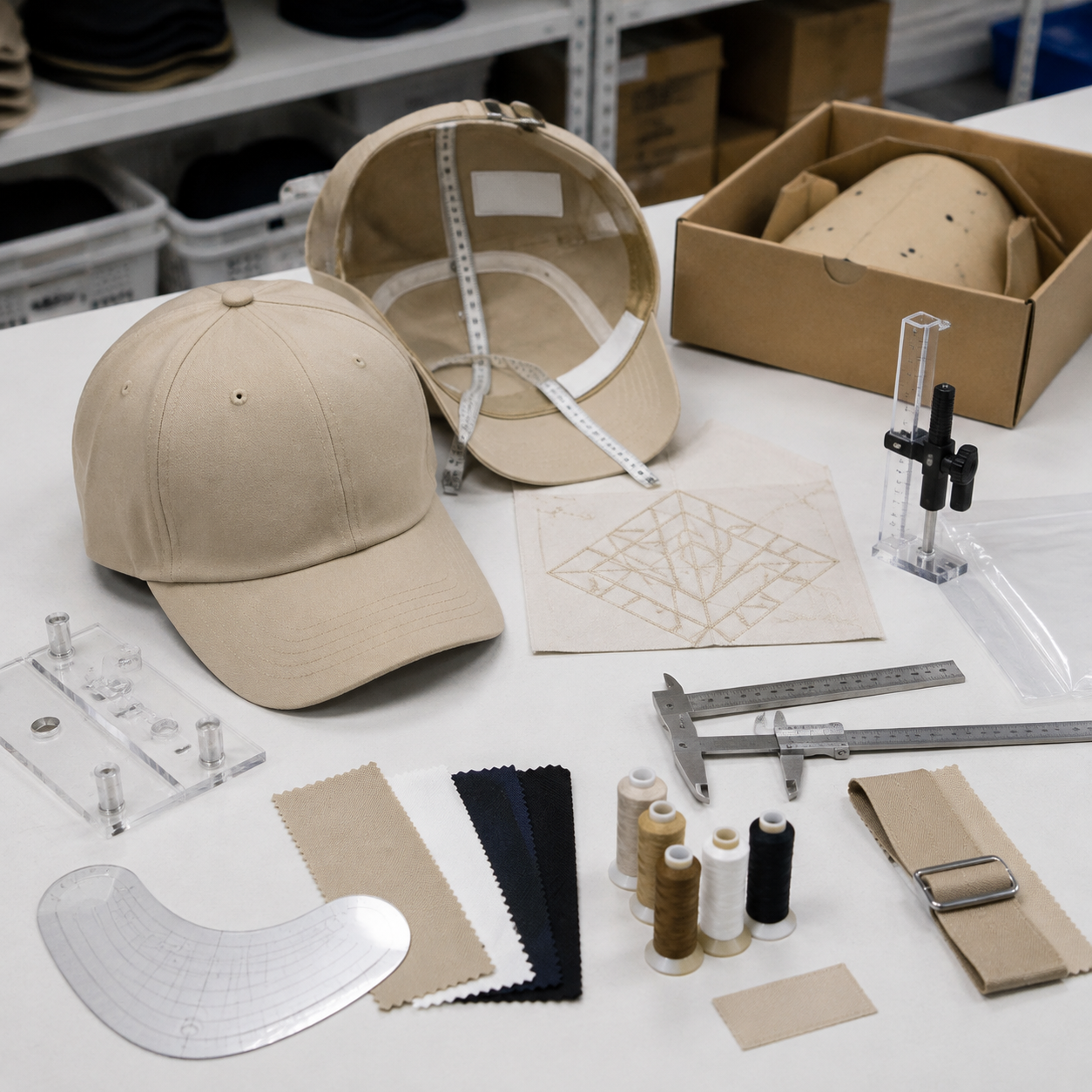
Baseball cap OEM sample approval is the documented decision that a production-intent cap is ready for manufacturing release. For a United States B2B order, that decision should connect the physical sample to controlled specification, artwork, label, packaging, quotation, inspection, and delivery revisions. A missing record should result in a hold. A failed controlled attribute should result in rejection or resampling.
Photographs remain supporting evidence rather than a substitute for the cap and its records. The Grand Canal supplier-authored procurement article identifies fabric weight and internal construction as details that photographs do not disclose. Buyers should therefore use images to confirm identity and visible condition while relying on physical inspection, measurements, material records, and approved references for release.
Unless a statement is attributed to a cited source or regulatory text, the controls below are recommended buyer-side RFQ and approval practices. They are not claims about a particular supplier's process and are not presented as legal or industry-standard requirements.
United States Baseball Cap OEM Sample Approval Release Gate
Record one clear disposition for the complete sample package: approve, hold, or reject and resample. A limited approval, such as approval of an embroidery strike-off, should name the represented attributes and state which cap attributes remain open.
| Release control | Evidence required before approval | Hold or reject condition |
|---|---|---|
| Sample identity | Supplier, buyer style or SKU, sample identifier, sample stage, issue date, and matching specification, artwork, label, packaging, and quotation revisions. | An identifier is missing, inconsistent, or superseded. |
| Production intent | Supplier confirmation of the pattern, materials, components, decoration process, labels, and packout planned for bulk manufacturing. | A sample-only input or undisclosed substitution could affect an approved attribute. |
| Measured conformity | Actual results, units, methods, instruments, conditions, tolerances, and dispositions for every controlled measurement. | A result is outside its agreed limit or was checked with an undefined method. |
| Fit and appearance | Named fit reference, physical color reference, artwork, placement origins, construction criteria, and written workmanship definitions. | Approval depends only on a photograph, screen color, unidentified comparison sample, or unstated visual judgment. |
| United States label evidence | Product-specific applicability review, final label artwork, physical placement evidence, supporting records, and responsible reviewer. | Applicability, wording, permanence, placement, legibility, or document scope remains unresolved. |
| Commercial and delivery alignment | Current quote tied to the approved revision, quantity, packaging, delivery rule, named United States destination, cost assumptions, and timing triggers. | A sample change has not been requoted, or a cost or duration lacks a defined basis. |
| Change control | Purchase-order language identifies the approved sample and the changes that require written reapproval. | A bulk-affecting substitution can occur without buyer review. |
Keep manufacturing authorization separate from a deposit, material reservation, or capacity reservation. Those commercial actions should not be treated as sample approval unless the controlled release record expressly says so.
Define What the Sample Approval Covers
The CDHB supplier-authored manufacturer-selection article recommends comparing suppliers against the same specification sheet and approving a pre-production sample before bulk authorization. The JoinTop supplier-authored manufacturing article presents fit and construction review before final decoration decisions. These are supplier-published process recommendations, not independent evidence of current capacity, repeatability, or capability.
Define each requested sample stage in the RFQ. A stage name alone does not establish what the sample represents.
| Sample stage | Decision it may support | Approval boundary |
|---|---|---|
| Development or fit sample | Pattern, crown profile, panel geometry, brim form, closure concept, and specified fit attributes. | List all substitute materials, components, decoration, labels, and packaging. Do not approve an attribute affected by a substitute. |
| Decoration strike-off | Artwork execution on the stated substrate, thread or ink selection, finished dimensions, backing, edge treatment, and visible quality. | It does not approve cap fit, full-cap placement, seam interaction, construction, labeling, or packout unless those elements are physically represented. |
| Production-intent sample | Manufacturing release when the agreed pattern, materials, components, decoration process, labels, and packout are represented. | Disclose and resolve every difference between the sample and planned bulk production before approval. |
The approval record should identify the physical sample retained by the buyer and the corresponding reference retained by the supplier. Both records should use the same sample identifier and revision set.
Make Sample Approval Specifications Measurable
The Grand Canal article reports that front-panel seam geometry can affect detailed embroidery. Convert that observation into an RFQ control by measuring decoration from named seams or edges and requiring a full-cap sample when seam interaction can affect placement or appearance.
| Controlled attribute | RFQ definition | Approval evidence |
|---|---|---|
| Crown height | Named panel location, endpoints, measurement path, cap condition, nominal value, unit, and tolerance. | Actual value, instrument, method, condition, and result. |
| Opening circumference | Inside measurement path, closure position, tension condition, nominal value, unit, and tolerance. | Actual value and the closure setting used during measurement. |
| Brim dimensions | Centerline and cross-brim endpoints, approved curve or flat condition, nominal values, units, and tolerances. | Actual values and a photograph showing endpoint placement. |
| Brim contour | Approved physical template or defined profile method, evaluation condition, and permitted deviation. | Sample-to-template result, including asymmetry or spring-back where observed. |
| Fit | Named headform, retained fit reference, or documented wearer-evaluation method; closure setting; and acceptance criteria. | Reference identity, closure setting, observations, and disposition. |
| Material and color | Material description, textile construction, finish, weight requirement and method, component references, substitution rules, physical color master, and comparison condition. | Supplier material identification, swatch comparison, color result, and disclosure of sample-only inputs. |
| Decoration | Artwork revision, process, finished size, placement origins, color references, backing, edge treatment, and criteria for coverage, registration, puckering, distortion, and reverse-side finish. | Actual dimensions and placement, substrate identity, detailed views, and a result for each criterion. |
| Construction and workmanship | Panel and seam layout, assembly requirements, closure operation, and defined defects such as open seams, skipped stitching, loose threads, twisting, brim waviness, stains, visible adhesive, or sharp edges. | Completed inspection record showing passing checks and deviations. |
| Label placement | Label revision, material, fold, attachment method, placement origin, orientation, and interaction with the sweatband or seam tape. | Physical placement measurement and views of the attached label. |
| Packout | Individual protection, crown support, brim protection, closure position, carton orientation, and post-unpacking evaluation condition. | Packing trial showing the cap before packing, inside the packout, and after removal. |
Use a measurement record with fields equivalent to attribute | method | nominal value | unit | lower limit | upper limit | actual value | instrument | condition | result. Agree on the method and acceptance limits before inspection. Do not import dimensions or tolerances from an unrelated cap; require values tied to the quoted pattern, material, construction, and process, then verify them in the supplier quote and sample record.
Inspect and Preserve Sample Approval Evidence
Use the same inspection sequence for an initial sample and any corrected sample:
- Match the received cap, sample identifier, stage, packing record, and revision set.
- Reconcile materials, components, construction, decoration, labels, and packaging with the controlled specification.
- Record actual values for passing and failing measurements, including units, endpoints, conditions, instruments, and methods.
- Compare color and finish with the named physical references under the agreed viewing condition.
- Evaluate fit with the RFQ-defined headform, retained reference, or documented wearer method.
- Measure decoration size and placement from the specified construction references.
- Inspect registration, coverage, edge definition, puckering, backing, and reverse-side finish against written criteria.
- Operate the closure and perform only functional checks that have documented methods and acceptance criteria.
- Inspect the proposed label attachment and packout on the physical cap.
- Photograph consistent views with a scale reference while retaining the physical sample.
- Log each deviation, corrective evidence, responsible party, disposition, and resampling requirement.
Reopen affected approvals after a change to the pattern, material, material source, finish, brim insert, closure, decoration process, artwork, label, or packout. The inspected sample is evidence for that unit and revision; it does not establish batch repeatability, future conformity, production capacity, or certification.
United States Labeling Evidence in Sample Approval
The cited cap supplier pages do not establish the legal labeling treatment for a specific United States product. Review the current FTC textile-labeling provisions, FTC care-labeling provisions, and CBP country-of-origin marking provisions at the time of approval. These links provide primary regulatory text, not certification. Their scope, definitions, exclusions, exceptions, and current wording must be checked against the exact cap and transaction before deciding what applies.
The label approval record should contain:
- The style, materials, intended wearer, product claims, sales channel, and packaging configuration reviewed.
- The responsible reviewer, review date, cited legal provisions, applicability conclusion, and unresolved questions.
- The proposed material or fiber description, responsible-business identification, origin wording, care information, and any other content identified by the product-specific review.
- Final artwork revision, label material, dimensions, fold, attachment, placement, permanence, and legibility evidence.
- Each supporting document relied on, including issuer, holder, covered product or material, issue or validity information, and scope.
- A hold condition for any question that remains unresolved before manufacturing release.
Do not infer certification or legal conformity from a supplier declaration, quotation statement, sample tag, logo, test-report title, or document that is expired or outside the relevant product and material scope. Label approval should follow the responsible reviewer's product-specific conclusion and inspection of the label as physically executed on the production-intent sample.
Reconcile Sample Approval With Landed Cost
Treat a sample change as a quotation-control event whenever it can affect material use, components, decoration, labels, packaging, inspection, freight, or delivery. Every monetary line should state its currency, unit and quantity basis, quote validity or as-of date, and status as quoted, estimated, excluded, or buyer-paid.
| Cost area | Required RFQ response |
|---|---|
| Quote identity | Supplier, style, approved revision set, quantity matrix, currency, validity, payment terms, and named United States destination. |
| Development | Sample, pattern, tooling, decoration setup, revision, courier, and order-credit treatment. |
| Goods | Unit price by material, color, decoration, label, and packaging configuration. |
| Origin and international movement | Packout, cartons, markings, origin handling, export documentation, freight method, routing basis, insurance treatment, and responsible party. |
| United States border costs | Classification and origin assumptions, customs-value basis, rate effective date, estimated duty or tariff, brokerage, and other entry charges. |
| Quality costs | Sample inspection, bulk inspection, applicable testing, rework, rejected-unit treatment, and replacement-freight responsibility. |
| Final delivery | Domestic transport to the named United States destination, appointment requirements, accessorial assumptions, and delivery responsibility. |
Example calculation structure to verify in the supplier quote: landed cost per accepted cap = included goods, development, packing, origin, freight, insurance, border, inspection, and final-delivery costs / accepted quantity.
The worksheet should identify every included line and the accepted-quantity denominator. Freight, duty, tariff, brokerage, and final-delivery figures remain estimates until classification, origin, customs value, shipment details, routing, entry date, current rates, and responsible parties are verified.
When the parties use an ICC Incoterms rule, record the selected rule, named place, and edition in the quotation and purchase order. That contractual selection does not approve sample conformity, establish legal labeling applicability, or prove that the quote includes every landed-cost line.
Tie Delivery to Sample Approval
Separate the schedule into sample preparation, dispatch, buyer receipt, inspection, correction, resampling, material readiness, bulk manufacturing, final inspection, export handling, transit, customs clearance, and delivery to the named United States destination.
For each quoted duration, require the supplier to state:
- Whether the duration uses business days or calendar days.
- Its start event and end event.
- Whether buyer review, revisions, material procurement, testing, inspection, dispatch, and transit are included.
- The party responsible for the next action.
- Dependencies that pause or reset the duration.
- The effect of resampling on manufacturing and delivery dates.
- Separate dispatch, transit, customs, and final-delivery assumptions.
A dated sample approval should start the bulk-manufacturing clock only when the quotation also identifies any payment, material-readiness, capacity, documentation, and inspection conditions.
Supplier-Published Data to Verify in the Sample RFQ
These figures are attributable only to the named supplier pages. They are not market benchmarks or evidence that another supplier will offer the same minimum or timing.
| Supplier-published figure | Unit, scope, date context, and source | RFQ treatment |
|---|---|---|
| 50 pieces | Unit: pieces. Scope: CDHB's stated starting MOQ for its own offer. Date context: the supplied page displays no publication or update date. Source: CDHB supplier page. | Verify the current minimum for the exact cap, color split, material, decoration, labels, and packout in the supplier quote. |
| 100 pieces per design | Unit and scope: pieces per design for JoinTop's stated offer. Date context: the page displays Last Updated July 22, 2026; that displayed date was not independently authenticated as the effective date of current commercial terms. Source: JoinTop supplier page. | Ask how color splits, artwork changes, custom components, and packaging affect the quoted minimum. |
| 18-25 days | Unit: days. Scope: JoinTop's stated development-sample timing. Date context: the page displays Last Updated July 22, 2026, subject to the same date-label limitation. The supplied source does not establish whether the duration uses business or calendar days or includes transit. Source: JoinTop supplier page. | Request a project-specific duration with start event, revision allowance, day basis, dispatch method, and transit stated separately. |
| 45-50 days after approvals and material readiness | Unit: days. Scope: JoinTop's stated bulk-production timing, with shipping described separately. Date context: the page displays Last Updated July 22, 2026, subject to the same date-label limitation. The supplied source does not establish the day basis. Source: JoinTop supplier page. | Require a current commitment tied to the actual approval record, material status, capacity condition, inspection stage, and delivery terms. |
Do not average these figures, apply them to another supplier, or assume a starting MOQ covers every custom input. A current quotation tied to the controlled cap revision should supersede a supplier's web-page figure.
Practical RFQ Checklist for Baseball Cap Sample Approval
Use this practical RFQ checklist before sending the request and again before issuing manufacturing authorization. Each checked item should point to a supplier response, controlled attachment, physical sample, or named buyer-side record. An unanswered item remains open rather than being treated as accepted by silence.
Product identity and sample stage
- [ ] Assign the buyer style or SKU, supplier style reference, sample identifier, sample stage, issue date, and revision status.
- [ ] State whether the requested sample is for development, fit, decoration, production intent, or another narrowly defined decision.
- [ ] Identify the exact sample stage permitted to authorize manufacturing and list every attribute excluded from that approval.
Specifications and inspection evidence
- [ ] Attach the controlled specification sheet with crown profile, panel layout, brim, closure, sweatband, seam tape, eyelets, top button, internal support, and workmanship criteria.
- [ ] Define every measurement point, path, nominal value, unit, tolerance, instrument, cap condition, and evaluation method.
- [ ] Name the fit reference, closure setting, physical color master, material construction, weight method, finish, and component references.
- [ ] Require disclosure and written approval of any sample-only material, unavailable component, source change, or proposed substitution.
- [ ] Require actual sample results for passing and failing checks, with photographs used only as supporting evidence.
Artwork and decoration
- [ ] Attach production artwork with a revision identifier and define the decoration process, finished size, colors, backing, edge treatment, and reverse-side requirements.
- [ ] Define horizontal and vertical placement from stable seams or edges and require full-cap review where panel geometry can affect execution.
- [ ] State written acceptance criteria for registration, coverage, distortion, puckering, edge definition, and visible workmanship.
United States labeling and packout
- [ ] Assign responsibility for the product-specific United States labeling review and require its conclusion before release.
- [ ] Attach final label artwork and specify material, fold, dimensions, attachment method, placement origin, orientation, permanence, and legibility criteria.
- [ ] Request supporting records with issuer, holder, covered material or product, issue or validity information, and scope; do not request or accept an unsupported certification claim.
- [ ] Define individual protection, crown support, brim protection, closure position, carton arrangement, markings, and post-unpacking acceptance criteria.
Landed cost and commercial controls
- [ ] Request a current quotation tied to the same style, specification, artwork, label, packaging, sample, and quantity revisions.
- [ ] Require currency, quantity basis, quote validity or as-of date, payment terms, named United States destination, and the status of each line as quoted, estimated, excluded, or buyer-paid.
- [ ] Separate development, tooling, setup, goods, packing, origin handling, freight, insurance, border, inspection, brokerage, final-delivery, rework, and replacement-freight costs.
- [ ] State the selected Incoterms rule, named place, and edition when an ICC Incoterms rule is used, while keeping sample conformity and labeling review as separate decisions.
- [ ] Require classification, origin, customs-value, rate-date, routing, and accepted-quantity assumptions for any landed-cost estimate.
Delivery and release controls
- [ ] Require separate durations for sample preparation, dispatch, buyer review, correction, resampling, material readiness, manufacturing, inspection, transit, customs clearance, and final delivery.
- [ ] For each duration, state the business-day or calendar-day basis, start event, end event, dependencies, exclusions, and responsible party.
- [ ] Define how a rejected sample, corrected sample, material substitution, artwork revision, label change, or packout change affects price and schedule.
- [ ] Require the supplier to retain a reference matching the buyer's approved physical sample and controlled revision set.
- [ ] Put the final
approve,hold, orreject and resampledisposition in writing and identify the authorized decision-maker and decision date. - [ ] Prohibit bulk-affecting changes to material, pattern, component, source, decoration, label, packaging, or process without written approval and any required resampling.
A purchase-order control can state:
Bulk manufacturing release applies only to the identified physical sample and controlled specification revision. No bulk-affecting material, pattern, component, source, decoration, label, packaging, or process change is permitted without written buyer approval and any required resampling.
Evidence Method and Limitations
Methodology: The Grand Canal supplier article was used only for its observations about product details not established by photographs and the interaction between front-panel seams and detailed embroidery. The CDHB supplier article was used for its same-specification comparison and pre-production approval recommendation and for its supplier-specific starting MOQ statement. The JoinTop supplier article was used for its process-sequencing recommendation and supplier-specific MOQ and timing statements. Numerical statements were transcribed with their units, supplier scope, displayed date status, and disclosed timing conditions; they were not averaged or generalized. The linked eCFR pages provide primary regulatory text for a current, qualified United States applicability review. The ICC page supports identification of a selected Incoterms rule. The author profile supports author identity and editorial role only.
Limitations and verification: The cap-industry sources are supplier-authored commercial pages, not independent factory audits, production records, capability assessments, or market datasets. Their displayed dates, undated status, current terms, and continued availability were not independently authenticated for this package. No physical sample, production batch, laboratory result, factory, customs entry, legal opinion, or current supplier quotation was examined. Materials, dimensions, tolerances, MOQ, timing, labeling treatment, document scope, tariff treatment, landed cost, packout, and delivery commitment remain product-, transaction-, date-, and quote-specific. Before manufacturing release, verify the physical sample, revision set, material availability, current quotation, applicable regulatory text, supporting documents, customs assumptions, inspection plan, packout, and delivery schedule with the responsible supplier and qualified United States reviewers.
Discuss Your Requirements
Review our manufacturing capabilities, then share your specifications for a supplier-fit review.