Baseball Cap OEM Quality Control Inspection for United Arab Emirates Buyers
By Vincent Xi | Editorial Author
For a United Arab Emirates B2B buyer, a baseball cap OEM quality control inspection should end in a documented release, hold, or rejection decision for the presented lot. It is an order-specific manufacturing control, not a general claim about supplier quality. The RFQ and purchase order should define the approved product baseline, inspection stages, lot, sample-selection method, defect rules, required records, corrective-action process, and person authorized to release shipment.
Release the lot only when the presented goods match the approved specification, results remain within the contracted limits, and the required evidence is complete. Hold the lot when documents conflict, goods are unavailable for agreed sample selection, records are missing, or the supplier proposes an unapproved change to materials, construction, decoration, packing, subcontracting, or process.
This article addresses baseball cap manufacturing and RFQ decisions only. It does not establish United Arab Emirates legal requirements, certify a supplier, or report the result of an actual inspection.
United Arab Emirates quality control inspection release rules
Put each decision point and its release authority into the RFQ or purchase order.
| Decision point | Evidence required | Buyer decision rule |
|---|---|---|
| Supplier award | Completed specification review, proposed inspection gates, access terms, quotation exclusions, change-control process, and open-issue list | Do not award while measurable requirements, inspection access, or cost responsibility remain unresolved |
| Bulk-production authorization | Approved sample revision, bill of materials, artwork, measurement chart, color references, test requirements, and packing specification | Do not authorize production when approvals conflict or a deviation lacks written disposition |
| Production continuation | First-output or during-production findings, measurements, defect records, containment actions, and correction evidence | Continue only under the hold and escalation rules stated in the order |
| Pre-shipment release | Lot identity, available quantity, sample-selection record, defect and measurement results, packing checks, photographs, and required documents | Release only when contracted criteria are met and the designated buyer representative approves shipment |
| Failed-lot disposition | Affected population, segregation record, rework or replacement plan, corrected and rejected quantities, and reinspection result | Do not release based only on selected corrected units when the wider affected population has not been verified |
| Delivery handoff | Released-carton references, final quantity reconciliation, packing evidence, and buyer-confirmed destination documents | Hold handoff if the goods or records differ from the released lot |
The order should state whether final payment, cargo booking, shipment instructions, or delivery handoff depends on the designated release decision.
Evidence used and claim boundaries
The cited pages support specific inspection topics. They do not establish universal requirements or prove that a shortlisted supplier performs a stated control.
| Supplied source | Supported context | Not established by the source |
|---|---|---|
| Tangren Cap | A first-party manufacturer description of stitching, head-circumference, metal-hazard, material, and packaging checks in its stated workflow | Another supplier's capability, independent verification, a universal requirement, a United Arab Emirates rule, or current certification |
| Headwind Group | Commercial sourcing guidance covering material inspection, seam durability, colorfastness, shipping cost, duties, and possible third-party inspection | A current freight or duty rate, transaction-specific legal guidance, a factory audit, or proof that a supplier performs a control |
| AQI Service | A commercial inspection-service page distinguishing pre-production, during-production, pre-shipment, defect-sorting, and container-loading services | A mandatory sequence, an acceptance limit, supplier performance, or certification |
| Vincent Xi author profile | The source for the author's name, role, and profile URL | Personal factory-inspection, laboratory-testing, supplier-management, or customer-outcome experience |
Use these sources to identify questions for the RFQ. Supplier-specific records, approved samples, inspection access, current documents, and purchase terms must support the actual release decision.
Freeze the approved baseball cap before inspection
An inspector cannot make a repeatable conformity decision from terms such as standard fit, normal stitching, or export quality. Convert the ordered baseball cap into controlled fields:
- Product identity: State the item code, cap style, panel construction, crown structure, visor construction, closure, size designation, colorway, and intended use.
- Document hierarchy: Identify which approved sample, bill of materials, drawing, measurement chart, artwork file, color reference, written approval, or purchase-order term controls when records conflict.
- Materials and components: Identify the shell, support material or buckram where applicable, sweatband, seam tape, visor insert, eyelets, closure, thread, labels, and unit and carton packaging.
- Measurements and fit: Define datum points, measuring method, tolerance, closure setting, conditioning requirement, tool or fixture, and result format.
- Decoration: Control the artwork revision, method, dimensions, placement, orientation, color reference, backing, edge condition, puckering rule, and treatment where decoration crosses a seam.
- Workmanship: Attach objective acceptance examples for seams, skipped or broken stitches, loose threads, raw edges, panel symmetry, visor attachment, eyelets, sweatband attachment, closure function, stains, holes, and permanent creasing.
- Buyer-required tests: Name the method, acceptance criterion, sample source, responsible party, required report fields, and submission deadline. A generic test report is insufficient unless its relevance to the ordered material and lot is defined.
- Foreign-object controls: State any required needle, sharp-object, segregation, detection, recordkeeping, and failed-check response rules appropriate to the contracted risk.
- Packing and change control: Define unit protection, assortment, carton quantity, carton condition, buyer-supplied marks, packing-list reconciliation, and the written approval path for any proposed change.
Tangren Cap's page supports asking about several of these check categories. It is not evidence that another supplier applies them. Obtain the shortlisted supplier's written process and contractually required records.
Make inspection criteria measurable
The values in the following table are hypothetical RFQ assumptions for a structured cotton-twill adjustable adult baseball cap. They are drafting examples, not observed product data, supplier capabilities, market benchmarks, or CrownsForge specifications. They have no market-data as-of date or external data source. Each value must be verified, revised, or rejected in the supplier quote, approved sample record, and final purchase specification.
| Critical-to-quality item | Example assumption to verify in the supplier quote | Proposed inspection method | Required evidence |
|---|---|---|---|
| Finished inner circumference | Hypothetical target of 58.0 cm with a +/-0.5 cm tolerance at the buyer-defined reference closure position | Measure without intentionally stretching the sweatband, using the agreed tape or fixture method | Unit identifier, result, closure setting, and tool or fixture reference |
| Visor center projection | Hypothetical target of 7.0 cm with a +/-0.2 cm tolerance for the proposed cap style | Measure along the centerline from the agreed crown-to-visor datum to the visor edge | Recorded result and a photograph showing both datum points |
| Decoration width and alignment | Hypothetical target width of 85 mm with a +/-1 mm tolerance and a maximum centerline offset of 2 mm for the proposed artwork | Use the approved placement template or fixture on the finished cap | Width and offset results with a straight-on evidence photograph |
| Export-carton quantity | Hypothetical packing assumption of 144 caps per carton for the proposed assortment | Use a buyer-approved physical or controlled count before sealing | Carton-level count reconciled with the final packing list |
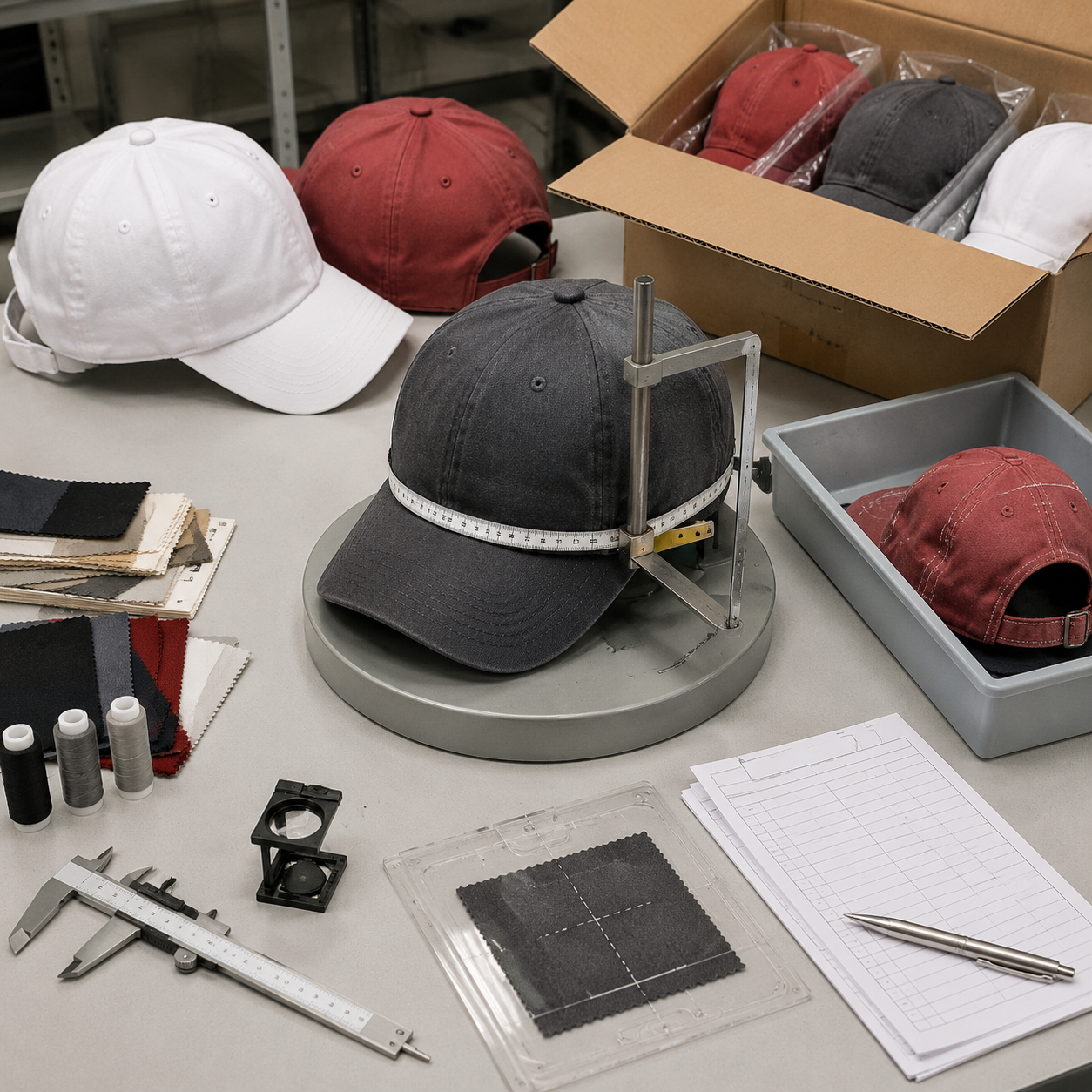
The measurement diagram should show where every datum begins and ends. For an adjustable closure, state the inspection setting. If repeatable measurement requires a fixture or head form, identify it in the specification and report. Where tool status matters to the buyer, require the instrument identifier and contracted verification record.
For color, identify the controlling buyer-approved physical swatch, material approval, thread reference, or other agreed reference. Define the evaluation conditions and require the inspection report to identify the reference used. Photographs can support the record but should not become the sole controlling color reference unless the order explicitly defines that method.
Set quality control inspection gates in baseball cap manufacturing
AQI Service presents inspection stages as separate commercial services. That source supports considering the stages individually; it does not make any stage mandatory. Select the gates that fit the order and state their hold conditions in the contract.
| Manufacturing gate | RFQ requirement | Evidence to request | Hold condition |
|---|---|---|---|
| Pre-production readiness | Reconcile the specification, approved sample, materials, artwork, measurements, defect rules, tests, and packing instructions | Supplier acknowledgment, approval register, and open-issue list | Conflicting revisions, missing approval, or unresolved deviation |
| Incoming-material control | Check approved identity, reference color, visible condition, component dimensions, and buyer-required traceability before use | Receiving record, material references, photographs, and required test documents | Mismatched, undocumented, or unapproved input awaiting disposition |
| First production output | Compare initial output with the approved construction, fit, decoration, measurements, and workmanship criteria | First-output report, measurements, photographs, and correction record | Output differs from the approved baseline |
| During-production inspection | Select units across the defined production population and record findings by relevant SKU, colorway, batch, or component lot | Selection record, defect results, measurements, containment action, and follow-up evidence | A result triggers the contracted pause or escalation rule |
| Pre-shipment inspection | Inspect the defined finished-goods lot, including contracted quantity and packing checks | Lot status, available quantity, selection record, defects, measurements, photographs, packing results, and disposition | Lot is incomplete, inaccessible, outside contracted limits, or missing required evidence |
| Sorting or rework verification | Identify the affected population and verify the contracted corrective action | Segregation record, rework instruction, corrected quantity, rejected quantity, and reinspection result | Evidence covers only selected display units rather than the affected population |
| Loading supervision, when contracted | Match released cartons and quantities to shipment references | Loading record, carton-condition evidence, count reconciliation, and handoff record | Cartons differ from the released lot or approved packing data |
Headwind Group's sourcing guidance supports asking about material inspection, seam durability, colorfastness, and possible third-party inspection. The RFQ still needs to define the applicable methods, evidence, responsibilities, and release consequences for the actual order.
Define the inspection lot and failed-lot response
Define the population being judged by the fields relevant to the order, such as style, SKU, colorway, production batch, material or component lot, packing status, quantity, and location. Require the inspector to record the quantity made available and select units under the access terms agreed with the buyer.
If the contract uses an acceptance quality limit arrangement or a published sampling standard, identify the buyer-selected procedure, applicable edition, inspection level, lot-size treatment, sample size, and acceptance and rejection limits for each defect class. A bare reference to AQL is not a complete contractual instruction. This article does not prescribe a sampling standard or numerical acceptance limit.
A standard's stated requirements are separate from a supplier's own practice. Referencing a standard is also not proof of certification. Verify any certification claim against a current document identifying the issuer, holder, covered site, scope, product relevance, and validity.
Attach baseball-cap-specific defect definitions:
- Critical: A condition the buyer classifies as a prohibited safety, legal, or contractual risk. A sharp foreign object may belong in this class when that treatment matches the order's documented risk rule.
- Major: A buyer-defined condition materially affecting intended use, fit, saleability, branding, required documentation, or conformity to the approved specification. Possible RFQ examples include a failed closure, incorrect material, wrong colorway, out-of-tolerance measurement, or decoration outside the approved placement limit.
- Minor: A buyer-defined workmanship departure that remains usable and saleable under the written criteria, such as a removable thread condition expressly allowed by the approved defect guide.
These are proposed RFQ categories, not universal classifications. State how multiple defects on the same unit are counted and how a defect that could fit more than one class is resolved.
The failed-lot clause should cover containment, segregation, sorting, rework, replacement, concession review, root-cause response, reinspection, cost allocation, and schedule consequences. Require evidence for the affected population before release.
> RFQ clause to adapt: The supplier shall present the defined lot for buyer-authorized inspection, permit sample selection under the agreed access rules, and withhold shipment until the designated buyer representative issues release. A failed or incomplete inspection does not authorize shipment. Corrective work requires documented disposition and any reinspection stated in the purchase order.
Compare OEM quotations on inspection evidence
Ask each shortlisted baseball cap supplier the same questions and require the answers to be linked to its quotation.
| RFQ question | Evidence expected | Material concern |
|---|---|---|
| Which specification revision will control production? | Identified revision with documented acceptance, comments, or deviations | Reliance only on an image, sample nickname, or informal message |
| How are material, component, process, and subcontractor changes controlled? | Written approval path and traceable change request | Undefined substitution rights |
| Can the buyer or appointed inspector select units from the defined lot? | Written access, availability, and selection terms | Inspection restricted to supplier-selected display units |
| How will measurements be reproduced? | Datum points, method, closure setting, tools or fixtures, and result format | A tolerance without a measurement method |
| How are decoration dimensions and placement checked? | Approved artwork revision, template or fixture method, and recorded results | Approval based only on a distant photograph |
| What happens after a failed gate? | Containment, correction, evidence, cost terms, schedule effect, and reinspection process | Shipment timing takes priority over written acceptance criteria |
| Which records support shipment release? | Lot identity, selection record, defects, measurements, photographs, packing checks, and required test records | A pass statement without underlying evidence |
| Which inspection charges are excluded? | Separate quotation lines for inspection, sorting, rework, waiting time, and reinspection | Unassigned cost or schedule responsibility |
Resolve any refusal to provide agreed access, lot information, sample-selection authority, or evidence during supplier selection rather than after packing.
Connect inspection to United Arab Emirates landed cost and delivery
Headwind Group identifies shipping costs, duties, and possible third-party inspection as sourcing considerations. It does not provide a current United Arab Emirates rate or transaction-specific legal interpretation. Ask the supplier to separate product price from inspection, reinspection, testing, special packing, origin handling, freight, insurance, and other stated charges. The quotation should also identify its currency, validity, named delivery term and place, cargo-ready assumptions, exclusions, and responsibility after a failed inspection.
The following is a hypothetical RFQ calculation to verify in the supplier and inspector quotations. It has no market-price as-of date because it is an example assumption, not a current rate: for a hypothetical order scope of 5,000 caps, assume an AED 1,800 pre-shipment inspection charge and an AED 1,800 reinspection contingency. The resulting example inspection provision is AED 3,600. Dividing that provision by the 5,000 ordered caps gives an example allocation of AED 0.72 per ordered cap. The calculation excludes freight, insurance, duty, tax, delay, rework, replacement, and rejected-goods costs.
Reserve buyer-approved review and correction time between the inspection-ready date and planned cargo handoff. Require the quotation to explain how a failed gate affects the manufacturing and delivery schedule instead of assuming the buyer will waive release criteria.
The supplied evidence does not establish current United Arab Emirates customs, tax, labeling, import-document, product-compliance, or climate-related requirements. The buyer should obtain transaction-specific instructions from its importer, consignee, customs broker, or other qualified adviser and issue an approved document and label matrix to the supplier. The inspection scope can then verify the ordered goods against those buyer-confirmed instructions without treating a supplier statement as legal confirmation.
Baseball cap quality control inspection RFQ checklist
- [ ] Identify the item code, construction, closure, size designation, intended use, and ordered colorways.
- [ ] Attach the revision-controlled bill of materials, approved sample record, artwork, measurement chart, color references, and document hierarchy.
- [ ] Define datum points, measurement methods, tolerances, closure settings, conditioning requirements, and required fixtures.
- [ ] Set objective workmanship, decoration, critical, major, and minor defect rules with counting instructions.
- [ ] Prohibit unapproved material, component, subcontractor, artwork, tooling, packing, or process changes.
- [ ] Name required tests, methods, acceptance criteria, sample source, responsible party, report fields, and deadline.
- [ ] State inspection gates, hold points, inspection-ready conditions, evidence, access terms, and release authority.
- [ ] Define the lot, sample-selection method, sampling procedure, defect limits, and treatment of incomplete or unavailable goods.
- [ ] Specify unit packing, assortment, carton quantity, carton condition, buyer-supplied marks, and packing-list reconciliation.
- [ ] Define containment, sorting, rework, replacement, concession review, reinspection, cost allocation, and schedule consequences.
- [ ] Request separate quotation lines for inspection-related costs and delivery effects following failure or delay.
- [ ] Add United Arab Emirates document and label instructions only after buyer-side confirmation by the relevant qualified party.
- [ ] State whether payment, cargo booking, delivery handoff, or shipment authorization depends on the inspection release.
Method, limitations, and author basis
Method: The supplied pages were reviewed by source type and permitted claim scope. Tangren Cap was used only for its first-party description of inspection topics. Headwind Group was used only for commercial sourcing considerations. AQI Service was used only for its taxonomy of inspection stages. Those topics were converted into proposed RFQ fields, hold points, evidence requests, and decision rules; they were not treated as mandatory practices or proof of supplier performance.
The numerical specifications and AED calculation are explicitly hypothetical examples. They were not derived from a supplier quote, product test, market survey, inspection report, or the cited commercial pages. They must be verified or replaced through the approved sample, supplier and inspector quotations, test requirements, and purchase contract.
Limitations: The supplied evidence does not determine the correct tolerance for a particular cap, prescribe a sampling procedure, establish a laboratory method, prove supplier suitability, confirm a current certification, or establish current United Arab Emirates import requirements. Commercial source agreement can identify a topic worth investigating, but it cannot replace order-specific evidence.
Author basis: The approved Vincent Xi author profile identifies Vincent Xi as Editorial Author. It does not support personal factory-visit, laboratory-testing, supplier-performance, or customer-outcome claims, so none are presented.
Discuss Your Requirements
Review our manufacturing capabilities, then share your specifications for a supplier-fit review.